

Did you know that nearly one in three applicants fails their behind-the-wheel test on the very first try? While many people lose points for minor errors like poor mirror checks, knowing how to fail a driving test instantly is the real secret to passing. It's completely normal to feel anxious about an examiner's judgement or to worry that one small slip-up will end your session early.
The confusion between a simple point deduction and an automatic disqualification often makes the road test feel more like a minefield than a driving evaluation at the test centre. We want to help you realize exactly what examiners are looking for so you can stay calm and focused. This guide helps you organize your preparation with a clear checklist of "never-do" actions to keep you safe and offers a reliable backup plan if you need to find a new booking quickly.
Key Takeaways
- Identify the crucial difference between minor point deductions and the critical safety breaches that result in an automatic disqualification.
- Discover the top traffic violations and dangerous manoeuvres that show you how to fail a driving test instantly so you can avoid them.
- Learn why common mistakes like "rolling stops" or mounting a curb are non-negotiable failures that end your test in minutes.
- Use practical strategies like verbal narration and exaggerated head movements to clearly demonstrate your safety awareness to the examiner.
- Understand the current 2026 retesting protocols and how to navigate the challenge of finding a new appointment slot at a local centre quickly.
Understanding the 'Automatic Disqualification' (AD) in Road Tests
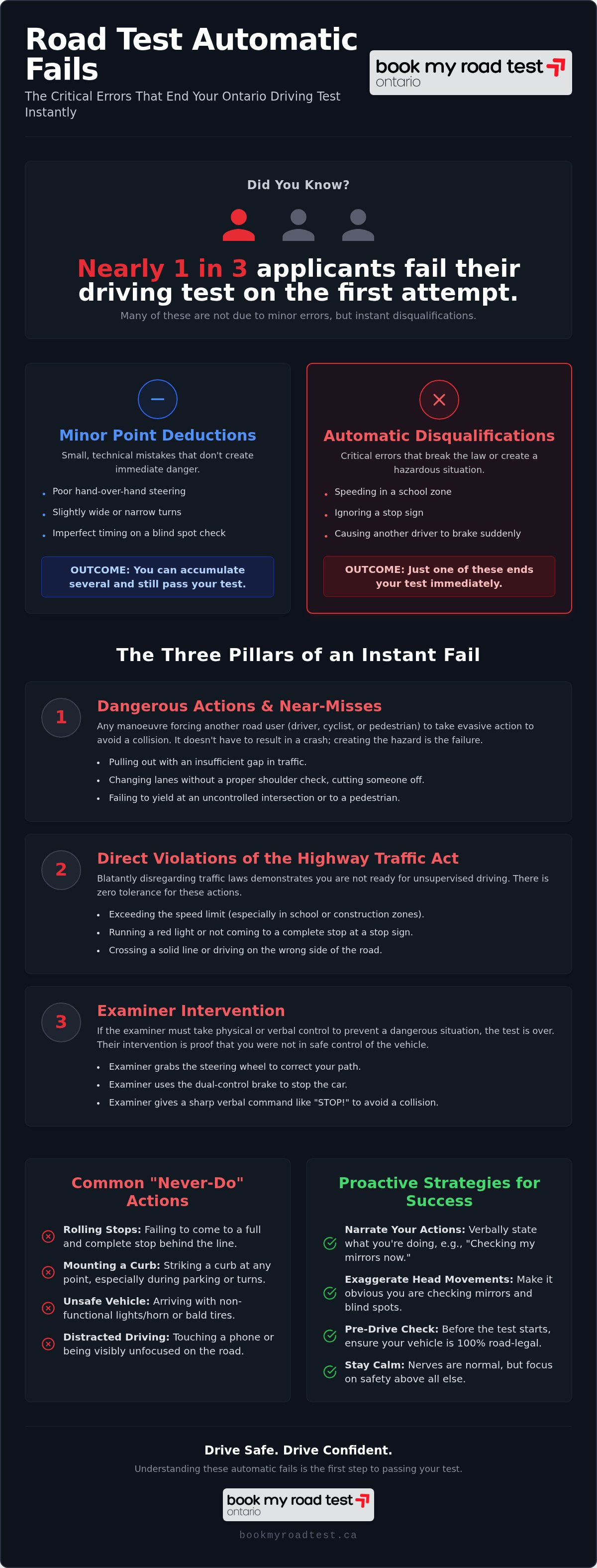
An Automatic Disqualification, often called an AD, is a critical error that ends your road test immediately. It's not a gradual loss of points; it's a single action that demonstrates a driver isn't yet ready to handle the responsibilities of the road independently. While many people focus on the technical details of parking, understanding how to fail a driving test instantly helps you identify the high-risk behaviours that examiners can't ignore. In 2026, examiners use strict safety protocols to ensure every new driver meets a high standard of road awareness.
The scoring system is designed to differentiate between learning curves and dangerous habits. This driving test overview highlights how these assessments are structured to evaluate both skill and safety. If an AD occurs, the examiner will typically ask you to pull over or direct you back to the test centre. The rest of the test route won't be completed because the primary metric of the exam, safety, has already been compromised.
Minor Points vs. Major Faults
It helps to think of your test as a balance sheet. Minor points are technical deductions for errors that don't directly cause a collision. These include things like poor hand-over-hand steering or failing to check your blind spot at the exact right second. Most jurisdictions allow you to accumulate a certain number of these points and still receive your licence. You can make several small mistakes and still pass the test if your overall performance is safe.
Major faults are different. These are actions that break the law or create an immediate hazard for other road users. Examples include speeding, ignoring a stop sign, or failing to yield to a pedestrian. While you have a buffer for minor points, you have zero margin for major faults. One major error is how to fail a driving test instantly every single time. Examiners view these faults as evidence that a driver lacks the necessary judgement to stay safe without supervision.
The Role of the Examiner During a Failure
Examiners are trained to prioritize safety over the completion of the test. If they perceive a situation is becoming dangerous, they'll intervene. This might involve grabbing the steering wheel or using the dual-control brake if your vehicle has one. Once an examiner has to take control of the car, the test is automatically over. Their intervention is proof that the driver was unable to manage the vehicle safely in that moment.
If this happens, stay calm and professional. The examiner isn't being mean; they're fulfilling their duty to protect you and other drivers. They'll provide feedback on what went wrong once you're safely parked back at the centre. Listen to this feedback carefully. It's the best way to realize what you need to change to ensure you don't repeat the same mistake on your next attempt.
The Three Pillars of Instant Road Test Failure
Your road test actually begins before you even put the car in gear. A common but overlooked way regarding how to fail a driving test instantly is showing up with a vehicle that isn't road-legal. If your brake lights are out, your horn doesn't work, or your tires are visibly bald, the examiner will cancel the appointment on the spot. This counts as a failure to provide proper equipment. Once the vehicle is cleared, the examiner focuses on three specific categories of safety during the drive.
Dangerous Actions and Near-Misses
A dangerous action is any manoeuvre that forces another road user to take evasive action to avoid a collision. This is a strict standard. If you pull out from a side street and an oncoming driver has to tap their brakes or swerve, the test is over. It doesn't matter if a crash didn't happen. The fact that you forced someone else to take a safety measure proves you didn't judge the gap correctly. Other triggers include changing lanes without a shoulder check or failing to yield at an uncontrolled intersection. Examiners in 2026 are trained to watch how your choices impact the flow of traffic around you.
Direct Violations of the Highway Traffic Act
Blatant disregard for traffic laws is a non-negotiable end to your session. This includes running red lights or ignoring "no turn on red" signs. Speeding is another major pillar of failure. While you might keep up with the flow of traffic in your daily practice, doing even 2 or 3 km/h over the limit in a school zone or construction site is how to fail a driving test instantly. Examiners expect strict adherence to every posted limit. Driving on the wrong side of the road, even briefly during a wide turn, or crossing a solid yellow line will result in an immediate trip back to the centre.
When the Examiner Intervenes
The "Threshold of Intervention" is the point where the examiner decides you're no longer in safe control of the car. Intervention can be physical, such as grabbing the wheel or using the instructor brake. It can also be verbal. If an examiner has to shout a warning to prevent you from hitting a curb or another car, the test ends there. Any time the examiner has to act as the primary safety mechanism, it confirms the driver isn't ready for an independent licence. If you find yourself needing to book a new road test appointment after an intervention, it's vital to practice until these safety reactions become second nature.
Common Scenarios That End Your Road Test in Minutes
During a parallel park or a three-point turn, the curb becomes a major obstacle. Many students wonder if a small touch is how to fail a driving test instantly. The answer depends on the severity. If you gently tap the curb while adjusting your position, the examiner might only deduct a few minor points. However, mounting the curb, where the tire actually climbs onto the sidewalk, is an automatic disqualification. Striking the curb with enough force to potentially damage the vehicle or jolt the examiner also ends the test immediately. It's a clear sign that you lack control over the vehicle's dimensions.
The Curb Controversy: Tap vs. Mount
Precision is key when manoeuvring near a sidewalk. A "tap" is generally defined as the tire rubber making light contact with the concrete without the car moving upward. While this isn't ideal, it usually won't end your day. Mounting the curb is different. If any part of the wheel sits on top of the curb, the examiner must fail you for a dangerous action. This is because mounting a curb in a real-world scenario could lead to hitting a pedestrian or losing control of the steering. Always prioritize leaving a small gap over trying to get perfectly tight to the edge.
Stop Signs and Red Lights
The "rolling stop" is perhaps the most frequent reason for an instant failure. You might feel like you've slowed down enough to see clearly. However, if your wheels are still rotating, you haven't stopped. In the eyes of the law, a 99% stop is a 100% failure. You must come to a complete, dead stop behind the white stop line. If you stop past the line, you're technically in the intersection. This is a major fault that suggests you don't respect the right-of-way of pedestrians or cross-traffic. Similarly, when turning right on a red light, you must stop fully and check for pedestrians and traffic before proceeding. Skipping this pause is a guaranteed way to be sent back to the centre.
Observation Failures at Railway Crossings
In 2026, examiners are placing increased scrutiny on railway crossings. Even if there are no lights or gates, you must look both ways. A common mistake is using only your eyes to scan. To pass, you must use exaggerated head movements. This proves to the examiner that you are actively observing the environment. Neglecting this check at an uncontrolled crossing is considered a critical lack of awareness and is how to fail a driving test instantly. It shows you aren't prepared for the unpredictable nature of road hazards. Interactions with school buses and emergency vehicles carry similar weight. If a school bus has its red lights flashing, you must stop. Failing to yield to an emergency vehicle with sirens is also an automatic fail, as these errors demonstrate a fundamental misunderstanding of high-stakes safety rules.
How to Avoid the Most Common Instant Fail Mistakes
Passing your road test isn't just about avoiding a crash. It's about convincing the examiner you are a safe, predictable driver. While we've already covered how to fail a driving test instantly through dangerous actions, you can proactively prevent these errors by adopting a few specific habits. Start by checking your vehicle twice before you even arrive at the test centre. Ensure all signals, brake lights, and the horn are in perfect working order. A simple bulb failure can end your test before it even starts.
Once you're on the road, use the "3-Second Rule" at every stop sign. When you reach a full stop, count to three slowly. This prevents the rolling stop and gives you time to scan the intersection properly. To make your awareness obvious, exaggerate your head movements. Examiners can't always see your eyes moving, so turn your head clearly when checking mirrors or blind spots. Some drivers find it helpful to narrate their driving. Quietly saying, "Checking left, checking right, scanning for pedestrians," proves your mental engagement to the person holding the clipboard. Seeking professional guidance can also help solidify these habits; for example, the training provided by Seattle Driving Academy focuses on the exact observation and safety techniques that examiners look for, ensuring students are fully prepared for their evaluation.
Mastering Observation and 'The Scan'
Develop a consistent 15-second scanning habit. This means looking far down the road to anticipate changes in traffic or upcoming construction zones. You should also check your mirrors every 5 to 8 seconds. This constant rotation of focus demonstrates spatial awareness and ensures you aren't surprised by vehicles in your blind spots. At every intersection, use the "Left-Centre-Right" technique. Failing to scan properly is how to fail a driving test instantly because it suggests you are oblivious to your surroundings. Even if you have a green light, showing that you've scanned all directions prevents an automatic fail for a lack of observation.
Mental Preparation and Anxiety Management
Anxiety often leads to rushing, which is the primary cause of law violations during a test. If you feel pressured, remember that the examiner is essentially a human GPS. They are there to provide directions, not to judge your character. If you make a minor mistake, like poor hand positioning, acknowledge it mentally and move on. Don't let a small deduction spiral into a major fault. If you are feeling overwhelmed by the process or the long wait times, you can book a road test appointment through a streamlined service to take the pressure off the logistics and focus entirely on your driving skills.
Failed Your Test? How to Secure Your Next Appointment Quickly
Failing is a setback, but it's not the end of your driving journey. Many drivers focus so much on how to fail a driving test instantly that they forget to plan for the possibility of a retest. In Ontario, you must wait at least 10 days before you can attempt the road test again. This mandatory pause is actually a helpful window. It gives you time to practise the specific manoeuvres that caused the automatic disqualification. Use this period to build muscle memory so those safety checks become automatic next time.
The real challenge in 2026 isn't the 10-day wait; it's the availability of appointments. Finding a new slot can feel like a full-time job. With thousands of applicants trying to secure dates, cancellations are snapped up in seconds. This is why many people find the logistics of rebooking more stressful than the test itself. It's difficult to stay in a "test-ready" mindset when your next attempt is several months away.
Navigating the 2026 Road Test Backlog
Current trends show that high-demand centres often have wait times stretching deep into the year. If you are trying to secure a G2 road test booking, the manual search process can be exhausting. You have to refresh the booking page constantly, hoping to catch a stray opening. For most people with work or school commitments, this isn't a practical way to manage their time. The frustration of missing a slot by a few seconds can take a toll on your confidence.
Strategic Rebooking: Finding Earlier Dates
Instead of spending hours at your computer, you can use an Ontario road test booking service to handle the heavy lifting. These services monitor the system for you and find cancellations as soon as they appear. It's one of the best road test booking hacks for getting back on the road sooner. While the service searches for a date that fits your schedule, you can focus on your driving practice and mental preparation.
Remember that a failure is just a data point. It tells you exactly what an examiner considers a safety breach. Now that you know how to fail a driving test instantly, you have the knowledge to avoid those specific pitfalls. Treat your next attempt as a fresh start rather than a repeat performance. With the right preparation and a streamlined booking process, you'll be much better positioned to pass your road test on the second try without the lingering anxiety of the first failure.
Drive Toward Success with Confidence
Realizing the specific safety breaches that lead to an automatic disqualification is your best defence on test day. By mastering full stops, maintaining constant observation, and ensuring your vehicle is road-ready, you eliminate the most common risks. Understanding how to fail a driving test instantly allows you to focus on demonstrating the calm, safe habits that examiners want to see during your evaluation.
If your first attempt didn't go as planned, don't let the 2026 booking backlog discourage you. Finding a new slot manually can take hours of frustrating work that drains your energy. We act as an independent and transparent facilitator to simplify the process. Our service specializes as an expert cancellation finder, saving you from constant manual searches. You can secure your next road test appointment without the wait! while you focus on refining your skills.
Every driver faces a learning curve, but with the right preparation and a streamlined plan, your licence is well within reach. Stay focused, stay safe, and you'll be ready for the road in no time.
Frequently Asked Questions
Can I fail my road test before even leaving the parking lot?
Yes, you can fail before you even put the car in gear. If your vehicle has non-functional brake lights, a broken horn, or expired insurance, the examiner will cancel the test immediately. This is a common way how to fail a driving test instantly that drivers often overlook by not inspecting their car the morning of the appointment.
Is hitting a curb an automatic fail in Ontario?
Hitting the curb isn't always an automatic failure, but mounting it is. If your tire climbs onto the sidewalk or you strike the concrete with enough force to cause vehicle damage, the test ends. A light tap during a parallel park is usually a minor point deduction rather than an instant disqualification. Examiners prioritize vehicle control and pedestrian safety in these scenarios.
What happens if I accidentally speed by only 2 or 3 km/h?
Speeding by even a small amount can result in an immediate failure, especially in sensitive areas. In school zones or construction sites, being 2 or 3 km/h over the limit is often treated as a major safety violation. Examiners expect you to respect posted limits precisely to prove you are a safe, law-abiding driver who is aware of their surroundings.
Will the examiner tell me immediately if I have failed?
Examiners typically wait until you are safely parked to give the final result, but they will intervene immediately if an automatic disqualification occurs. If you commit a critical error, they will often shorten the route and direct you back to the centre. You'll receive a detailed explanation of the specific failure once the vehicle is turned off and the assessment is complete.
How many minor mistakes equal one automatic failure?
There isn't a specific number of minor mistakes that converts into an automatic failure. Minor errors like poor hand positioning or mirror timing accumulate points on your score sheet. However, an automatic failure is a single, stand-alone event that ends the test regardless of how many minor points you have or haven't earned during the session.
Do I have to pay the full fee again if I fail instantly?
Yes, you must pay the applicable retest fee for every new attempt. Failing instantly doesn't offer a discount on the next booking. Because fees and wait times are significant, it's helpful to understand how to fail a driving test instantly so you can avoid these costly mistakes and pass on your next try without further financial loss.
What is the most common reason for an instant fail on the G test?
On the G test, the most common reason for an instant fail is improper highway merging. This includes entering the highway at a speed significantly lower than the flow of traffic or failing to yield to existing vehicles. These actions create an immediate hazard that requires examiner intervention to prevent a collision, leading to a disqualification.
Can I appeal the examiner's decision if I think the 'instant fail' was unfair?
You cannot appeal the examiner’s decision to change the pass or fail result. Their judgement on safety and road law is final during the assessment. If you feel you were treated unfairly, you can speak with a supervisor at the DriveTest centre to file a formal complaint, but this will not overturn the failure or grant a refund.


