

Did you know that nearly 50% of Ontario drivers fail their G2 road test on the very first try? It's a frustrating reality that often boils down to a few specific, avoidable mistakes. If you're feeling anxious about an examiner judging your every move or feel confused by the common reasons for failing g2 test first time, you're certainly not alone. The pressure is high, especially when you consider the stress of long wait times to book a second attempt at a busy DriveTest centre.
This 2026 guide is designed to give you peace of mind by identifying the most frequent errors and showing you exactly how to avoid them. We'll help you understand the crucial difference between a minor point deduction and an automatic fail. You will learn exactly what examiners look for during turns and lane changes so you can demonstrate the "exaggerated safety" required to pass. We also provide a clear path for those who need to book a re-test quickly, ensuring a single setback doesn't keep you off the road for months.
Key Takeaways
- Understand the most common reasons for failing g2 test first time so you can proactively correct these habits before arriving at the DriveTest centre.
- Learn to distinguish between minor point deductions and automatic disqualifications that can end your road test immediately.
- Master the specific observation and signalling techniques that examiners require for every turn and lane change.
- Discover how to manage test-day anxiety and adapt your driving to unpredictable Ontario weather conditions.
- Find out how to analyze your examiner’s feedback and navigate the mandatory waiting period to secure a fast re-test.
Why Failing Your G2 Road Test the First Time is More Common Than You Think
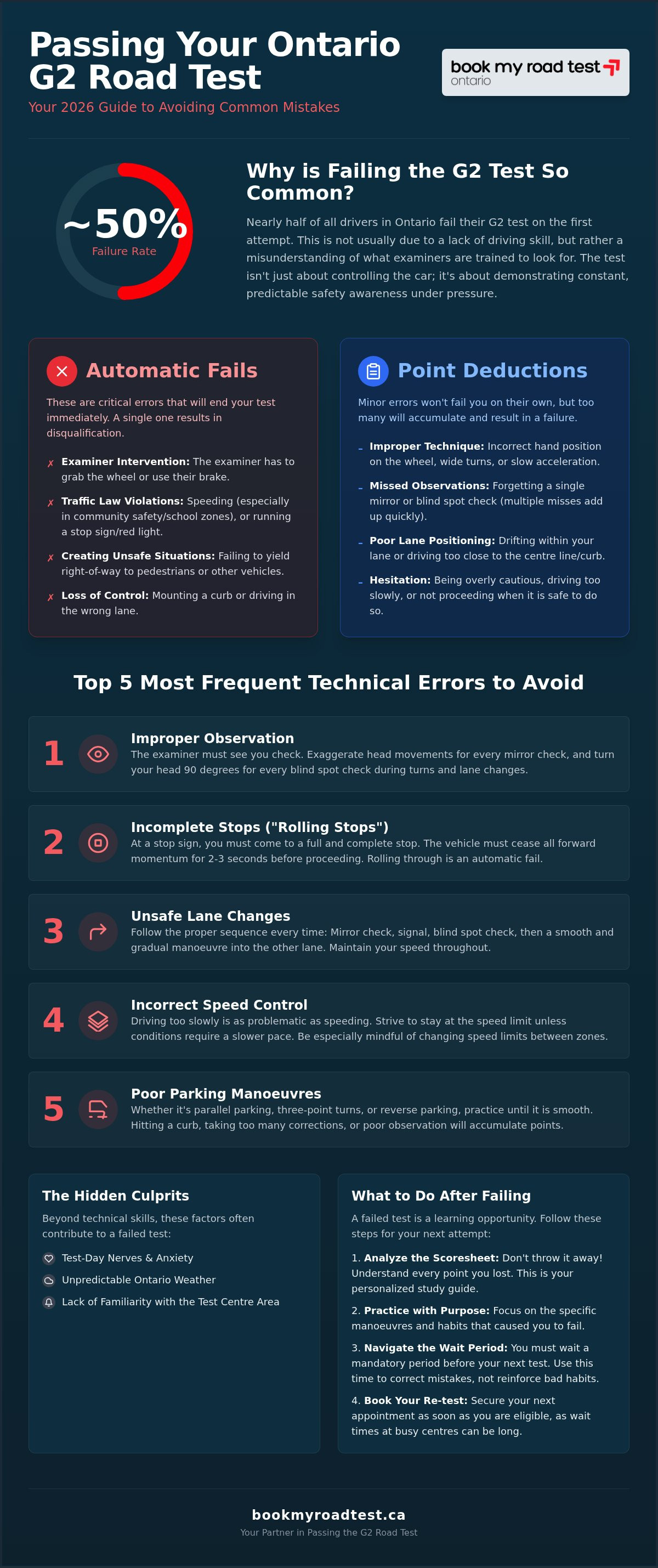
Failing the G2 road test is a rite of passage for many in Ontario. With failure rates hovering around 40% to 50% at various DriveTest centres, it's clear that many applicants struggle during their first attempt. This often happens because the environment inside the car changes drastically on test day. You're no longer driving with a supportive parent or friend; you're sitting next to a professional whose job is to scrutinize every decision you make. This psychological shift can lead to one of the main reasons for failing g2 test first time: the loss of composure under pressure.
The Ontario graduated licensing system is designed to ensure that new drivers gain experience in low-risk environments before moving to more complex situations. However, many learners fail to realize that the safety habits they use in daily life might not meet the strict criteria required during an official evaluation. You might feel like a safe driver because you haven't had an accident, but the examiner is looking for a specific performance that proves you're constantly aware of your surroundings. This requires "exaggerated" movements, such as obvious head turns, to ensure the examiner actually sees you checking your blind spots.
The Difference Between "Good Driving" and "Test Driving"
Experienced learners often fail because they become too comfortable behind the wheel. They might have perfect mirror placement, but they forget that an examiner cannot see eye movements alone. If you don't physically turn your head for a shoulder check, it simply didn't happen in the examiner's eyes. Another silent killer of first-time attempts is the "rolling stop." While common in suburban neighbourhoods, failing to come to a complete, three-second halt at a stop sign is a guaranteed way to fail your test.
Understanding the Examiner’s Perspective
Examiners prioritize predictability over everything else. They aren't looking for someone who can navigate tight spaces with speed or flair. They want to see a driver who communicates clearly with signals and maintains a steady, safe pace that doesn't force others to react to them. Your body language and confidence level also influence the scoring. If you appear hesitant or erratic, the examiner will naturally feel less safe. Ultimately, the examiner’s role is to act as a risk assessor for the Ministry to determine if you can safely share the road with others.
Automatic Fails vs. Scoring Points: How the G2 Test is Graded
Understanding the DriveTest scoring sheet is the best way to demystify the evaluation process. The examiner isn't just looking at your general ability; they're checking off specific criteria across various categories. While many applicants focus on the big manoeuvres like parallel parking, the reasons for failing g2 test first time often involve a combination of minor technical deductions and major safety violations. You don't need a perfect score to pass, but you must avoid the "fatal" errors that trigger an immediate end to your attempt.
The grading system is divided into two main categories: point deductions and automatic disqualifications. Points are lost for minor errors in technique or observation. However, an automatic disqualification (AD) is a single action so serious that the examiner must fail you on the spot. If you find yourself needing to book a road test again after a disqualification, reviewing your feedback sheet is the first step toward improvement.
What Constitutes an Immediate Disqualification?
An automatic fail happens when your actions create an unsafe situation or violate a fundamental traffic law. Common disqualifications include disobeying a stop sign, speeding in a school zone, or failing to yield the right-of-way to a pedestrian. The most definitive AD occurs when the examiner has to intervene physically. If the examiner "grabs the wheel" or hits their passenger-side brake to prevent a collision, the test ends immediately. Once an AD is recorded, the examiner will usually direct you back to the DriveTest centre via the shortest route possible.
How Minor Errors Accumulate Into a Failure
While one small mistake won't end your test, they add up quickly. Examiners track "points off" for technical flaws like improper hand positioning on the steering wheel, slow acceleration, or poor lane positioning. These are often referred to as technical errors. Safety violations, such as missing a blind spot check, carry more weight. For example, missing three shoulder checks during lane changes can lead to enough accumulated points to result in a failure. You can still pass with several minor mistakes, provided they don't compromise the safety of other road users or pedestrians. The goal is to keep your total deductions below the failure threshold while maintaining a clean record of safety-critical actions.
The 5 Most Frequent Technical Errors on the G2 Road Test
Technical proficiency is the foundation of a successful road test, but many drivers are surprised to learn that simply "knowing how to drive" isn't enough. You must also perform for the examiner by demonstrating specific safety habits. This performance aspect is one of the most common reasons for failing g2 test first time attempts in Ontario. Even if you have months of practice, you might be missing the technical markers that DriveTest staff use to evaluate your readiness for the road.
Poor Observation and "The Blind Spot Check"
Observation is the most frequent area where points are lost. You might be checking your mirrors with your eyes, but if your head doesn't move, the examiner assumes you aren't looking. A proper "neck check" involves a clear, exaggerated rotation of your head toward the blind spot. In residential areas, you should follow the 5-10 second mirror rotation rule. This means scanning your mirrors and the road ahead constantly to show you are aware of potential hazards like cyclists or pedestrians. To execute a safe lane change, you must activate your signal, check your rear-view and side mirrors, and perform a physical blind spot check over your shoulder in the direction of the move.
Improper Lane Positioning and Turning Technique
Maintaining the correct lane is vital at multi-lane intersections. Ontario rules require a "Left-to-Left" and "Right-to-Right" approach. You must turn from the leftmost lane into the leftmost lane, or the rightmost into the rightmost. Many learners fail because they drift into the middle lane during a turn, which is a significant lane discipline error. Precision matters more than speed during manoeuvres like the three-point turn or parallel parking. Touching the curb while parking is generally a minor deduction, but climbing the curb or hitting it with enough force to jar the vehicle is an automatic fail.
Speed control and right-of-way etiquette also require careful balance. Driving 10 km/h under the limit can be just as problematic as speeding because it impedes the flow of traffic. If you move too slowly without a valid reason like poor weather or road conditions, you will lose points. Similarly, hesitation at four-way stops often signals a lack of confidence to the examiner. If it's your turn to go, you must take the right-of-way predictably to keep traffic moving safely. Finally, don't forget to signal when leaving a parallel park or entering a roundabout, as these small omissions suggest a lack of routine.
The Hidden Culprits: Nerves, Weather, and Lack of Routine
Technical skill is only half the battle. Often, external factors you can't control, such as the weather or your own heart rate, become the primary reasons for failing g2 test first time. Even a student who drives perfectly with their parents can struggle when the environment changes. Success requires more than just knowing how to operate a vehicle; it requires a solid routine and the ability to adapt to the unexpected. If you're unprepared for these variables, they can quickly derail an otherwise perfect drive.
Managing Test-Day Anxiety and Pressure
Anxiety is a physical response that leads to unforced errors. Your leg might shake on the gas pedal, or you might forget to check a mirror you've checked a thousand times before. To combat this, arrive at the DriveTest centre at least 30 minutes before your appointment. This gives you time to acclimatize to the busy environment and watch other drivers finish their tests. A 20-minute "warm-up drive" immediately before you check in can also help settle your nerves. It ensures your brain is in "driving mode" before the examiner even opens the car door.
Dealing with Unfavourable Road Conditions
Ontario weather is notoriously unpredictable. If it starts to rain or light snow begins to fall during your test, you must adjust your following distance and speed immediately. Failing to adapt to these shifts is a common mistake. You can drive slightly below the speed limit for safety, but you must not be marked for "impeding traffic" by going too slow without a valid reason. For more details on preparation, check out everything you need to know about the Ontario G2 road test in 2026.
Consistency is your best friend on test day. Many learners make the mistake of using a different car for their test than the one they used for practice. Every vehicle has different blind spots, pedal sensitivity, and mirror angles. Switching cars at the last minute adds unnecessary stress and leads to clumsy handling. Similarly, "winging it" without a professional mock test often leads to failure. A professional instructor can identify the bad habits you've picked up in your daily routine that an examiner will certainly catch. If you want to ensure you're ready and have a spot secured, you can find a road test appointment through a streamlined service to avoid the stress of navigating busy schedules alone.
What to Do After Failing Your G2: Booking a Re-test Fast
Failing your road test is a frustrating setback, but it's a common hurdle that many Ontario drivers face. Once the initial disappointment fades, your first priority should be reviewing the examiner's feedback sheet. This document is a roadmap for your next attempt. It highlights the exact reasons for failing g2 test first time, whether you struggled with mirror checks or lane discipline. In Ontario, you must wait a mandatory 10 days before you can take the test again. This period is designed to give you enough time to practise the skills that were lacking during your first evaluation.
The real challenge in 2026 isn't the 10-day waiting period; it's the availability of appointments. While the law allows you to re-test quickly, the standard DriveTest booking system often shows no availability for four to eight weeks. This delay can be particularly stressful if your G1 licence is nearing its expiry date. Losing momentum can also cause your newly refined driving habits to slip, making it harder to pass on the second try. To get back on the road sooner, many drivers turn to specialized services that can identify earlier openings.
Securing a New Appointment Without the Long Wait
Professional booking services act as an efficient facilitator by monitoring DriveTest cancellation slots 24/7. When another driver cancels or reschedules, these spots become available instantly. A dedicated service can help you secure these last-minute openings, often bypassing the typical month-long wait times. Getting back behind the wheel while the examiner's feedback is still fresh in your mind is a proven strategy for success. Learning about road test booking hacks Ontario can save you weeks of checking the website manually and reduce the overall stress of the process.
Preparing for Success on the Second Attempt
Use your waiting time effectively by focusing solely on the mistakes noted in your feedback. If you failed due to technical errors like poor observation, consider booking a single professional driving lesson. An instructor can provide a mock test in the same area as your chosen DriveTest centre, helping you navigate local intersections and speed zones with confidence. This targeted practice ensures you aren't just driving, but driving to the specific standards the Ministry requires. When you feel ready to try again, don't let a crowded schedule hold you back. Book your road test re-test today and skip the long Ontario wait times so you can earn your G2 with confidence.
Master Your G2 Road Test and Get on the Road
Passing your G2 road test is about more than just basic vehicle control; it's about demonstrating a consistent commitment to safety that satisfies the examiner's strict criteria. By understanding the common reasons for failing g2 test first time, you can turn a potential setback into a successful second attempt. Focus on the "exaggerated safety" habits we've discussed, such as clear head movements and precise lane discipline, to prove you are a low-risk driver. These adjustments, combined with a calm pre-test routine, are the keys to earning your full driving privileges.
If you've already faced a failure, don't let long wait times discourage you. Our independent and transparent service is trusted by thousands of drivers to find cancellation slots in days, not months. You can secure your next G2 road test appointment fast with Book My Road Test Ontario and bypass the usual bureaucratic delays. Stay focused, keep practising your shoulder checks, and you'll be holding your G2 licence before you know it. You've got this!
Frequently Asked Questions
How long do I have to wait to retake my G2 test in Ontario after failing?
You must wait at least 10 days before you are eligible to attempt the G2 road test again. This mandatory period allows you time to practise the specific skills identified on your examiner's feedback sheet. Keep in mind that you will also need to pay a $53.75 retake fee to book your next appointment at a DriveTest centre.
Will I fail my G2 test if I hit the curb while parallel parking?
A light touch against the curb during parallel parking usually results in a minor point deduction rather than an immediate failure. However, if your tire climbs the curb or hits it with enough force to jar the vehicle, the examiner will record an automatic disqualification. It is generally safer to finish your park slightly further from the curb than to risk climbing over it.
Can I fail the G2 road test for driving too slowly?
Yes, driving significantly below the speed limit without a valid reason can lead to a failure for "impeding traffic." While it might feel safer to drive slowly, examiners look for drivers who can keep up with the natural flow of traffic. Unless weather or road conditions dictate otherwise, you should stay within 2 to 3 km/h of the posted speed limit.
What are the most common automatic fails on the G2 test?
The most frequent automatic disqualifications include causing a collision, disobeying a stop sign, and any dangerous action that requires the examiner to intervene. These are the most critical reasons for failing g2 test first time attempts in Ontario. Speeding in a school zone or failing to yield the right-of-way to a pedestrian will also end your test immediately.
Do I need to bring my own car for the G2 road test?
You must provide the vehicle for your road test, as DriveTest centres do not supply cars for applicants. You can use your own car, a rental, or a driving school vehicle, provided it is in good working order. The examiner will check that your signals, brake lights, and tires meet safety standards before the test begins.
How many points can I lose and still pass the G2 test?
The scoring system allows for several minor technical errors, provided they do not involve a safety violation or an automatic disqualification. While the Ministry does not publicly disclose the exact passing threshold, most instructors advise that staying under 30 points is a safe target. However, focusing on "exaggerated safety" and clear observation is more important than worrying about the specific point count.
What happens if my G2 licence is about to expire and I fail my test?
If your licence expires before you can pass a re-test, you will lose your driving privileges and may have to restart the graduated licensing process from the G1 stage. To avoid this, you should book a re-test as soon as possible after a failure. Using a booking service to find a cancellation slot can help you secure an appointment before your current licence becomes invalid.
Is it harder to pass the G2 test at certain DriveTest centres?
Statistics from 2026 show that pass rates vary significantly depending on the location and traffic complexity. For example, the pass rate in Brampton was 47%, while the rate in Bancroft was much higher at 79%. Urban centres often have lower pass rates due to higher traffic volumes, more pedestrians, and complex multi-lane intersections.


