

Your G road test can be over before you even put the car in drive if a single brake light is out or a signal is fuzzy. In 2026, passing requires a zero-defect approach to both your vehicle and your paperwork. This g road test checklist ontario 2026 is designed to prevent those frustrating out-of-order disqualifications and give you the best chance at success on your first try.
We understand the pressure you're feeling. Between the anxiety of merging onto a 400-series highway at high speeds and the struggle to find an open booking slot, it's easy to feel overwhelmed. You want to arrive at the test centre with total confidence, knowing you haven't missed a single detail. At Book My Road Test Ontario, we've simplified the entire process to help you focus on what matters most: your driving skills and safety.
This guide provides a clear path to your full G licence. You'll learn exactly which documents to bring, how to verify your vehicle meets strict official provincial standards, and how to master the highway manoeuvres that trip up most drivers. We also share a streamlined way to secure your test date so you can stop stressing about availability and start preparing to pass.
Key Takeaways
- Learn how to navigate the 2026 booking landscape and why the G test is the final hurdle in Ontario's graduated licensing system.
- Use our g road test checklist ontario 2026 to verify essential documents and vehicle standards, like functional signals and horns, before your arrival.
- Shift your focus from basic vehicle control to advanced traffic management and high-speed environments to meet the examiner's expectations.
- Master the "Three-Point Check" and precise highway merging techniques to demonstrate professional-level awareness and safety.
- Prepare for the final countdown with tips on kiosk check-in at the centre and maintaining the right mindset during the evaluation.
Preparing for Your G Road Test: The 2026 Booking Landscape
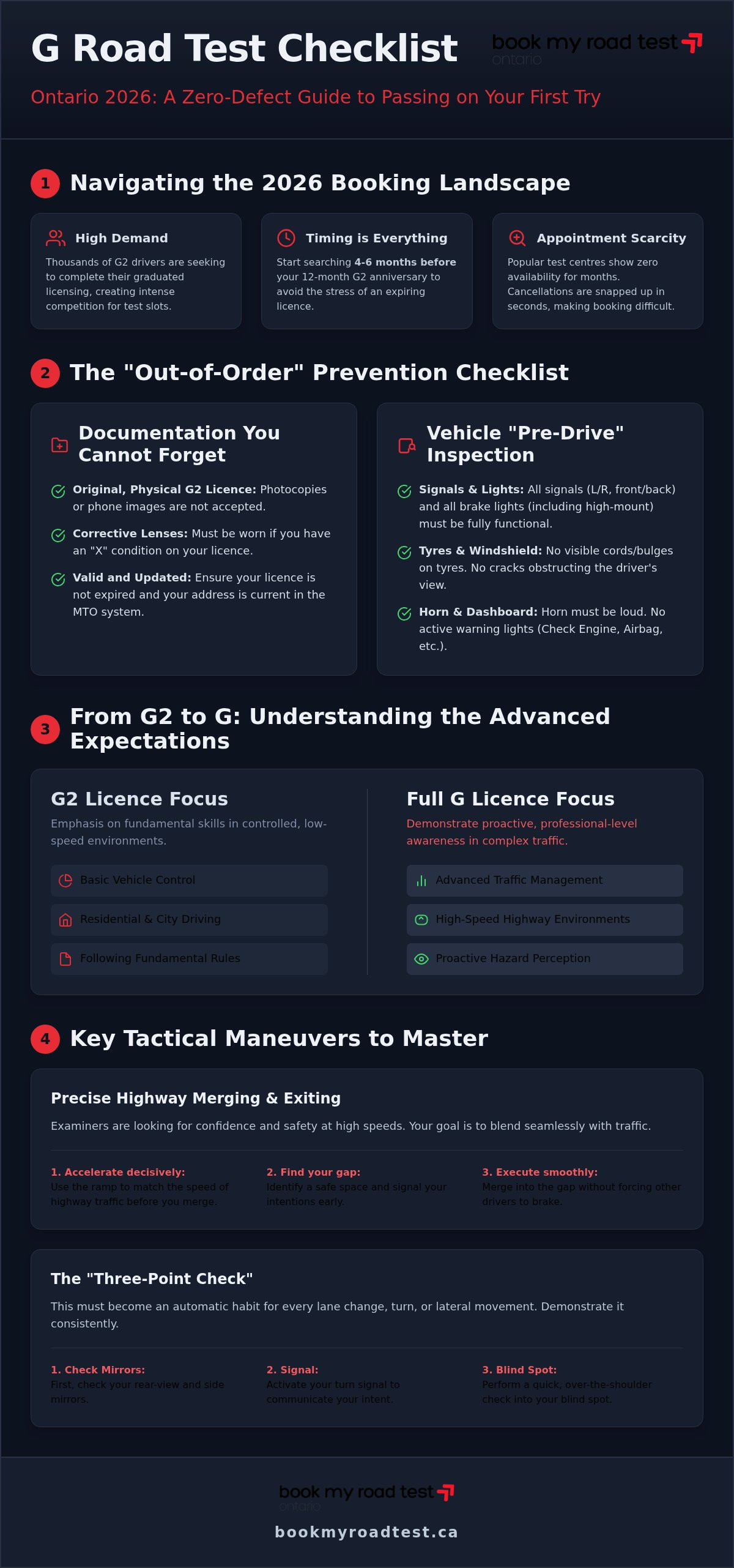
In 2026, the demand for road tests in Ontario remains high. Thousands of drivers are currently holding G2 licences and are eager to complete the graduated licensing system. The G road test is your final evaluation. Once you pass, you'll have a full licence without the restrictions of the G2 level. However, simply being ready to drive isn't enough. You also need to navigate a crowded booking system where popular centres across Ontario often show zero availability for months. This is where a g road test checklist ontario 2026 starts: with a plan to actually get your car to the starting line.
Using an independent booking service, like Book My Road Test Ontario, can simplify these logistics. Instead of refreshing a webpage for hours, you can rely on facilitators who understand how the system flows. They help you find a spot that fits your schedule, letting you focus on practising your highway merges instead of managing administrative hurdles. It's about making a complex process manageable so you can approach your test day with a clear mind.
The Importance of Timing Your Booking
Timing is everything. You're eligible for your G test exactly 12 months after receiving your G2. If you wait until that anniversary to look for a date, you're already behind. We recommend starting your search 4 to 6 months before your eligibility date. This lead time is crucial. It ensures you don't face the stress of a looming licence expiration. If your G2 expires before you pass your G, you might have to start the entire process over. Booking early gives you a necessary safety net if you need to reschedule or retake the test.
Overcoming Appointment Scarcity
Road test slots are a limited resource. While the official portal is the primary source, it often feels like a dead end during peak seasons. Last-minute cancellations happen every day, but they're usually snapped up in seconds. Staying organized while checking multiple centres across Ontario is a time-consuming task. Many drivers find that the effort required to hunt for a slot is exhausting. You might wonder, is a road test booking service worth it ontario? For many, the answer is yes. Book My Road Test Ontario removes the guesswork and provides a streamlined path to a confirmed appointment. We act as a reliable partner to help you secure a date without the typical bureaucratic headaches.
The Mandatory G Road Test Document and Vehicle Checklist
Arriving at the DriveTest centre is only half the battle. Before you even start the engine with an examiner, your vehicle and paperwork must pass a rigorous inspection. If your car doesn't meet Ministry standards, the test is declared "out-of-order." This means you'll lose your appointment slot and forfeit your prepaid fee. Following a thorough g road test checklist ontario 2026 is the first step toward success. You don't want a simple burnt-out bulb to stand between you and your full G licence.
Documentation You Cannot Forget
You must present your original, physical G2 driver's licence at the check-in kiosk. A photo on your phone or a photocopy will not work. If your licence has an "X" condition, you must wear your spectacles or contact lenses during the entire evaluation. It's also essential to verify that your licence is valid and not expired. If you've moved, ensure your address is updated in the MTO system. Discrepancies in your personal information can lead to delays or a cancelled test. If you arrive without your physical licence, the staff cannot proceed, and you'll have to book a new date.
Vehicle Safety: The "Pre-Drive" Inspection
The examiner will perform a walk-around before they enter the vehicle. They'll ask you to activate your left and right signals, both at the front and back. You must also demonstrate that your brake lights, including the high-mount light in the rear window, are functioning perfectly. The horn must be loud enough to be heard from a distance. For 2026, inspectors are particularly strict about tyres and windshields. Any tyre with visible cords, significant bulges, or lack of tread will fail. Similarly, a windshield with a crack that obstructs the driver's view or spans across the glass will result in an immediate disqualification.
If you're using an electric vehicle (EV), ensure the battery has sufficient charge for a 30-minute drive plus potential traffic. Many modern cars now feature electronic parking brakes. You should be comfortable demonstrating how to engage this to the examiner, as they need to know the vehicle can be secured safely. Finally, check your dashboard for any warning lights. An active "Check Engine," "Airbag," or "ABS" light is often enough for an examiner to refuse the test for safety reasons. If you're feeling overwhelmed by the logistics, you can book a road test through our streamlined service to find a date that gives you plenty of time to prep your vehicle.
G2 vs. G Road Test: Understanding the Advanced Expectations
Many drivers assume the G test is simply a longer version of the G2. This is a common trap. While the G2 focuses on basic vehicle control in quiet residential areas, the full G evaluation demands advanced traffic management. Examiners expect you to act as a seasoned driver who can predict hazards before they happen. They look for maturity, decisiveness, and a high level of situational awareness. In 2026, the scoring threshold is tighter. You aren't just being tested on your ability to drive; you're being evaluated on your ability to share the road safely with high-speed traffic.
Observation is the biggest differentiator. At the G2 level, you might get away with a quick glance at your mirrors. For the G test, your mirror rhythm must be constant. You should be checking your rear-view mirror every 5 to 8 seconds and whenever you slow down or stop. This proactive scanning shows the examiner that you're aware of the entire environment, not just the car directly in front of you. Failing to demonstrate this "searching" behaviour is one of the most frequent reasons candidates fail to complete their g road test checklist ontario 2026 requirements.
What Stays the Same?
Your fundamental skills must remain sharp. The examiner will still watch how you handle residential streets and school zones. Smoothness counts. If your braking is jerky or your hand positioning on the wheel is sloppy, you'll lose points. You must continue to respect pedestrian crossovers and maintain a safe three-second following distance. These basics are the foundation of safe driving. While the G test adds new challenges, it doesn't excuse you from the rules you learned during your first road test.
- Maintaining a 30 km/h or 40 km/h speed in posted school zones.
- Full stops at all stop signs, ensuring the vehicle's motion completely ceases.
- Using the "push-pull" or "hand-over-hand" steering method for clean turns.
The "G-Only" Requirements
The defining feature of the G test is the highway component. You must demonstrate total confidence on 400-series highways or high-speed regional roads. This includes merging at the exact speed of traffic, which usually means reaching 100 km/h on the ramp before joining the flow. Advanced lane changes are also required. You'll need to move between lanes in heavy traffic while maintaining a consistent speed. While the G test builds on previous skills, you can refresh your memory with our guide on everything you need to know about the Ontario G2 road test in 2026 to ensure your basics are still sharp. Mastering these high-speed environments is essential for passing your final evaluation in Ontario.
Tactical Maneuvers: A Step-by-Step Execution Guide
Success on the G test depends on your ability to execute complex manoeuvres with precision. You aren't just driving; you're performing for an evaluator who is looking for specific, safe habits. The "Three-Point Check" is the most critical habit to master. Before every single turn or lane change, you must check your rear-view mirror, your side mirror, and your blind spot. This sequence must be obvious. A quick glance with your eyes isn't enough. You need a clear head movement to prove to the examiner that you've actually looked. Integrating this habit into your routine is a mandatory part of any g road test checklist ontario 2026.
Mastering the Highway Merge
The highway merge is often where candidates feel the most anxiety. In Ontario, you are expected to merge at the exact speed of the highway traffic. If the limit is 100 km/h, you should be at 100 km/h by the time you reach the end of the acceleration lane. Don't hesitate. Use the full length of the ramp to build your speed. While accelerating, perform your mirror and blind spot checks. Find a safe gap and join the flow smoothly. Once you're on the highway, remember lane discipline. You must stay in the right-hand lane unless you are passing another vehicle or following an examiner's instruction to turn.
Emergency roadside stops and parallel parking may still be requested, depending on the specific route and current Ministry protocols. For an emergency stop, signal right, check your mirrors and blind spot, and pull over to a safe area. Ensure you're far enough from traffic and engage your hazard lights. When parallel parking, keep your movements slow and controlled. The examiner is looking for safety and accuracy, not speed. If you're worried about finding a test centre with a route you're comfortable with, you can find a road test appointment that fits your needs through our booking service.
City Driving and Intersections
Intersections require constant vigilance. Even when you have a green light, you must scan from left to right to ensure no one is running a red. This "left-centre-right" scan should be a deliberate head movement. When turning right on a red light, you must come to a complete stop first. Creeping through the stop is an automatic fail. Only proceed when the way is clear and you've checked for pedestrians and cyclists. Sharing the road in urban centres means giving cyclists plenty of room. Always check your blind spot for bikes before making a right turn. These small details show the examiner you're a responsible, full-licence driver.
Final Countdown: Tips for Test Day Success
The morning of your test is about managing nerves and logistics. Arriving at the DriveTest centre at least 30 minutes before your scheduled time is essential. This buffer gives you plenty of room to park, locate the check-in area, and settle your mind. Rushing into the parking lot two minutes before your start time only adds unnecessary stress. By being early, you can double-check your g road test checklist ontario 2026 one last time to ensure your G2 licence is in your pocket and your vehicle is ready.
The Check-In Process
DriveTest centres usually have specific parking rows reserved for road test candidates. Look for signs or numbered spots as you enter. Once parked, head inside to the automated kiosks. You'll need to enter your licence number and vehicle plate details. The kiosk will print a ticket or give you instructions to return to your car. Stay in the driver's seat with your seatbelt off until the examiner approaches. They'll start with the exterior vehicle check we discussed earlier, so keep your window down to hear their instructions clearly.
Mental preparation is just as important as your driving skills. Try to treat the examiner like a voice-activated GPS. They are there to provide directions and evaluate your safety, not to trick you. If you make a minor mistake, like a slightly wide turn or a late signal, don't let it ruin your focus. Many drivers fail because they dwell on a small error and then commit a larger, "major" mistake later. Keep your eyes on the road and stay proactive with your mirror checks until the engine is turned off back at the centre.
Securing Your Next Slot if You Fail
If you don't pass on your first attempt, it isn't the end of the road. Ontario regulations require a mandatory 10-day wait period before you can take the G road test again. This time is meant for practice. Your examiner will provide a feedback sheet that outlines exactly where you lost points. Study this document carefully. If you struggled with highway merging or blind spot checks, focus your practice sessions there. When you're ready to try again, using a road test booking service can help you find a new appointment quickly without the frustration of constant manual searching.
Before you head out for your evaluation, take a moment to review our road test booking hacks Ontario. These strategies can help you feel more prepared for the administrative side of the day. Remember that passing the G test is a marathon, not a sprint. With the right preparation and a calm mindset, you'll be trading in that G2 for a full licence in no time.
Claim Your Full Ontario Driving Freedom
Transitioning from a G2 to a full G licence is a major milestone that requires both technical skill and administrative preparation. Success in 2026 comes down to two things: preparing your vehicle for a zero-defect inspection and mastering high-speed highway manoeuvres. By following this g road test checklist ontario 2026, you've already taken the most important step toward passing your evaluation. You now have the tools to handle everything from the initial kiosk check-in to the final 400-series highway merge with total confidence.
Don't let booking frustrations or long wait times stand in your way. Our independent booking experts offer fast and secure appointment management, so you can spend your time practicing rather than refreshing the DriveTest site. Secure your G road test appointment today with Book My Road Test Ontario and let us simplify the logistics for you. You've put in the hard work on the road, and now it's time to secure your full licence. We're here to help you cross the finish line.
Frequently Asked Questions
How long is the G road test in Ontario for 2026?
The G road test typically lasts between 20 and 30 minutes. This duration includes the initial vehicle safety check and the actual driving evaluation on city streets and highways. You should plan to be at the centre for at least an hour to account for check-in and post-test processing. Arriving early ensures you can complete your g road test checklist ontario 2026 before the examiner arrives.
Can I take my G test if my G2 licence is expired?
No, you cannot take a road test with an expired licence. Your G2 must be valid on the day of your appointment. If your licence is near its five-year expiry date, you should book your test well in advance to avoid losing your driving privileges. If it has already expired, you may need to start the graduated licensing process over by taking the G1 written knowledge test first.
What happens if my vehicle fails the safety inspection at the centre?
Your test will be declared "out-of-order" if your vehicle fails the pre-drive inspection. This happens if you have non-functional brake lights, signals, or a windshield with a major crack. If this occurs, you will forfeit your prepaid test fee and must book a new appointment. Ensuring your car meets all standards is a vital part of the g road test checklist ontario 2026 to avoid these costly delays.
Is the G road test still "shortened" in 2026?
The G road test in 2026 is a comprehensive evaluation that focus heavily on high-speed environments and highway driving. While some temporary modifications existed in previous years, you should prepare for a full assessment of your skills. This includes merging at highway speeds, lane changes, and residential driving. Examiners expect to see advanced traffic management skills throughout the entire 20 to 30 minute session.
How many times can I fail my G test before I lose my G2?
There is no specific limit on the number of attempts, but you are restricted by your licence's expiry date. Each failed attempt requires a mandatory 10-day waiting period before you can try again. If your G2 licence expires before you pass the G test, you will lose your driving privileges and must re-qualify. Each standalone G road test attempt costs C$91.25 as of August 2026.
Do I need to bring my own car for the G road test?
You must provide a vehicle for the test, but it doesn't have to be your own. You can use a rental car, a driving school vehicle, or a car borrowed from a friend or family member. Regardless of who owns it, the vehicle must be in excellent mechanical condition and have valid insurance and plates. The examiner will check these details before the test begins to ensure the car is safe for the road.
What is the passing score for the Ontario G road test?
Ontario does not use a simple percentage score, but rather a system that tracks minor and major errors. You pass by demonstrating safe driving habits and avoiding "automatic fail" actions. These major errors include breaking a traffic law, causing a collision, or requiring the examiner to intervene. Too many minor errors, like failing to check your blind spot or improper mirror use, will also result in a failing grade.
Can I use a backup camera or parking sensors during the test?
You can have a backup camera and sensors active, but you cannot rely on them as your primary source of information. The examiner will watch to ensure you are physically turning your head and checking your mirrors. If you stare only at the camera screen during a reverse manoeuvre, you will lose points. These tools are considered secondary aids to your own visual observations and head movements.


