

Imagine waiting months for your appointment, only to have the examiner walk away before you even start the engine because of a small crack in your windshield. It's a frustrating reality for many Ontario drivers who lose their time and their prepaid fees because they didn't know exactly what to bring for g road test. You've spent hours mastering highway merges and lane changes, so the last thing you want is a cancellation over a simple paperwork technicality.
We understand that the pressure of the day is high, and the rules around vehicle standards can feel like a moving target. This guide provides a fail-proof checklist to ensure you arrive at the DriveTest centre with total confidence. We'll cover the essential documents you need in hand, like your physical driver's licence, the mechanical requirements your car must meet, and the specific arrival protocols for 2026. By the time you finish reading, you'll know exactly how to navigate the check-in desk and pass the vehicle inspection without a single hiccup.
Key Takeaways
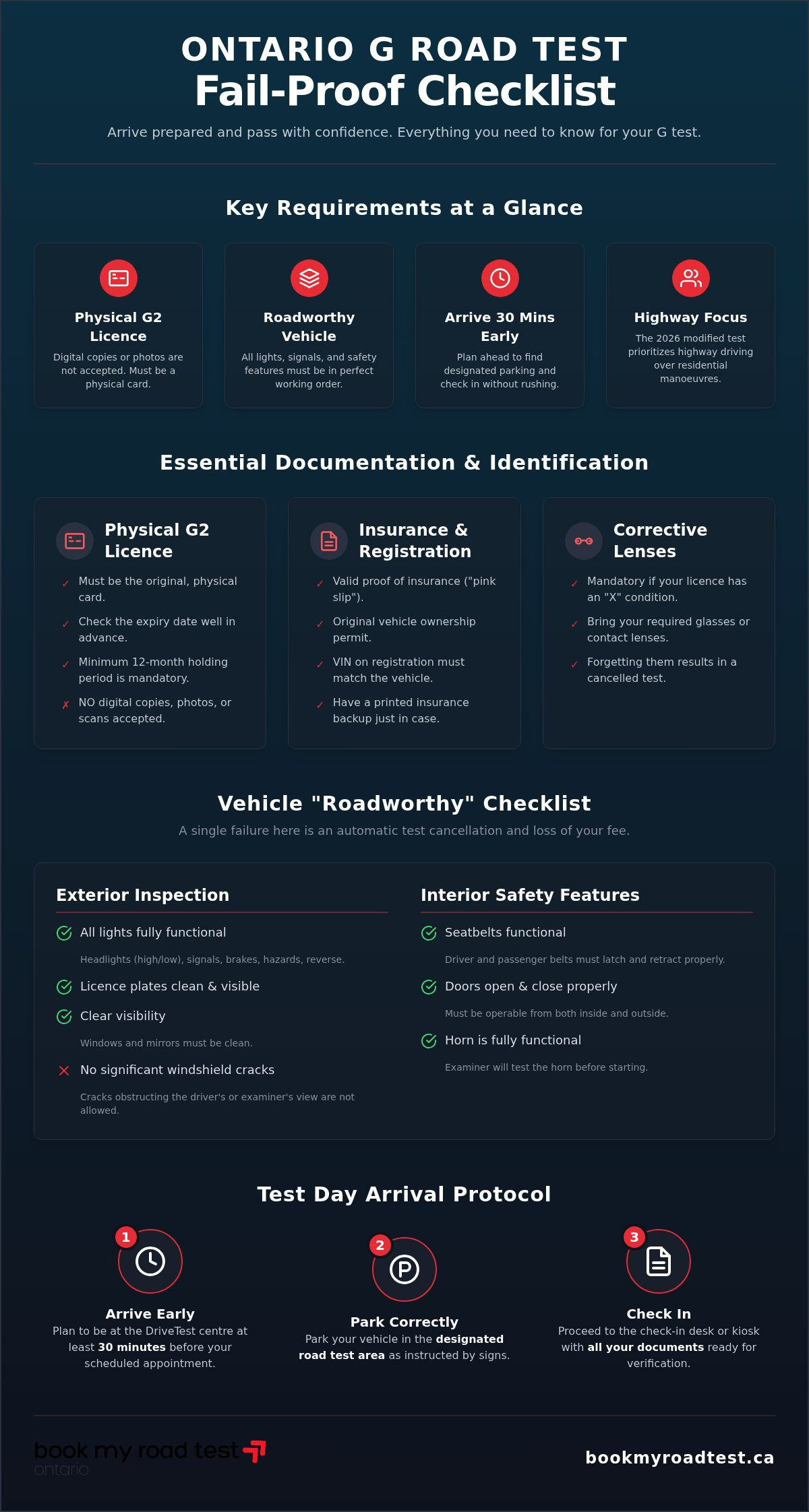
- Verify you have your physical G2 licence and valid insurance ready, as digital copies are not accepted at the check-in desk.
- Ensure your vehicle meets provincial safety standards by checking that all lights, the horn, and the windshield are in perfect working order.
- Use our comprehensive guide to understand exactly what to bring for g road test to avoid a last-minute cancellation.
- Plan to arrive at the DriveTest centre at least 30 minutes early and park in the designated road test area to ensure a smooth start.
- Familiarize yourself with the 2026 modified test requirements, which prioritize highway driving over residential manoeuvres.
Essential Documentation and Identification for Your G Test
Arriving at the DriveTest centre without the right paperwork is the fastest way to lose your appointment and your prepaid fee. Examiners follow strict provincial protocols. If your documentation is incomplete, they cannot legally proceed with the evaluation. When planning what to bring for g road test, your focus should be on physical, original documents that prove your identity and your vehicle's legal status. Forgetting a single card can result in a cancelled session, forcing you back into a long queue for a new booking.
The Physical Licence Requirement
You must present your physical G2 driver's licence at the check-in kiosk or desk. DriveTest staff will not accept photos of your licence on a phone, digital scans, or photocopies. If you've recently renewed your licence and only have a temporary paper version, you must also bring a valid government issued photo ID, such as a passport, to verify your identity. Without that photo verification, the examiner cannot confirm who is behind the wheel.
Check your licence expiry date well in advance of your test day. If your G2 is expired, you may not be allowed to test unless you have already visited a ServiceOntario location to extend it or have a valid temporary extension document. Additionally, ensure you have held your G2 licence for at least 12 months. This is a mandatory waiting period in Ontario's graduated licensing system. The system will flag your file if you try to test even one day early, leading to an automatic disqualification for that day.
Insurance and Registration Protocols
Your vehicle must be legally covered to be on the road for the duration of the exam. You need to show a valid proof of insurance, commonly known as a "pink slip." While Ontario now accepts official digital insurance cards on your smartphone, it's a smart move to have a printed backup in case of battery issues or poor reception inside the centre. When confirming what to bring for g road test, remember that the vehicle registration papers are also mandatory.
Ensure the permit is the original or a clearly legible copy of the front and back. If you are using a rental car, you must bring the rental agreement and proof that the vehicle is insured for a road test. The examiner will check that the vehicle identification number (VIN) on the registration matches the car you're driving. If there's a discrepancy or the insurance has expired, the test will be cancelled immediately. This results in a forfeited fee and the stress of finding a new appointment during peak seasons.
Corrective Lenses
If your licence has an "X" condition code, you are legally required to wear corrective lenses while driving. Bring your glasses or contacts to the desk during check-in. If you show up without them, the examiner will mark the vehicle as unfit for your use. This leads to a cancelled session and the same financial loss as missing paperwork. Always double check your licence codes to avoid these simple but costly administrative errors.
Vehicle Standards: The "Roadworthy" Checklist
Your vehicle is the most important piece of equipment you'll provide on test day. Many applicants focus entirely on their driving skills but overlook the mechanical state of their car. If your vehicle fails a pre-test inspection, the examiner will cancel the session immediately. When considering what to bring for g road test, you must treat your vehicle as a verified tool that meets all provincial safety standards. A clean, well-maintained car sets a professional tone before you even pull out of the parking lot.
The Exterior Inspection
The examiner begins by walking around the car to check every signal and bulb. A single burnt-out turn signal or brake light is an automatic "out of order" disqualification. Before you leave home, have a friend help you verify that your high and low beam headlights, hazard lights, and reverse lights all function perfectly. Ensure your licence plates are clean and clearly visible. While Ontario has moved away from physical plate stickers, your vehicle must still be legally registered in the provincial system.
Visibility is a safety priority. Clean your mirrors and windows thoroughly to remove any dirt, salt, or frost. If you're struggling to find an available time slot for your exam, you can book a road test appointment through a facilitator to secure a date once your vehicle is ready. A clear view for both you and the examiner is a non-negotiable requirement for highway driving.
Interior Safety Features
The interior must be just as reliable as the exterior. The examiner will check that both the driver and passenger seatbelts latch and retract properly. If the passenger side seatbelt is frayed or stuck, the test cannot proceed. Additionally, both the driver and passenger doors must open and close easily from both the inside and the outside. This is a critical safety requirement for emergency exits. If your door handle is finicky, fix it before arriving at the centre.
Pay close attention to your dashboard. If your ABS or Airbag warning lights are illuminated, the vehicle is considered unsafe for a road test. Clear any obstructions from your dashboard and ensure your horn produces a loud, clear sound when pressed. These small details often determine whether your test starts at all or if you're sent home with a forfeited fee.
Windshield and Tires
Your windshield must provide an unobstructed view of the road. Any crack that is larger than a loonie or located directly in the driver's field of vision will likely result in a cancellation. Check your windshield wipers to ensure they don't streak and verify that your washer fluid reservoir is full, especially during winter months. Finally, inspect your tires. They must have adequate tread depth and show no visible bulges or deep cuts in the sidewalls. Using a vehicle with "bald" tires is a major safety violation that ends the test before it begins.
Personal Preparation and Modified Test Considerations
Preparing your mind and body is just as vital as preparing your vehicle. On the morning of your exam, your focus should be on precision and comfort. Part of knowing what to bring for g road test includes bringing the right experience and declaring it honestly. If you arrive stressed or physically restricted, it can impact your reaction times during high-speed manoeuvres. Taking a few minutes to organize your personal gear ensures you can focus entirely on the road ahead.
The Highway Declaration Form
Before the drive begins, you must complete a Highway Declaration form at the DriveTest centre. This document requires you to confirm your experience on 400-series highways or roads with speed limits of at least 80 km/h. To qualify for the test, you must have driven on these high-speed routes at least five times within the three months leading up to your appointment. The examiner uses this to ensure you have the necessary exposure to handle highway traffic safely.
Be accurate when reporting your history. If you cannot truthfully meet this requirement, the examiner will cancel the test, and you will lose your fee. Providing false information is a serious administrative offence that can lead to a failed attempt or further licensing complications. If you've been practicing primarily on local roads, ensure you get those five highway trips in before your scheduled date.
Footwear and Comfort
Your choice of shoes directly impacts your "pedal feel," which is critical when merging onto high-speed highways. Avoid flip-flops, high heels, or heavy work boots. These can make it difficult to gauge the pressure on the brake or accelerator. Flat-soled sneakers are usually the best choice for smooth transitions. Additionally, avoid bulky winter coats or restrictive clothing that limits your range of motion. You need to be able to perform quick, clear blind-spot checks without fighting your jacket.
As of 2026, the G road test remains in its modified format. This version focuses heavily on highway merging and lane changes rather than residential manoeuvres like parallel parking or three-point turns. Since you'll be spending more time at higher speeds, adjusting your seat and mirrors before the examiner enters the vehicle is essential. This shows you are organized and ready to focus on the specific demands of the 400-series highways. When you consider what to bring for g road test, remember that your physical readiness is a major part of the fail-proof checklist.
Arrival Logistics: Navigating the DriveTest Centre
Preparation doesn't end once you've gathered your documents and checked your signal lights. The final hurdle before the drive begins is the arrival and check-in process. DriveTest centres are busy environments with strict timelines. If you miss your window, the system automatically marks you as "Out-of-Order." This effectively cancels your test and often results in the loss of your prepaid fee. Managing your time effectively is just as important as knowing what to bring for g road test to ensure you actually get behind the wheel.
Aim to arrive at the centre at least 30 minutes before your scheduled appointment. This buffer accounts for potential traffic, full parking lots, and queues at the check-in kiosks. Arriving early also allows you to settle your nerves and perform one last walk-around of your vehicle. If you haven't secured your appointment yet, you can book your road test through an independent facilitator to find available slots in your preferred area.
Parking and Positioning
Most DriveTest centres have a specific zone marked with "Road Test Only" signs. Do not park in the general visitor area. Instead, look for these numbered spots, which are usually located close to the building or in a designated row. It's a standard recommendation to back into the parking space. This allows you to pull forward at the start of your test, which is safer and provides better visibility when the examiner is watching your initial exit. Before you leave the vehicle to check in, write down or take a photo of your parking spot number. You'll need this information for the kiosk.
The Check-in Sequence
Once parked, head inside to the self-service kiosks. You'll need to enter your G2 licence number, your vehicle's plate number, and its make and colour. The kiosk will also ask for your parking spot number. After the system verifies your details, it will print a ticket or display a confirmation message. Keep this ticket with you. If the kiosk prompts you to speak to a representative, join the designated "Road Test" line at the counter. This usually happens if there is a minor issue with your file or if you're using a temporary paper licence that needs manual verification.
After checking in, return to your vehicle immediately. Sit in the driver's seat with your seatbelt off and your window rolled down. The examiner will look for you at your designated parking spot. They move quickly between tests and will not search the building or the parking lot for you. If you aren't in your car when they arrive, they may move to the next applicant, resulting in a cancelled test. Staying with your vehicle ensures the process remains efficient and professional.
Securing Your G Road Test Appointment
Ontario’s DriveTest centres often face significant demand throughout the year. During peak summer months or school breaks, finding an available slot at many testing locations across the province can feel nearly impossible. Securing your appointment is the essential first step that makes all your other preparation relevant. While you now know exactly what to bring for g road test, those documents and vehicle checks only matter once you have a confirmed date and time locked into the provincial system.
Avoiding Licence Expiration
Waiting until the final month of your G2 licence is a common mistake that adds unnecessary pressure. If you happen to fail your first attempt or your test is cancelled due to a sudden vehicle defect, you might not find a second opening before your licence officially expires. This is a high-stakes situation. If your G2 expires, you may be required to start the graduated licensing process from the beginning, which includes retaking the written G1 test. To prevent this "deadline stress," many savvy drivers use a road test booking service to find cancellations. This allows you to secure dates much sooner than the standard public portal typically displays.
The Benefit of Professional Facilitation
Manually checking the booking website repeatedly is a tedious and time-consuming task. A professional facilitator acts as a steady partner, utilizing efficient methods to help you find a G test booking that fits your specific schedule and preferred location. This service is particularly helpful for busy professionals or students who cannot afford to spend hours refreshing a browser window. Once your slot is locked in, you can shift your energy toward mastering highway merges and reviewing the safety requirements of your car.
Final Checklist Summary
To ensure your day goes smoothly, keep this summary in mind as you prepare:
- Documentation: Have your physical G2 licence and valid insurance slip ready.
- Vehicle Safety: Verify all signals, the horn, and tire tread depth.
- Logistics: Arrive 30 minutes early, park in the "Road Test" zone, and check in at the kiosk.
Preparation is the key to passing on your first attempt without administrative delays. If you're ready to secure your spot and move forward, Book your road test today and start your final countdown to a full G licence. Having a plan for what to bring for g road test gives you the confidence to focus on your driving instead of the paperwork.
Drive Toward Success with Total Confidence
Success on test day starts long before you shift your vehicle into drive. It begins with meticulous preparation and a clear understanding of provincial requirements. By prioritizing your physical documentation and conducting a thorough safety check of your car, you ensure your evaluation isn't cut short by an administrative error. Mastering exactly what to bring for g road test allows you to walk into the DriveTest centre with a calm mind, focusing entirely on your highway manoeuvres rather than worrying about a cracked windshield or a missing insurance slip.
As an independent booking facilitator, we've helped thousands of Ontario drivers navigate the complexities of the licensing system. We provide a fast and secure appointment search to help you find the slots that fit your life. Don't let long wait times or a lack of local availability delay your progress any further. Skip the wait and book your Ontario road test appointment now. You've put in the practice hours and studied the rules; now it's time to cross the finish line and enjoy the freedom of your full G licence.
Frequently Asked Questions
What happens if I forget my physical G2 licence on the day of the test?
Your test will be cancelled immediately if you don't have your physical G2 licence. DriveTest centres do not accept photos, digital scans, or photocopies for identification. You'll lose your appointment slot and your prepaid fee. Always double check your wallet before leaving home to ensure the original card is with you.
Can I use a rental car for my G road test in Ontario?
You can use a rental car, provided you have the original rental agreement and valid proof of insurance. The vehicle must still pass the examiner's mechanical inspection. Ensure the rental company allows the car to be used for a road test. Bring all physical rental documents to the check-in desk to avoid any administrative issues.
Will a small crack in my windshield cause my test to be cancelled?
A crack larger than a loonie or any damage directly in the driver's field of vision will result in a cancellation. Examiners prioritize clear visibility for highway driving. If you have a small chip, it's best to have it repaired before your appointment. This is a common detail people overlook when planning what to bring for g road test.
Do I need to bring my own car, or does DriveTest provide one?
DriveTest does not provide vehicles for road tests. You must bring your own car or arrange for a rental that meets provincial safety standards. Many drivers prefer using a car they've practiced in, as familiarity with the vehicle's controls helps reduce stress during the highway evaluation. Ensure the vehicle is in excellent mechanical condition before you arrive.
How much highway driving experience do I need to declare for the G test?
You must declare that you've driven on 400-series highways or roads with speed limits of 80 km/h or higher at least five times in the last three months. This experience is mandatory for the examiner to proceed with the test. If you cannot truthfully meet this requirement on the Highway Declaration form, your test will be cancelled and your fee forfeited.
Is the G road test still modified in 2026?
Yes, the G road test remains in its modified format, focusing heavily on highway merging and lane changes. Residential manoeuvres like parallel parking and three-point turns are currently omitted to streamline the evaluation. When considering what to bring for g road test, ensure your vehicle is capable of reaching highway speeds safely, as this is the core of the exam.
What should I do if I arrive late for my appointment?
If you arrive late, check in at the kiosk or counter as soon as possible. However, late arrivals usually fall under the "Out-of-Order" policy, which means your test is cancelled and your fee is lost. Aiming to arrive 30 minutes before your scheduled slot is the safest way to account for traffic or parking challenges at the centre.
Can I bring a passenger or a pet with me during the road test?
No passengers, children, or pets are allowed in the vehicle during the exam. Only you and the DriveTest examiner may be inside the car. Occasionally, a second staff member may ride along for training or evaluation purposes, but this is the only exception. Make sure you have made arrangements for pets or children before you head to your appointment.


