

What if the difference between earning your G2 licence and waiting months for a retest isn't just your driving skill, but how well you understand the examiner's tablet? It's natural to feel a sense of dread when an examiner sits beside you and begins silently recording your every move. You might worry that a small habit, like a slightly wide turn, is enough to end your session early. We know the g2 test scoring criteria often feel like a "black box" of secrets, especially when pass rates at many centres across the province are lower than most applicants realize.
You deserve to walk into your appointment feeling prepared and steady. This guide will demystify the specific marking system used by examiners in 2026 so you can drive with absolute confidence. We'll break down the 75% passing requirement, explain the difference between minor deductions and automatic fails, and highlight the manoeuvres that matter most. You'll gain a clear view of the score sheet, helping you secure your licence without the stress of a second attempt. Let's get you ready to pass.
Key Takeaways
- Understand how examiners use standardized marking sheets to evaluate your driving habits and specific maneuvers during the session.
- Learn the g2 test scoring criteria used to distinguish between minor technical flaws and major safety errors that could cost you your licence.
- Identify the automatic fail triggers, including dangerous driving actions and situations where an examiner must intervene to maintain safety.
- Master strategic habits like exaggerated head checks and consistent steering positions to demonstrate your safety awareness clearly to the examiner.
- Prepare for test day by verifying your vehicle's condition and arriving at the DriveTest centre with plenty of time to check in.
Understanding the G2 Road Test Scoring System
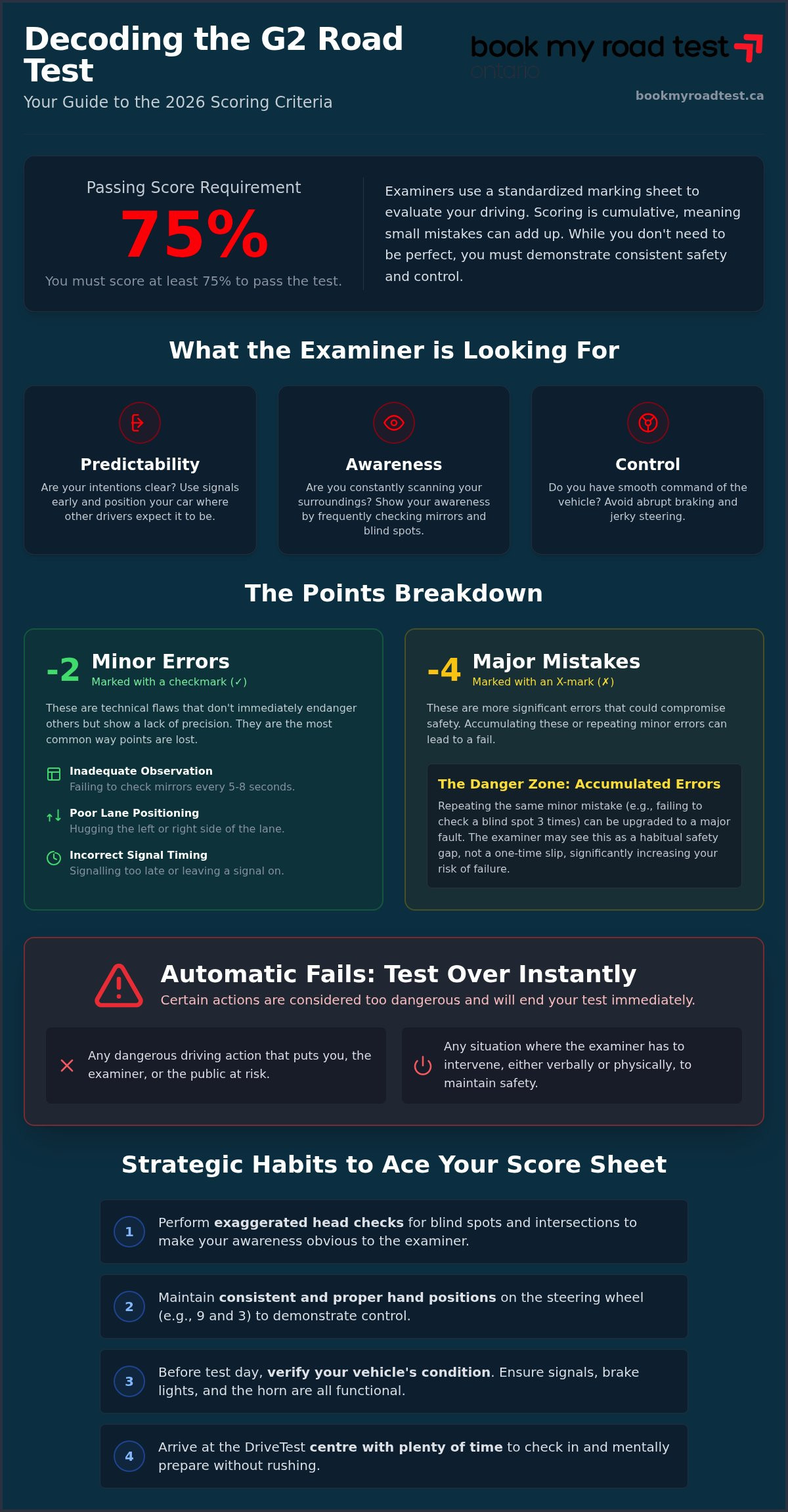
The G2 road test isn't a subjective guessing game. Examiners use a standardized marking sheet to ensure every applicant is treated fairly across all DriveTest centres. This system removes personal bias, focusing instead on objective, observable actions. Understanding the g2 test scoring criteria helps you realize you're being evaluated on two main fronts: specific manoeuvres like parallel parking and your general driving habits throughout the session.
Scoring is cumulative, which means that while a single small mistake won't usually disqualify you, these minor errors add up quickly. However, certain major errors result in an immediate end to the test. The g2 test scoring criteria function as a balance of technical vehicle handling and consistent safety observation. You don't need to be a perfect driver to pass, but you must demonstrate that you aren't a risk to yourself or others.
The Purpose of the Level Two Evaluation
This stage is a critical part of Ontario's graduated licensing system. It moves beyond the basic knowledge of the G1 and tests your ability to handle a vehicle independently. Examiners watch how you interact with other road users in real-world settings, such as busy residential streets and commercial business sections. They need to see that you can manage a car safely without a co-driver present to guide your decisions. Successfully passing this evaluation proves you've mastered the advanced skills required to drive on most roads without supervision.
What the Examiner is Actually Looking For
The examiner isn't looking for professional-level precision; they're looking for safety and confidence. They prioritize three core pillars during your 20-minute drive:
- Predictability: Are your intentions clear to other drivers? This means using signals early and positioning your car where others expect it to be.
- Awareness: Are you constantly scanning your environment? You must show that you're aware of your surroundings by checking mirrors and blind spots frequently.
- Control: Do you have smooth command over the steering, braking, and acceleration? Abrupt braking or jerky steering suggests a lack of confidence and can lead to point deductions.
By focusing on these three areas, you align your driving with the logic of the marking sheet. This approach helps you stay calm, knowing exactly what counts toward your final score. When you demonstrate steady control and clear awareness, the examiner feels safe in the vehicle, which is the ultimate goal of the test.
Minor Errors vs. Major Mistakes: The Points Breakdown
The examiner's marking sheet uses two distinct symbols to track your performance: checkmarks for minor errors and X-marks for major mistakes. Understanding the g2 test scoring criteria means knowing how these points accumulate against your final grade. In 2026, you need a score of at least 75% to pass. Since minor errors result in a 2-point deduction and major errors cost 4 points, your margin for error is narrower than it looks. Most students don't fail during the big manoeuvres like parallel parking; they lose their licence during the "driving along" portions of the test where small habits are scrutinized.
These "driving along" errors are the most common way points slip away. They occur during the stretches between specific tasks when you might let your guard down. If you're consistently making small mistakes, the examiner sees a pattern of unsafe habits rather than a one-time slip-up. Once you feel confident in your ability to manage these points, you can find a road test appointment through a third-party service to avoid long wait times.
Common Minor Point Deductions
Minor errors are technical flaws that don't immediately endanger other road users but show a lack of precision. Examiners frequently deduct points for the following:
- Inadequate observation: Failing to check your mirrors every 5 to 8 seconds is a frequent mistake.
- Poor lane positioning: Hugging the left or right side of the lane too closely suggests poor vehicle control.
- Signal timing: Signalling too late or leaving the signal on after completing a turn or lane change.
Accumulated Errors: The Danger Zone
Repeating the same minor mistake can lead to a failure even if you never commit a major violation. If you fail to check your blind spot three times, the examiner may stop viewing it as a minor slip and start seeing it as a habitual safety gap. This pattern often moves you into the "danger zone" on the score sheet.
Balance is key here. Examiners look for a middle ground between hesitation and aggressiveness. If you wait too long at a clear intersection, you'll lose points for impeding traffic. Conversely, being too bold can lead to major deductions. Interestingly, examiners might show slight leniency in poor weather conditions, such as heavy rain or snow, provided you maintain safety and adjust your speed appropriately. They want to see that you can adapt your skills to the environment while following the core rules of the road.
Automatic Fails: What Ends Your Test Instantly
While most errors result in a point deduction, some actions are so serious they stop the evaluation immediately. These disqualifying actions are non-negotiable safety violations. If an examiner feels the need to intervene by touching the steering wheel or applying the brake, the test is over. This intervention means you've put the vehicle in a position where the examiner had to take control to prevent a hazard. Traffic law violations are equally strict. Speeding, even by a few kilometres per hour, or failing to come to a complete stop at a red light or stop sign will result in an instant failure. These rules are a core part of the g2 test scoring criteria, ensuring that only drivers who can follow the law under pressure earn their licence.
Dangerous actions that force other drivers to take evasive manoeuvres also trigger an automatic fail. If a driver has to slam on their brakes or swerve because of your lane change, you haven't demonstrated the required safety standards. Examiners are also trained to watch for unsafe actions at railway crossings, which is a specific automatic fail trigger in 2026. Knowing these "red lines" helps you prioritize safety over everything else during your drive.
The "Big Five" Disqualifying Actions
Most automatic failures fall into five specific categories. Understanding these helps you avoid the most common pitfalls that end a test prematurely:
- Collision: Any contact with another vehicle, a pedestrian, or a fixed object like a pole or pylon.
- Dangerous Manoeuvre: Turning directly into the path of oncoming traffic or pulling out from a curb without looking.
- Violation of Law: Failing to stop for a school bus with its lights flashing or ignoring an emergency vehicle with sirens on.
- Inability to Perform: Failing to complete a basic task, such as a three-point turn, after multiple attempts suggests you aren't ready for the road.
- Dangerous Position: Stopping your vehicle in the middle of an intersection or on a railway crossing.
Misconceptions About Automatic Fails
Many students worry that a single small mistake will end their test, but that isn't always the case. For example, hitting a curb during parallel parking is a common concern. The g2 test scoring criteria distinguish between "touching" and "mounting." If your tyre gently brushes the curb, it's typically a minor deduction. However, if the car climbs up onto the curb, it's an automatic fail.
Similarly, stalling a manual transmission vehicle isn't an instant fail unless it happens in a dangerous location, like a busy intersection, and you can't restart the car quickly. There is also a persistent myth that examiners will ask you to do something illegal to "test" you. This is false. Examiners will never ask you to break the law. If they give an instruction that seems unclear, it's usually a test of your ability to find a safe way to execute a legal manoeuvre, not a trick to make you fail.
Strategic Habits to Ace Your Score Sheet
Passing your road test requires more than just following the rules; it requires making your safety visible to the person sitting beside you. Building habits that align with the g2 test scoring criteria is about removing any doubt from the examiner's mind. One of the most effective strategies is the "exaggerated head check." Since examiners can't always see your eye movements, you should physically turn your head to look at your mirrors and blind spots. These theatrical habits satisfy the g2 test scoring criteria for observation by ensuring the examiner records every scan you make.
Maintaining two-handed steering is another non-negotiable habit. You should keep your hands in the 9-and-3 or 10-and-2 position at all times, except when shifting or using signals. Avoid the temptation to "palm" the wheel during turns, as this suggests a lack of control. You can also use verbalization to your advantage. Briefly explaining your actions, like saying "waiting for that pedestrian to clear," shows the examiner you're aware of your surroundings. Once you've mastered these habits, you can book your road test appointment to put your skills to the test.
Mastering Intersections and Turns
Intersections are where many applicants lose points due to poor scanning habits. You must perform a "left-right-left" scan every time you approach an intersection, even if you have the green light. This shows you're checking for red-light runners or pedestrians. Proper blind spot checks are equally vital. You must perform a clear over-the-shoulder look before every lane change or turn. Finally, always turn into the correct lane. Turning from the left lane into the right lane is the number one technical error on turns and results in an immediate point deduction on your score sheet.
Residential and Business Driving Logic
Your speed management in residential and business areas tells the examiner how well you respect the environment. Aim to stay exactly at the limit or 1 to 2 kilometres per hour below it. Never go even slightly over. You also need to demonstrate clear right-of-way etiquette. Knowing when to go and when to wait without hesitating shows you understand the flow of traffic. Be especially vigilant in school zones and construction areas. Identifying these signs and adjusting your speed immediately proves you're scanning for hazards and reacting to changing road conditions before they become a problem.
Securing Your Appointment and Final Preparation
Once you've mastered the habits required to satisfy the g2 test scoring criteria, the final step is ensuring you actually have a chance to show them off. Many students find that the logistical challenge of finding an open slot is more difficult than the drive itself. High demand often leads to months of waiting, which can cause your skills to get rusty. Using a third-party booking service can help you find a last minute road test cancellation Ontario drivers often miss. This allows you to jump into a session while your training is still fresh in your mind.
On the day of your test, arrive at the DriveTest centre at least 30 minutes early. This gives you enough time to check in at the kiosk and settle your nerves. If you arrive late, you risk losing your fee and your spot. Remember that your vehicle must also meet strict standards. If your car isn't in good working order, the examiner will cancel the test before you even leave the parking lot.
Pre-Test Vehicle Checklist
Examiners perform a quick safety inspection before they get into the car. Your vehicle must be roadworthy and safe for both of you. Ensure the following are functional:
- Brake lights and turn signals: Check both the front and back of the vehicle.
- Horn and windshield wipers: These must work regardless of the weather.
- Tires: Ensure they have adequate tread and aren't visibly underinflated.
- Fuel or battery: Have enough charge for a 20 to 30-minute drive plus idling time.
The Final Mental Reset
Your mindset during the evaluation is just as important as your technical skill. Try to treat the examiner like a human GPS. Listen to their directions clearly, and don't spend your mental energy overthinking the "why" behind their instructions. If you make a mistake, don't let it derail your entire session. A single slip-up during a manoeuvre might only be a minor deduction according to the g2 test scoring criteria. Keep your focus on the road ahead rather than the mistake behind you. If you're ready to secure your G2 road test appointment today, taking the leap is the best way to move toward your full licence.
Ready to Earn Your G2 Licence?
Mastering the g2 test scoring criteria is about more than just driving; it's about proving your safety habits to the examiner. You now know how to distinguish between minor point deductions and the automatic fails that end a session. By practicing exaggerated head checks and maintaining smooth vehicle control, you'll walk into your test with a clear plan for success. Confidence comes from knowing exactly what the marking sheet requires.
Don't let long wait times stall your progress. Our independent booking experts serve all of Ontario and can help you skip the months-long backlog. Find a G2 Road Test Appointment Faster and get on the road sooner. You've put in the work to understand the system. Now, it's time to drive with confidence and secure your independence.
Frequently Asked Questions
How many points can you lose on the G2 test in Ontario?
You must achieve a minimum score of 75% to pass your evaluation. The g2 test scoring criteria assign different weights to errors; minor mistakes deduct 2 points, while major errors deduct 4 points. If your total deductions exceed 25% of the possible score, you won't pass. Keeping track of these points is less important than maintaining consistent safety habits throughout the session. Focus on steady driving to keep your deductions well below the limit.
Is parallel parking an automatic fail if you hit the curb?
Touching the curb during parallel parking is generally a minor error, not an automatic fail. However, if your vehicle "mounts" the curb by placing the full weight of a tyre on top of it, the examiner will end the test immediately. You have three attempts to complete the manoeuvre safely. As long as you don't hit other cars or create a hazard, a slight curb brush won't stop you from earning your licence.
What are the most common reasons for failing the G2 road test?
Most applicants fail due to poor observation habits rather than technical parking mistakes. Failing to check your blind spots before lane changes or neglecting to scan intersections are top reasons for deductions. Other common issues include poor speed management, such as driving too slowly for traffic conditions, and failing to yield the right-of-way to pedestrians. Demonstrating clear awareness of your surroundings is the best way to satisfy the g2 test scoring criteria.
Can I use a backup camera during my G2 road test?
You are allowed to have a backup camera in your vehicle, but you cannot rely on it as your primary source of information. Examiners expect you to perform physical head checks and use your mirrors while reversing. If you stare only at the camera screen during a manoeuvre like parallel parking, you will lose points for inadequate observation. Use the technology as a secondary aid while keeping your primary focus on the world outside your windows.
Do I have to go on the highway for my G2 test?
No, the G2 road test evaluates your skills on city streets and residential roads rather than 400-series highways. You will be tested on your ability to manage intersections, perform roadside stops, and navigate business areas. Highway driving is reserved for the final G road test. This allows you to gain a year of experience on local roads before you're required to demonstrate high-speed merging and lane-changing skills for your full licence.
What happens if I fail my G2 road test?
If you don't pass, you'll need to wait a minimum of 10 days before you can attempt the test again. You will also have to pay a retake fee to secure a new appointment. Use this time to review the feedback on your score sheet and practice the specific manoeuvres where you lost points. Since wait times can be long, it's helpful to look for cancellations as soon as your eligibility window opens again to avoid a long delay.
How long is the G2 road test in 2026?
The G2 road test typically lasts between 20 and 30 minutes. This timeframe includes the initial vehicle safety check and the actual driving portion through local residential and business sectors. The examiner uses this window to observe your habits across various traffic situations. While the test is relatively short, it's designed to be intensive. You must maintain high levels of concentration and safety observation from the moment you leave the parking spot until you return.
Can I take the G2 test in my own car?
Yes, you can use your own vehicle for the test as long as it meets all provincial safety requirements. The car must have working lights, signals, and a functional horn. It should also be clean and free of any obstructions that could hinder the examiner's view. If your car is deemed unroadworthy during the pre-test inspection, the examiner will cancel the session. Ensure your insurance and registration are up to date before you arrive at the centre.


