

What if the secret to passing your road test isn't about being a perfect driver, but about proving you aren't a risky one? Many drivers feel a wave of anxiety when they see an examiner clutching a marking sheet. It’s natural to worry that one small mistake or a slightly wide turn will end your chances of earning your full licence, especially if you're facing a looming expiry date. You can breathe easier once you understand how is the ontario g test scored and what the 2026 marking scheme actually requires.
We’ll clarify the current status of the modified G test so you don't spend hours practicing parallel parking if it isn't on the exam. This guide breaks down the difference between minor point deductions and the errors that lead to an instant fail. You will learn to demonstrate the specific highway merging and observation habits that examiners prioritize. By the end, you’ll have a clear roadmap to pass on your first attempt and secure your G licence with confidence.
Key Takeaways
- Understand how is the ontario g test scored using a competency-based system that evaluates your safety profile rather than just a simple numerical grade.
- Identify the five core driving domains examiners watch for, including specific observation habits that often catch drivers off guard.
- Learn the difference between minor point deductions and the "instant fail" mistakes that can end your road test immediately.
- Clarify the 2026 status of the modified G test to focus your practice on high-speed highway merging and lane changes.
- Discover the most effective ways to prepare for your assessment and secure a booking before your G2 licence expires.
Understanding the Ontario G Road Test Assessment Framework
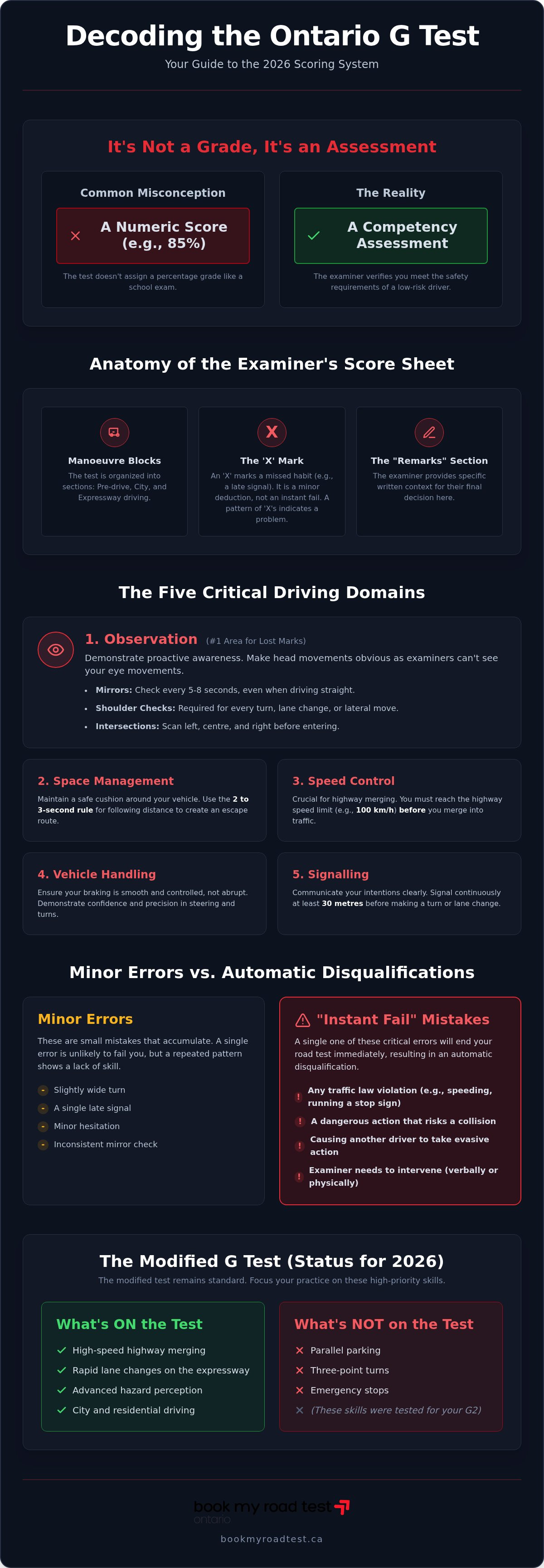
Many drivers enter the DriveTest centre expecting a numeric grade, similar to a high school math test. However, the reality of how is the ontario g test scored is quite different. It's a competency-based assessment. This means the examiner isn't looking to give you an 85% or a 92%. Instead, they use a standardized score sheet to track whether your driving habits meet the safety requirements for a fully licensed driver. Within the Ontario graduated licensing system, the G test serves as the final validation of your ability to handle advanced skills like high-speed highway driving, rapid lane changes, and complex hazard perception.
The G test marking scheme is a cumulative record of your driving habits that determines if you can consistently manage a vehicle without endangering yourself or others.
The Anatomy of the Examiner’s Score Sheet
The examiner's sheet is organized into specific manoeuvre blocks: Pre-drive, City, and Expressway. Each block contains a list of required actions, such as mirror checks or signalling. When you fail to perform a habit correctly, the examiner places an "X" in the corresponding box. It's a common mistake to think one "X" means you've failed. In reality, these marks identify missed habits rather than instant disqualifications. A single "X" for a late signal is a minor deduction, but a cluster of them in the same category shows a pattern of poor driving. The "Remarks" section at the bottom is where the examiner notes specific reasons for your result, providing context that a simple checkmark cannot.
Objective vs. Subjective Grading
The scoring system blends objective facts with subjective observations. Objective marks are straightforward. Did you stop fully at the line? Did you signal? These are yes-or-no questions. Subjective marks are more nuanced. The examiner must decide if your blind spot check was "effective" or if your following distance was "safe." Because examiners can't see your eyes through sunglasses, "theatrical" head movements are a practical necessity. You need to make it obvious that you're scanning the road. If the examiner doesn't see your head move, they'll assume you didn't look, resulting in an "Unsatisfactory" mark for observation. Conversely, consistent checking and smooth execution earn you a "Satisfactory" result. Understanding how is the ontario g test scored helps you realize that the visibility of your actions is just as important as the actions themselves.
The Five Critical Driving Domains Evaluated by Examiners
To truly grasp how is the ontario g test scored, you need to look at the five pillars of safe driving. Examiners use these categories to organize their feedback and determine your overall competency behind the wheel. The five domains include observation, space management, speed control, vehicle handling, and signalling. Each category represents a different aspect of your interaction with the road and other drivers. Mastering these areas ensures you project the image of a low-risk driver during your evaluation and helps you avoid the common pitfalls that lead to an unsatisfactory result.
Observation: The #1 Area Where Drivers Lose Marks
Observation is the primary area where most candidates lose marks. Examiners want to see a proactive "life-saver" look throughout the entire drive. You're expected to check your mirrors every 5 to 8 seconds, even when driving straight. This shows you're monitoring your environment and anticipating changes in traffic. A shoulder check is required for every turn, lane change, or lateral movement to cover your blind spots. When approaching an intersection, you must scan left, centre, and right to ensure the path is clear before entering. Because examiners can't always see your eyes, you should use clear head movements to make these checks obvious.
Highway Merging and Speed Management
The modified G test remains the standard across Ontario centres in 2026. This version prioritizes high-speed skills because basic tasks like parallel parking and three-point turns were already covered in your G2 exam. One of the most critical scoring criteria is your performance on the acceleration lane. You must reach the highway speed limit, typically 100 km/h, before you merge into traffic. Merging at a lower speed is considered a hazard and will negatively impact your score. Once you've joined the flow of traffic, maintain a safe gap using the 2 to 3 second rule. This space management gives you a vital escape route if the car ahead brakes suddenly. Always stay in the right lane unless you're passing another vehicle or preparing for a highway exit.
Vehicle handling and communication are the final pieces of the puzzle. Your braking should be smooth and controlled rather than abrupt. Signalling must happen at least 30 metres before a turn to give other drivers enough time to react. If you've practiced these skills and understand how is the ontario g test scored, the next step is to secure a road test appointment that fits your schedule. Being prepared for the scoring criteria is half the battle; the other half is getting your date locked in before your G2 licence expires.
Minor Errors vs. Major Mistakes: How Many Can You Make?
You don't need a perfect drive to earn your full licence. Understanding how is the ontario g test scored helps you realize there's room for small slip-ups, provided they don't compromise safety. Minor errors are small infractions, such as a slightly wide turn or a signal that starts a second too late. While one or two won't fail you, they add up. Generally, if you accumulate more than 15 to 30 minor errors, depending on the specific centre's criteria, you'll receive an unsatisfactory result. Major mistakes are more serious. These show a lack of control, like mounting a curb or failing to yield when it's safe to do so. Even if no accident occurs, these errors weigh heavily on your score sheet and often lead to an immediate failure.
Accumulated Errors: The "Death by a Thousand Cuts"
Repeated minor mistakes are a red flag for examiners. If you miss one mirror check, it's a slip. If you miss three, it's a habit. Examiners look for patterns. If they see a "cluster" of errors in one domain, such as observation, they may fail you even if your total error count is relatively low. Common minor error traps include:
- Steering Technique: Shuffling your hands too slowly or losing smooth control during a turn.
- Signal Timing: Turning off your signal too early or forgetting to cancel it after a lane change.
- Stop Line Positioning: Stopping slightly over the white line rather than behind it.
If you realize you've made a mistake, don't dwell on it. Take a deep breath and focus on the next move. One wide turn won't end the test, but losing your focus because of it certainly will.
The Subjective Pass/Fail Threshold
Much of how is the ontario g test scored comes down to the examiner's impression of your defensive driving mindset. They want to see that you're in command of the vehicle and the situation. Sometimes, being too cautious is just as bad as being aggressive. For example, if you stop at an intersection when you clearly have the right of way, you're being unpredictable. This confuses other drivers and will result in a deduction for poor space management or impeding traffic. Confidence is communicated through smooth operation. If you brake gently and accelerate decisively, you signal to the examiner that you're ready for the responsibilities of a full G licence. Balancing safety with the natural flow of traffic is the key to staying below the failure threshold.
Automatic Disqualifications: The Instant Fails You Must Avoid
While accumulating minor points is a slow path to failure, automatic disqualifications end your attempt immediately. These "instant fails" occur when a driver commits a high-risk action that compromises road safety. Understanding how is the ontario g test scored requires you to identify these non-negotiable rules before you even pull out of the DriveTest parking lot. In many cases, these errors aren't just about poor driving habits; they are direct violations of the Highway Traffic Act or demonstrations of a complete lack of vehicle control.
The "Traffic Violation" Category
The most common instant fails involve basic traffic laws that drivers often get lazy with in their daily lives. During a test, there is zero room for error. A "rolling" right turn on a red light is an automatic disqualification. You must come to a complete, motionless stop before the line. Similarly, the "California Roll" at a stop sign will result in an immediate fail. Other critical violations include:
- Yellow Light Decisions: Failing to stop for a yellow light when you had ample time and distance to do so safely.
- Failing to Yield: Forcing a pedestrian to wait or another vehicle to change its course because you didn't respect right-of-way rules.
- Speeding: Exceeding the posted limit by even 5 km/h is a violation of the law and results in a fail, regardless of the traffic flow.
Dangerous Actions and Examiner Intervention
Examiners are trained to prioritize safety above all else. If your actions put the vehicle, the examiner, or other road users in jeopardy, the test ends. This includes mounting a curb during any manoeuver. While a light "brush" against the curb might only be a minor deduction, putting the tire up on the concrete shows a lack of steering precision. You must also ensure your lane changes and merges are seamless. If you force another driver to brake or swerve because of a poorly timed move, you have failed the assessment.
Examiner intervention is the most common cause of instant failure.
This occurs whenever the examiner has to physically grab the steering wheel or verbally command you to stop to avoid a hazard. Finally, involvement in any collision that was preventable will end the test, even if you weren't the primary party at fault. Demonstrating that you can handle these high-pressure moments without intervention is the only way to secure your full licence. Once you feel ready to navigate these challenges, you should book your road test appointment through a reliable service to avoid long wait times. Knowing how is the ontario g test scored gives you the mental edge needed to stay calm and follow the rules to the letter.
Preparing for Success and Securing Your G Test Appointment
Preparation is the most effective way to manage the anxiety of a road test. While you now understand how is the ontario g test scored, applying that knowledge in real-time requires practice. One of the best strategies is conducting a "mock test" with a licensed driving instructor. They can use a replica of the examiner’s score sheet to identify exactly where you might receive "X" marks for missed habits. This allows you to correct your observation or steering techniques before they become a reason for failure on your official attempt.
Beyond your driving skills, you must ensure your vehicle is in top mechanical condition. DriveTest examiners will cancel your appointment immediately if your brake lights or signals aren't working, or if you have significant windshield cracks that obstruct your view. Reviewing the official MTO Driver’s Handbook is also vital for refreshing your knowledge of specific right-of-way rules. It’s a good idea to book your test several months before your G2 licence expiry date. This buffer ensures that if you don't pass on your first try, you still have time to secure a second attempt before your licence becomes invalid.
Final Checklist for Test Day
Success on test day starts with a smooth check-in process. You must bring your physical G2 licence and have your confirmation details ready. Arriving at the centre at least 30 minutes early is essential. This gives you time to find a parking spot, register at the kiosk, and settle your nerves. Mental preparation is just as important as physical practice. By arriving early and being organized, you reduce the stress that often leads to "rookie" mistakes, such as forgetting a blind spot check or failing to signal a turn.
Beating the Wait Times for a G Road Test
For many drivers, finding an available slot is the most difficult part of the entire process. High demand often leads to long wait times, which can be stressful if your licence is nearing its expiry. Staying flexible with your dates and times is key to getting your Full G licence sooner. If you're struggling to find an opening, using a road test booking service can be a game-changer. These services specialize in finding and securing cancellations, helping you bypass the standard backlog. Once you've mastered the details of how is the ontario g test scored, getting that appointment confirmed is the final step toward driving with total independence.
Drive with Confidence and Earn Your Full Licence
Mastering the rules of the road is only half the battle. You now know that the competency-based marking scheme prioritizes your safety profile over a simple numeric grade. By focusing on consistent observation habits and smooth highway merging, you can avoid the minor error clusters that lead to failure. Understanding how is the ontario g test scored gives you the clarity needed to stay calm when the examiner starts marking their sheet.
Once you've refined your driving habits, the final step is getting behind the wheel for your evaluation. Secure your G road test appointment today with our booking service. Our independent platform helps you quickly find cancellation slots, saving you from the stress of constant manual searching. We provide a reliable way to get your date locked in before your G2 licence expires. This ensures you don't have to start the graduated licensing process from the beginning.
You have the knowledge and the skills. Now it's time to get on the road and prove it. Good luck on your test.
Frequently Asked Questions
How many mistakes are allowed on the G test in Ontario?
Generally, you can make between 15 and 30 minor errors before failing your test. However, this threshold depends on the specific centre and whether your mistakes are clustered in one category. If you repeat the same minor error three or more times, it shows a lack of habit and may lead to failure. Any major error or dangerous action results in an immediate fail regardless of your total points.
Does the G test still have parallel parking in 2026?
No, the G road test remains modified in 2026 and does not include parallel parking, roadside stops, or three-point turns. These manoeuvres were already evaluated during your G2 test. The current format focuses strictly on advanced skills like highway merging and lane changes at high speeds. This streamlined version was kept to help DriveTest centres manage high demand and reduce wait times for all Ontario drivers.
What is the most common reason for failing the G road test?
Poor observation is the most frequent cause of failure for most candidates. Many drivers lose marks because they don't check their mirrors every 5 to 8 seconds or they forget to perform a shoulder check before moving laterally. Knowing how is the ontario g test scored helps you prioritize intersection scanning. You must clearly move your head left, centre, and right to prove to the examiner that you are scanning for hazards.
Can I fail the G test for speeding just a little bit?
Yes, speeding is considered a violation of the Highway Traffic Act and typically results in an automatic failure. Even exceeding the limit by 5 km/h is enough for an examiner to disqualify you. You are expected to maintain a steady speed that matches the flow of traffic without breaking the law. On the highway, reach the posted limit in the acceleration lane before merging, then stay exactly at that limit.
What happens if I fail my G test and my G2 is about to expire?
If your G2 licence expires, you lose your driving privileges and must start the licensing process again from the G1 stage. To avoid this risk, you should book your test several months before the expiry date. If you fail with only a few weeks left, finding a new slot through a booking service is the most effective way to secure a retake. This helps you avoid the stress of a total licence expiry.
How long do I have to wait to retake the G test if I fail?
You must wait at least 10 days before you can attempt the G road test again. This mandatory waiting period gives you time to practice the specific skills mentioned in your examiner's remarks. While you can log in and book a new date immediately after failing, the system won't allow a test date within that 10-day window. Due to high demand, you may need to look for cancellation slots to get a date quickly.
Do I need to bring my own car for the G road test?
Yes, you are responsible for providing a vehicle in good working order for your assessment. The examiner will perform a basic safety check before the test begins. Your vehicle must have functioning brake lights, turn signals, and a clean windshield without major cracks. It should also be properly insured and registered. If your vehicle fails this pre-drive inspection, your test will be cancelled and you will lose your booking fee.
Is the G test harder than the G2 test?
The G test isn't necessarily harder, but it evaluates more advanced driving environments. While the G2 test focuses on basic vehicle control in residential areas, the G test assesses your ability to handle high-speed highways. Understanding how is the ontario g test scored helps you realize the focus shifts toward space management and merging. If you are comfortable driving at 100 km/h and maintain strong observation habits, you should find the test manageable.


