

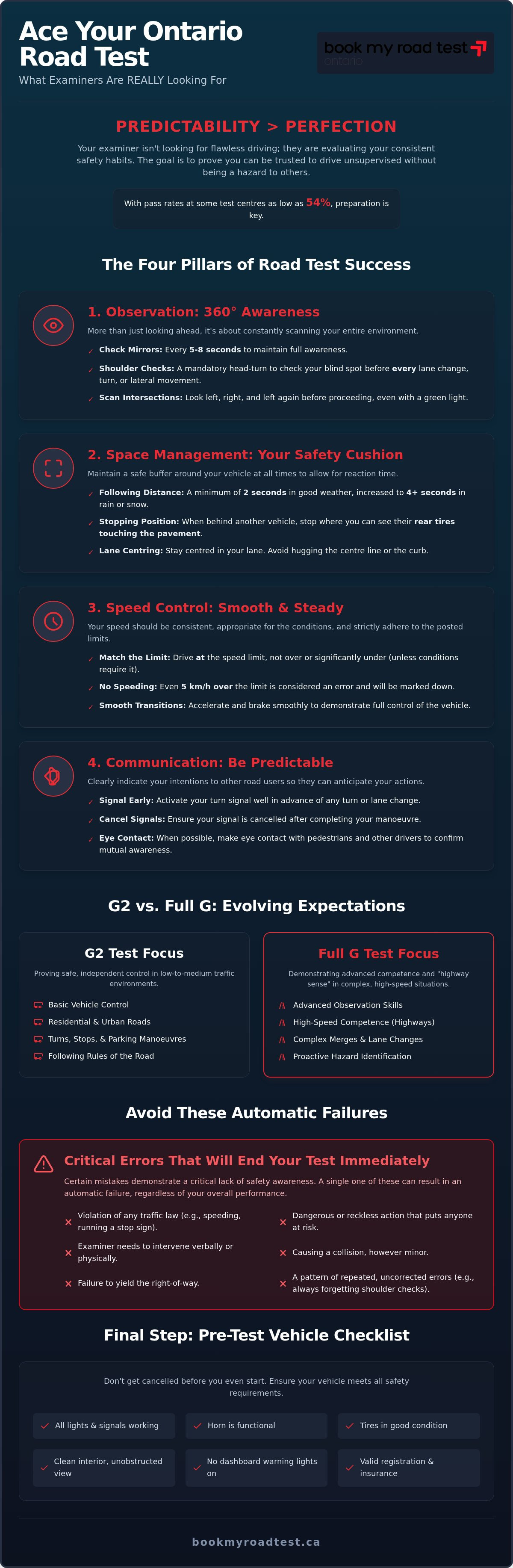
Your driving examiner isn't looking for a perfect driver; they're looking for a predictable one. Most candidates walk into their appointment assuming they need to demonstrate flawless mechanical precision to pass. However, when you ask what do driving examiners look for, the reality is that they're scanning for consistent safety habits that prove you won't be a hazard once you're driving solo. They want to see that you're aware of your surroundings, checking your mirrors constantly, and in full control of your vehicle at every intersection.
We know how stressful this process feels. With pass rates at some test locations sitting as low as 54 percent, the fear of failing and waiting months for a re-test is a valid concern. It's frustrating when marking criteria feel vague, leaving you worried about every small move you make. This article will give you the clarity you need by identifying the exact technical skills examiners prioritize. We'll provide a clear checklist of what to do, explain the difference between minor mistakes and automatic failures, and help you prepare for the logistical side of the day so you can head to the test centre with total confidence.
Key Takeaways
- Understand that examiners prioritize predictable safety habits over mechanical perfection to ensure you are ready for unsupervised driving.
- Learn exactly what do driving examiners look for by mastering the four pillars of success: observation, space management, speed control, and communication.
- Identify the threshold for point deductions and the specific major errors that lead to an automatic test failure.
- Discover how to project confidence and avoid dangerous hesitation so the examiner feels secure throughout the evaluation.
- Streamline your test day logistics by ensuring your vehicle meets all safety requirements to prevent an administrative cancellation.
What is the Goal of a Canadian Road Test?
The Canadian road test often feels like a high-stakes performance where one wrong move ends your dreams of driving freedom. In reality, it's a safety evaluation designed to protect everyone on the road. When you ask what do driving examiners look for, they aren't scanning for a driver who can parallel park with millimetre precision. They're looking for someone who can navigate a busy intersection without causing a heart attack for the person in the passenger seat.
Examiners prioritize predictability above all else. If other drivers can easily anticipate your next move because you use your signals and maintain a steady pace, you're already halfway to passing. Road readiness is the demonstration of safe, legal, and confident vehicle control in real-world traffic. This means you can handle a car without someone else telling you when to brake or check your blind spot. While many driving test components focus on specific manoeuvres, the ultimate goal is to prove you can be trusted to drive unsupervised.
The Examiner’s Role and Mindset
Examiners act as the final gatekeepers of public safety. They aren't out to get you or looking for reasons to fail you; they're simply trained to identify driving patterns. While a single minor wobble might not fail you, a recurring habit of forgetting your shoulder checks signals a lack of awareness. They want to see that your safety habits are second nature rather than forced for the sake of the test.
The first five minutes of your drive are vital. This is when you establish a professional rapport and show you're in control. If you arrive with a clean vehicle and follow the initial instructions calmly, the examiner starts the drive feeling relaxed. A relaxed examiner is much easier to drive with than one who is constantly reaching for their clipboard to mark down errors.
The Difference Between G2 and G Requirements
Expectations change as you move through the graduated licensing system. For a G2 test, the focus remains on basic vehicle control and following the rules of the road in residential areas. You'll need to show you can handle turns, stops, and basic parking. It's about proving you've moved past the learner stage and can handle a car safely on your own in low-to-medium traffic volumes.
The full G test is more demanding. At this stage, what do driving examiners look for shifts toward advanced observation and high-speed competence. Examiners expect you to handle complex highway merges at the correct speed and demonstrate "highway sense" by keeping a safe following distance. The criteria for observation become much more rigorous because the stakes are significantly higher at 100 km/h. You must show that you're constantly scanning your environment and reacting to hazards before they become dangerous.
The Four Pillars of Road Test Success
Success on your road test isn't about one single manoeuvre. It's about how four core pillars work together: Observation, Space Management, Speed Control, and Communication. Understanding what do driving examiners look for starts with these elements. They interact to create your "safety profile." If your observation is weak, your space management will naturally suffer because you aren't seeing hazards early enough to react. Consistency across all four areas is what convinces an examiner you're a safe driver who can handle the what to expect on your road test experience with ease.
Observation: More Than Just Looking
Observation requires 360-degree awareness. You need to check your mirrors every 5 to 8 seconds and scan intersections thoroughly before entering. The shoulder check is where most candidates lose points. It's a quick look over your shoulder into the blind spot before any lateral move, like a lane change or a right turn. Examiners need to see you doing this. A helpful tip is to wear a baseball cap; the movement of the brim makes your head turns much more obvious to the person in the passenger seat. Once you've mastered these habits, you can book your road test and focus on showing off your skills.
Space Management and Space Cushions
You must maintain a "space cushion" around your vehicle at all times. Follow the two-second rule in good weather, but increase it to four seconds if it's raining or snowing. When stopping behind another vehicle at a red light, ensure you can see their rear tires touching the pavement. This gives you enough room to pull out safely if they stall or break down. Proper lane positioning is also vital. Avoid "hugging" the centre line or the curb; stay centred in your lane to give yourself the most room to react to unexpected obstacles or pedestrians.
Speed Control and Communication
Speed control means staying exactly at the posted limit. Driving 5 km/h over is an error, but driving 10 km/h under can be just as dangerous if it impedes the flow of traffic. Communication is your way of telling other drivers your plans. Use your signals at least 30 metres before a turn to give others time to react. Smoothness is also a key indicator of vehicle mastery. Jerky braking or aggressive acceleration suggests you aren't yet comfortable with the car. When pondering what do driving examiners look for, remember they want to see you communicating clearly and controlling the vehicle with confidence.
Common Mistakes and Automatic Failures
Understanding the marking sheet is the best way to calm your nerves before your appointment. Canadian road tests distinguish between minor errors and major disqualifications. Minor errors are point deductions for small mistakes like poor hand position or a slightly wide turn. If you accumulate too many of these points, usually exceeding 30 depending on your province, you'll fail. However, a major error ends the test immediately. An automatic failure, or disqualification, occurs when a driver commits a dangerous action, violates a traffic law, or requires the examiner to intervene.
When considering what do driving examiners look for, they are specifically watching for high-risk behaviours that jeopardize public safety. Here are the top five most common reasons for automatic failure in Canada:
- Failing to yield the right-of-way to pedestrians or other vehicles.
- Committing a traffic law violation, such as a rolling stop.
- Mounting the curb with a wheel during any manoeuvre.
- Requiring the examiner to take physical or verbal control of the car.
- Involvement in a collision, regardless of who is at fault.
Dangerous Actions and Interventions
An examiner intervention is a clear sign that the drive has become unsafe. This happens if the examiner has to grab the steering wheel or use the passenger-side brake to prevent a hazard. Physical interventions are rare but conclusive. Verbal interventions, where the examiner must give a command to avoid a dangerous situation, also count as a fail. These actions prove that the student isn't yet ready for the responsibility of a solo licence.
Mounting the curb is another frequent disqualifier. While touching the curb during a parallel park might only be a minor deduction, putting a tire fully on top of the sidewalk is seen as a loss of vehicle control. Similarly, a near-miss scenario, where you force another driver to brake or swerve because you failed to yield, shows a lack of awareness. For more detail on these specific scoring criteria, you can consult Alberta's official road test guide.
Traffic Law Violations
Traffic laws are non-negotiable during your evaluation. The "rolling stop" is perhaps the most common trap for learners. You must feel the vehicle's weight shift back as it comes to a complete halt behind the stop line. Simply slowing down to a crawl is a violation that leads to an immediate fail. Consistency in following these rules is a huge part of what do driving examiners look for during the session.
Speeding is equally critical. You must never exceed the limit in school zones or construction areas. These zones often have lower limits that are strictly enforced. Disregarding traffic lights, turning right on a red without a full stop, or crossing a solid white line will also result in a disqualification. These rules ensure that every driver remains predictable and safe on the road.
Demonstrating Confidence and Road Readiness
Confidence is more than just knowing how to operate the pedals. It's about projecting an aura of being in control of your vehicle and your environment. Examiners are essentially passengers in your car; if they feel nervous, you aren't doing your job. When people wonder what do driving examiners look for, they often forget the psychological impact of their driving style. Smooth acceleration and decisive steering tell the examiner you've practiced enough to make these actions second nature. If you're feeling ready to show these skills, you can secure your road test date and start your final preparations.
Hesitation is a common pitfall for nervous drivers. While being cautious is good, being overly timid creates a hazard. If you have the right of way but refuse to take it, you're being unpredictable. Unpredictability causes other drivers to make risky moves to get around you. If you find yourself in a tricky situation where a manoeuvre feels unsafe, don't force it. It's better to wait for a clear opening and calmly mention your reasoning. This shows the examiner that you're prioritizing safety over speed and that you're thinking like a seasoned driver.
Physical Cues for the Examiner
Your body language tells a story before you even leave the parking lot. Sit upright and keep your hands at 9-and-3 or 10-and-2. This position offers the most control during a sudden turn. Active scanning is vital. Don't just stare straight ahead. Even on a green light, glance left and right to ensure no one is running a red. Use your eyes to search for cyclists or pedestrians tucked behind parked cars. Showing this level of awareness proves you're ready for the responsibility of a licence. What do driving examiners look for is often as simple as seeing your head move to check your surroundings.
Handling Manoeuvres with Poise
Manoeuvres are where nerves often peak. For parallel parking, examiners value the process over a perfectly straight finish. They want to see your signal, your 360-degree checks, and your use of mirrors. If you end up slightly crooked but followed every safety step, you'll likely pass that section. During a three-point turn, perform a full observation before every move. For an emergency stop, pull over smoothly and immediately engage your hazard lights and parking brake. These small details show you understand the vehicle's safety systems and can operate them under pressure.
Logistics: The Final Step to Your Licence
You've spent weeks mastering the four pillars of success and building your confidence behind the wheel. Now, it's time to focus on the logistical details that ensure your appointment actually happens. Logistical stress is a silent performance killer. Arriving late or realizing you've forgotten your paperwork can cause a spike in anxiety that translates into poor decision-making on the road. To give yourself the best chance, you must treat the administrative side of the test with the same importance as your driving skills.
What do driving examiners look for before you even pull out of the parking lot? They look for a driver who is prepared and a vehicle that is in top working order. The pre-test vehicle check is a mandatory part of the process. If your car fails to meet safety standards, the examiner will deem it unfit, and your test will be cancelled on the spot. This isn't just a minor delay; it often means losing your fee and waiting weeks for a new slot. Ensuring your vehicle is ready is the first way to prove you are a responsible, safety-conscious driver.
Vehicle Preparation Checklist
Your vehicle doesn't need to be brand new, but it must be safe and legal. Before you head to the test centre, run through this essential checklist to avoid an immediate cancellation:
- Functioning turn signals and brake lights on both the front and rear.
- A clean, unobstructed windshield with working wipers and plenty of washer fluid.
- A horn that sounds clearly and tires with adequate tread and proper inflation.
- Sufficient fuel for at least 30 to 45 minutes of driving.
- Your current licence and any required corrective lenses listed on your file.
Securing Your Appointment Efficiently
Securing your appointment efficiently is the final hurdle to your freedom. In many provinces, the demand for road tests far outweighs the available slots. This scarcity creates a high-pressure environment where candidates feel they only have one shot to succeed or they'll be stuck waiting for months. This mindset often leads to the very hesitation and nerves that can result in a fail. When you are worried about the wait time for a re-test, you aren't focused on what do driving examiners look for during the actual drive.
By using Book My Road Test Ontario, you can bypass the frustration of checking for openings every hour. This independent facilitator streamlines the administrative side of the process by monitoring for cancellations and securing dates quickly for a fee. When you outsource this task, you reclaim your time. You can spend those extra hours practicing your parallel parking or reviewing the rules of the road instead of fighting with a booking portal. This professional approach ensures you arrive at the centre focused on your performance, not your paperwork. Once the logistics are handled, you can step into your test with the peace of mind needed to earn your licence.
Take the Final Step Toward Your Licence
Success on your Canadian road test comes down to more than just following the rules of the road. It requires a commitment to the four pillars of safety: observation, space management, speed control, and clear communication. By mastering these habits and avoiding the common pitfalls that lead to automatic disqualification, you prove to the examiner that you're ready for the responsibility of solo driving. Understanding what do driving examiners look for is the key to replacing test-day anxiety with genuine confidence.
Don't let the administrative burden of finding an appointment distract you from your practice. As an independent and transparent booking facilitator, we help you save hours of searching by quickly finding last-minute cancellation slots that others might miss. This allows you to focus entirely on your skills while we handle the logistics. Secure your road test appointment today with Book My Road Test Ontario and get ready to earn your freedom on the road. You've done the hard work; now it's time to show the examiner you're a safe, capable driver. Good luck, and we'll see you on the road.
Frequently Asked Questions
How many mistakes can I make on my road test before I fail?
You can typically accumulate up to 30 points in minor errors before failing your road test. Each minor mistake, such as a wide turn or incorrect hand positioning, results in a small deduction on your score sheet. However, a single major error or dangerous action leads to an immediate disqualification. Examiners are looking for a consistent pattern of safe driving rather than total perfection across every single manoeuvre.
What is the most common reason for failing a driving test in Canada?
The most common reason for failure in Canada is a lack of observation, specifically failing to check blind spots during lane changes. When asking what do driving examiners look for, they prioritize your awareness of other road users. Other frequent causes include rolling stops at stop signs and failing to yield the right-of-way to pedestrians. These errors demonstrate that a driver isn't fully aware of their surroundings or traffic laws.
Does the examiner mark me down for being too slow?
Yes, driving too slowly can result in a point deduction or even a failure if it creates a hazard. You're expected to maintain the posted speed limit whenever conditions are safe. If you drive significantly under the limit without a clear reason, such as heavy rain or snow, you become unpredictable to other drivers. This behaviour is often marked as "impeding traffic" because it forces others to make risky passes.
Can I use a backup camera during my parallel parking test?
You can use a backup camera during your parallel parking test, but you cannot rely on it exclusively. Examiners require you to perform physical shoulder checks and use your mirrors to demonstrate 360-degree awareness. If you stare only at the screen without looking out the windows, you'll lose points for poor observation. Treat the camera as a secondary tool rather than your primary method for navigating the space.
What happens if I hit the curb during the road test?
Touching the curb lightly during a manoeuvre like parallel parking is usually a minor point deduction. However, mounting the curb with a tire is considered a loss of vehicle control and results in an automatic failure. If you feel the tire climb onto the sidewalk, the test will likely be terminated immediately. It's better to stop, adjust your position, and try again rather than forcing the car over the curb.
Do I need to bring my own car for the driving test?
Yes, you are responsible for providing a safe and reliable vehicle for your road test. Whether it's your personal car, a rental, or a driving school vehicle, it must meet all provincial safety standards. This includes working signals, brake lights, and a clean windshield. If the examiner finds a mechanical issue during the pre-test check, they'll cancel your appointment and you'll have to pay a fee to rebook.
How long does the actual road test portion last?
The actual driving portion of a Canadian road test typically lasts between 20 and 45 minutes. A G2 or Class 5 basic test usually takes about 20 minutes and focuses on residential streets. A full G or advanced test lasts longer, often around 35 to 45 minutes, because it includes highway driving and more complex intersections. This timeframe gives the examiner enough data to judge your overall road readiness and safety habits.
Can the examiner talk to me or give me advice during the test?
Examiners will provide clear directions for turns and manoeuvres, but they won't give you advice or coaching. Their role is to observe and evaluate your independent driving ability. While some examiners might engage in light small talk to put you at ease, they're mostly focused on their marking sheet. What do driving examiners look for during these interactions is simply your ability to follow instructions while maintaining focus on the road.


