

What if the most stressful part of your G road test isn't actually the high-speed merge, but the way you observe the traffic around you? It's common to feel a spike of anxiety when you see a 400-series on-ramp, especially with Ontario's recent shift to 110 km/h speed limits on most provincial highways. You aren't alone in worrying about timing your merge perfectly or missing a blind spot check while under pressure. That is why dedicated highway driving practice for g test preparation is the only way to turn that nervous energy into professional confidence.
In this 2026 success guide, you'll learn how to master the specific manoeuvres examiners prioritize, ensuring you pass on your first attempt. We will break down the latest observation requirements and lane-change techniques that prove you're a safe, predictable driver. Plus, we'll explain how to navigate the logistical hurdle of finding an available appointment at a local road test centre, and how **Book My Road Test Ontario** can help you secure your spot so you can get on the road without the typical months-long wait.
Key Takeaways
- Understand exactly what examiners look for during the G road test, specifically your ability to handle 400-series highways with confidence.
- Learn a structured 5-step routine for highway driving practice for g test success, starting with off-peak hours to build your skills safely.
- Master critical high-speed manoeuvres, including how to reach highway speeds before merging and when to begin decelerating for exits.
- Identify the top reasons for test failure, such as missing blind spot checks or merging too slowly into live traffic.
- Discover how to secure a road test appointment without the typical months-long wait at popular DriveTest centres.
Mastering the Highway: What to Expect on Your G Road Test
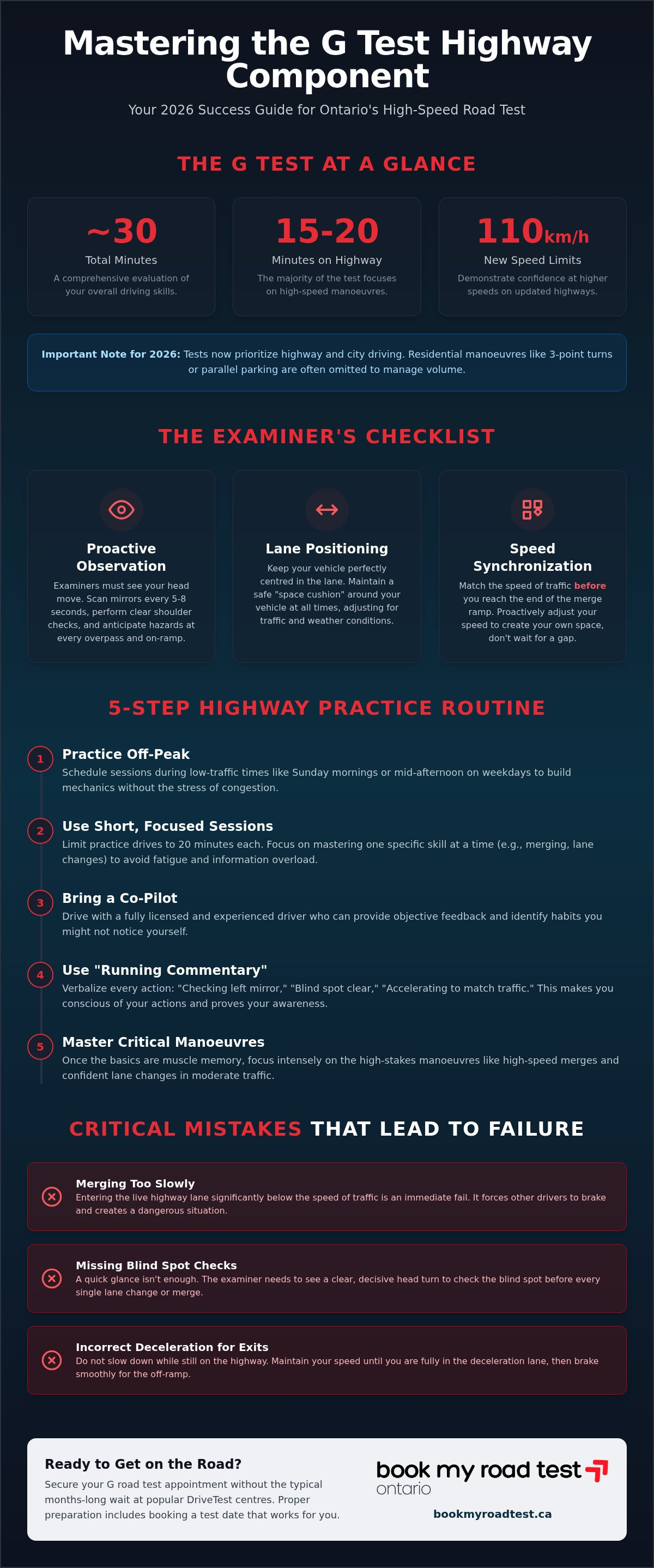
The G road test, often referred to as a final-stage road test, represents a significant milestone in many graduated licensing systems across the country. This isn't just another trip around the block. It's a comprehensive evaluation of your ability to share the road with high-speed traffic safely and predictably. For many, dedicated preparation is key, and resources like Book My Road Test Ontario can help guide candidates. While the entire exam typically lasts about 30 minutes, you'll likely spend 15 to 20 minutes specifically on a major multi-lane highway or a high-speed expressway. Success depends on three core pillars that every examiner watches closely. Consistent highway driving practice for g test candidates is the best way to turn these requirements into muscle memory.
- Proactive Observation: Moving your eyes every five to eight seconds and performing clear shoulder checks.
- Lane Positioning: Keeping your vehicle centred while maintaining a safe "space cushion" from other drivers.
- Speed Synchronization: Matching the actual flow of traffic before you even reach the end of the merge ramp.
The 2026 G Test Requirements
As we move through 2026, many driving tests continue to adapt, often focusing strictly on highway and city driving skills. This approach may omit residential manoeuvres like parallel parking or three-point turns to help manage volumes at driving test centres. However, the expectations for highway performance are strict. Candidates are typically required to confirm they have driven on a major highway or a road with a speed limit of at least 80 km/h a specified number of times in the months before their appointment. Additionally, with speed limits on many major highways now posted at higher speeds, you must demonstrate that you can safely reach these speeds on the merge ramp without disrupting traffic.
Why Highway Practice is Different from City Driving
5-Step Highway Practice Routine for G Test Success
Aimless driving won't help you pass your G test. You need a structured routine that mimics the pressure of the actual exam. To build a solid foundation, your first two steps should focus on environment and feedback. Start by scheduling your highway driving practice for g test sessions during off-peak hours. Sunday mornings or mid-afternoon on weekdays are ideal because they allow you to focus on your mechanics without the stress of heavy congestion. Limit these sessions to 20 minutes each, focusing on one specific skill at a time to avoid fatigue.
The next part of your routine involves bringing a fully licensed driver to act as an objective observer. Use a "running commentary" technique where you verbalize every action you take. Say "checking left mirror," "blind spot clear," or "accelerating to match traffic" out loud. This forces you to be conscious of your habits and helps your passenger identify if you've missed a critical check. Once you've mastered the basics, you can find an available road test slot and move on to the technical manoeuvres examiners watch most closely.
Step 1: The Perfect High-Speed Merge
The merge is often where candidates feel the most anxiety. As you enter the on-ramp, floor the accelerator to reach the posted limit-usually 100 km/h or 110 km/h depending on the stretch of highway. Signal early to alert other drivers of your intent. Your goal is to find a gap and synchronize your speed before the solid line becomes broken. Never wait for a gap to appear; proactively adjust your speed to slot into the flow of traffic. Examiners will fail a candidate for entering the live lane too slowly, as it forces other drivers to brake.
Step 2: Observation and Mirror Cycles
Examiners need to see your head move. If you only move your eyes, they will assume you aren't looking. Establish a strict habit of checking your mirrors every five to eight seconds. This "mirror cycle" proves you are aware of your surroundings. Additionally, you must scan every highway overpass and entrance ramp you approach. This shows you are anticipating potential hazards, such as vehicles entering the highway or emergency cars on the shoulder. Clear, visible head movements are the only way to guarantee the examiner marks these checks as complete.
Step 3: Safe Lane Changes at Speed
Consistency is the key to a successful lane change. A common mistake is instinctively lifting your foot off the gas while moving into the next lane. You must maintain a steady speed or slightly accelerate to ensure you don't disrupt the flow of traffic behind you. Keep at least a 3-second following distance from the vehicle in front. Follow the fluid sequence: check your blind spot, check the mirror, signal, check the blind spot again, and move smoothly. This "double blind spot" check is a hallmark of a safe driver and is exactly what is required for 2026 Ontario standards.
Critical Highway Maneuvers: Merging, Lane Changes, and Speed Control
Technical precision is what separates a passing grade from a failure during the G road test. While your routine builds the habit, your execution of specific manoeuvres proves to the examiner that you can handle high-speed environments without assistance. High-speed highway driving practice for g test candidates must focus on three specific areas: the entry, the exit, and the space you keep around your vehicle. Consistency here shows you are a predictable driver who won't cause other motorists to slam on their brakes or swerve.
- The Entry: You must reach the posted highway speed before your tires touch the live lane.
- The Exit: Maintain your full cruising speed until you have completely crossed into the deceleration lane.
- Lane Centring: Your vehicle should stay perfectly centred. Avoid "wandering" toward the line when you turn your head to check your mirrors.
The Art of the "Smooth" Merge
Success starts on the curved portion of the on-ramp. This is where you should begin glancing at the highway to identify a potential gap. By the time the ramp straightens out, you should already know which vehicle you intend to move in behind. If the highway is posted at 100 km/h or 110 km/h, you must reach that exact speed. Merging at 80 km/h in a 100 km/h zone is considered a dangerous action and often results in an automatic failure. At older DriveTest centres with shorter ramps, you may need to apply firmer pressure to the accelerator to meet these requirements before the lane ends.
Maintaining Your Speed Cushion
A "speed cushion" is the empty space you maintain on all four sides of your car. While city driving often relies on a two-second following distance, highway speeds require a three-to-four second gap. This extra time is vital because braking distances increase significantly at 110 km/h. If another driver cuts into your safety cushion, do not panic or tap your brakes abruptly. Simply ease off the accelerator until the safe gap is restored. Always stay in the right-most lane unless the examiner specifically instructs you to perform a lane change or if you need to pass a significantly slower vehicle. Driving in the "passing lane" without a reason is a common point deduction during the Ontario G test.
Finally, remember that exiting the highway is just as important as entering. One of the most frequent mistakes is braking while still in the live highway lane. This creates a chain reaction of braking behind you. Wait until your entire vehicle has moved into the off-ramp's deceleration lane before you begin to slow down. Check your speedometer frequently during this transition; after driving at 110 km/h, doing 60 km/h on a ramp can feel much slower than it actually is, potentially leading to taking a curve too fast.
Common Highway Mistakes That Lead to G Test Failure
Understanding the most frequent pitfalls is just as vital as knowing the correct manoeuvres. Many candidates perform well during their highway driving practice for g test sessions but falter under the gaze of an examiner. Small errors in judgment, often called "minor deductions," can quickly add up and result in an unsuccessful attempt. However, certain mistakes are classified as "dangerous actions," which result in an immediate disqualification. Recognizing these triggers before you arrive at the DriveTest centre can save you the frustration of a retake and the loss of your prepaid test fee.
- Failing to check blind spots: This remains the primary reason for failure; you must check your blind spot every time you change lanes or when your current lane ends.
- Inadequate merge speed: With many Ontario highways now posted at 110 km/h, entering the live lane at 80 km/h is a major safety hazard that examiners will not overlook.
- Following too closely: Maintaining a safe cushion is mandatory. Tailgating at high speeds is often marked as a dangerous action because it leaves no room for emergency braking.
- Poor lane discipline: You should always return to the right-most lane after a pass unless told otherwise. Straddling lane markings or lingering in the left lane will result in lost points.
Observation Errors: The "Invisible" Mistakes
Examiners cannot read your mind; they rely entirely on your physical head movements to verify that you are actually observing your surroundings. Simply moving your eyes to look at a mirror isn't enough to prove you're aware of the traffic flow. You must visibly turn your head to demonstrate that you are checking your blind spots and scanning the road ahead. This is especially critical when a highway lane narrows or ends. You are required to perform a full blind spot check before merging into the adjacent lane, even if the road appears empty. Additionally, you should scan every on-ramp you pass to show you've noticed vehicles entering the highway. This proves you are a proactive driver rather than a reactive one.
Dangerous Actions and Automatic Disqualifications
A "dangerous action" is any move that requires the examiner to intervene or that forces another driver to take evasive action. Braking for no reason on a high-speed highway is a classic example. This move is unpredictable and often leads to rear-end collisions in heavy traffic. Another common issue is how candidates handle instructions. If an examiner asks you to change lanes but traffic makes the move unsafe, do not force the vehicle into a tight spot. Simply verbalize that it isn't safe yet, wait for a proper gap, and then execute the move. Forcing a lane change will result in an immediate failure. Integrating these lessons into your highway driving practice for g test will ensure you walk away with your full licence. Once you've ironed out these mistakes, you can book your road test appointment and approach the centre with confidence.
Final Prep: Booking Your G Test Appointment Without the Stress
Once the mechanics of the high-speed merge and the three-second cushion feel like second nature, you're ready for the final hurdle. Consistent highway driving practice for g test success has prepared you for the road, but now you must navigate the administrative side. In Ontario, securing a slot can be surprisingly difficult. Demand is high. Wait times at popular DriveTest centres often stretch for several months. Before you get started, check your licence expiry date. You want to ensure you have a comfortable buffer in case you need a second attempt before your G2 expires.
Logistical planning is just as important as your technical skills. If your licence is nearing its five-year limit, you cannot afford to wait for the standard system to show an opening in three months. Planning your test date alongside your practice routine ensures you stay sharp. If you wait too long after finishing your practice to take the test, your confidence might dip. A proactive approach to booking is the best way to ensure your hard work doesn't go to waste.
Why Finding a Slot is the Hardest Part
The official booking portal operates on a live inventory feed. This means slots appear and disappear in seconds as people cancel or reschedule. If you are only looking at one specific location, you might find yourself waiting until next season. Being flexible with your test location can drastically improve your chances of finding an earlier date. Some centres have higher availability, making them worth a short drive. These road test booking hacks Ontario drivers use can help you navigate this backlog effectively.
Streamlining the Process with Book My Road Test Ontario
You don't have to spend your days refreshing a webpage. Our road test booking service is designed to handle the heavy lifting for you. We act as an independent intermediary to find and secure appointments that work for your schedule. We actively search for cancellations and newly released openings at centres across the province. This approach saves you time. It removes the administrative stress that often accompanies the final step of the licensing process.
Having your g test booking managed by professionals allows you to stay focused on your highway driving practice for g test rather than logistics. You've done the work. You've mastered the merge and sharpened your observation skills. Now, it is time to cross the finish line. Secure your road test appointment today!
Get Your Full G Licence with Confidence
Mastering the highway is about more than just speed; it's about becoming a predictable and safe part of Ontario's traffic flow. You now have the tools to execute high-speed merges, maintain a proper speed cushion, and avoid the common observation errors that lead to test failure. Consistent highway driving practice for g test preparation has given you the technical skills needed to succeed. The final step is simply finding the right time and place to prove those skills to an examiner.
Don't let a crowded booking portal delay your progress. Book My Road Test Ontario acts as your independent partner in navigating the DriveTest system. We are independent booking experts who provide stress-free appointment searching, serving drivers across Ontario by finding cancellations that others miss. We handle the administrative logistics so you can stay focused on the road. When you're ready to trade your G2 for a full G, book your G road test appointment now. You've put in the work; now it's time to get your licence and enjoy the freedom of the road.
That freedom might even lead you to explore the beautiful landscapes of British Columbia, where you can learn more about Toast The Okanagan Wine Tours to experience the region's best vineyards through a professional, guided excursion.
Frequently Asked Questions
How much highway driving experience do I need for the G test?
You must declare that you have driven on a 400-series highway or a road with a speed limit of at least 80 km/h at least five times in the three months before your test. This requirement ensures you have recent experience with high-speed traffic flow. Without this specific declaration, the DriveTest centre will not allow you to proceed with your road test appointment.
Do I have to go on the 401 for my G road test?
Not necessarily, but you will be tested on a high-speed provincial highway. Depending on your chosen DriveTest centre, this could be the 400, 403, QEW, or Highway 417. If a 400-series highway is not located near the centre, the examiner will use a high-speed expressway with a limit of at least 80 km/h to evaluate your merging and lane-changing skills.
What is the speed limit I should maintain during the highway portion?
You must maintain the posted speed limit, which is now 110 km/h on nearly 89% of Ontario's provincial highway network. If the limit is 100 km/h, you should stay exactly at that speed when traffic allows. Maintaining a consistent speed shows the examiner you are confident and predictable. Avoid driving significantly slower than the limit, as this creates a hazard for other motorists.
Can I fail my G test if I merge at 90km/h instead of 100km/h?
Yes, merging at 90 km/h in a 100 km/h zone is a common reason for point deductions or failure. Your highway driving practice for g test sessions should focus on reaching the flow of traffic before the merge lane ends. Entering the live lane significantly slower than the posted limit forces other drivers to brake, which examiners often classify as a dangerous action.
Is the Ontario G road test still modified in 2026?
Yes, the modified G road test remains in effect throughout 2026 at Ontario DriveTest centres. This version focuses strictly on essential highway and city driving skills while excluding residential manoeuvres like parallel parking or three-point turns. The modification helps manage high test volumes while ensuring drivers can safely handle high-speed environments and complex intersections.
How many times can I change lanes on the highway during the test?
The examiner will typically ask you to perform at least two lane changes on the highway: one to the left and one back to the right. They want to see a fluid sequence of mirror checks, signalling, and blind spot checks. While they may ask for more if traffic conditions require it, these two are the standard requirement for demonstrating lane-change proficiency.
What happens if there is heavy traffic on the highway during my test?
If traffic is heavy, you must still demonstrate safe merging and lane-changing skills while adjusting your speed to match the actual flow. You aren't expected to hit 110 km/h if traffic is moving at 60 km/h. However, you must maintain a safe following distance and continue your mirror cycles. Examiners will evaluate how you handle real-world congestion with patience and safety.
How can I find a G road test appointment faster?
The most efficient way to secure an appointment is to use a professional booking service that monitors the live DriveTest inventory for cancellations. Since new slots appear as other drivers reschedule, frequent checking is required to catch them. Being flexible with your preferred test location and time of day also increases your chances of finding a slot within weeks rather than months.


