

What if passing your Ontario road test tomorrow has less to do with your steering and more to do with your mindset? It's a common realization that even the most skilled drivers can crumble under the watchful eye of an examiner. If you're feeling the pressure of a looming appointment, you aren't alone. Most applicants fear failing and being stuck in a months-long backlog for a new slot. This guide delivers the essential last minute driving test tips you need to walk into the DriveTest centre with total composure.
We understand that the process feels bureaucratic and stressful, so we've simplified everything into a functional checklist for 2026. You'll learn how to master the mental game, verify your vehicle's readiness, and understand the specific manoeuvres that examiners prioritize. From the mandatory 400-series highway declarations to the strict zero-tolerance policies for drivers under 21, we provide the clarity required to pass on your first attempt. This roadmap ensures you arrive prepared, stay calm, and finally secure your G2 or G licence without the headache of a retake.
Key Takeaways
- Confirm your physical Ontario driver's licence is valid and verify your exact DriveTest centre location to prevent avoidable delays.
- Manage test-day nerves by utilizing visualization techniques and reframing the examiner as a safety partner rather than a judge.
- Review the technical requirements for essential manoeuvres like three-point turns and roadside stops to ensure smooth execution.
- Perform a final vehicle safety check and follow our last minute driving test tips to meet all equipment and etiquette standards.
- Understand how to interpret your results sheet and manage the mandatory waiting period if you need to book a retake.
Essential Night-Before Preparation Checklist
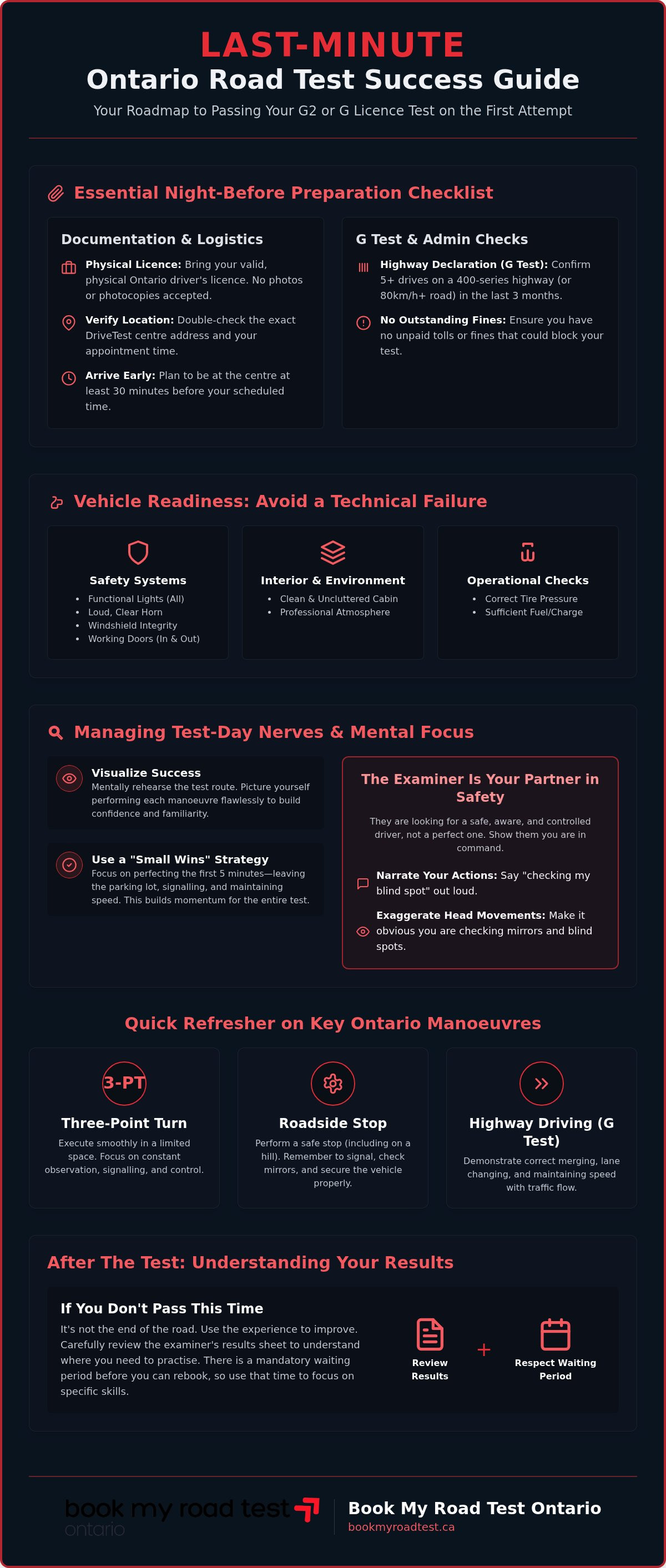
Your success depends on more than just your steering and braking skills. It starts with logistical organization the night before. One of the most important last minute driving test tips is to ensure you actually have the legal right to test. If you arrive without the correct paperwork, the DriveTest staff will cancel your appointment, and you may forfeit your fee. This is a common point of failure that has nothing to do with how well you drive.
Confirm you have your physical, plastic Ontario driver's licence. DriveTest centres will not accept a photo of your ID on a phone or a paper photocopy. Understanding Canadian driver's license requirements is vital, as the graduated licensing system has strict rules about document validity. Check the expiry date tonight. If your licence is expired or you've lost the card, you'll need to visit a ServiceOntario centre before heading to your road test.
Verify your appointment details once more. Double check the exact DriveTest centre address and your scheduled time. Some cities have multiple locations, and showing up at the wrong one is a frequent mistake. Plan your route to arrive at least 30 minutes early. This gives you enough time to find a parking spot, register at the kiosk, and settle your nerves before the examiner approaches your vehicle.
The Documentation You Cannot Forget
If you're taking the G road test, you must be ready to declare your highway driving experience. Ontario requires you to have driven on a 400-series highway or a road with a speed limit of at least 80 km/h at least five times within the last three months. Without this declaration, the examiner will cancel your test immediately. Also, ensure you have no outstanding fines or unpaid tolls. These administrative blocks can stop your test before you even start the engine.
Vehicle Safety Self-Inspection
The examiner will perform a basic safety check before getting into your car. If your vehicle doesn't meet Ministry of Transportation standards, the test ends right there. Test these items tonight:
- Functional Lights: Check both front and rear turn signals, brake lights, and hazard lights.
- The Horn: Ensure it's loud and clear.
- Windshield Integrity: Confirm there are no major cracks that obstruct the examiner's view.
- Door Operation: Both the driver and passenger side doors must open from the inside and outside.
Managing Test-Day Nerves and Mental Focus
Anxiety is the biggest obstacle for many Ontario drivers. While technical skills matter, your mental state dictates how you apply them under pressure. One of the most effective last minute driving test tips involves visualization. Spend ten minutes tonight walking through the test route in your mind. Picture yourself successfully merging onto the 400-series highway or performing a flawless three-point turn. This mental rehearsal builds familiarity, making the actual exam feel like a repeat performance rather than a new challenge.
Building momentum is equally critical. Use a "Small Wins" strategy. Focus entirely on the first five minutes: leaving the parking lot, signalling correctly, and maintaining a steady speed. Successfully navigating the initial few intersections provides a massive confidence boost that carries you through the rest of the test. If you can handle the first few turns with composure, the rest of the exam usually falls into place.
Avoid the urge to "cram" practice sessions on the morning of your exam. Excessive driving right before the test often leads to mental fatigue and overthinking. Trust the preparation you've already done. If you're feeling overwhelmed by the pressure of your current slot, you can always reschedule your appointment to a time when you feel more prepared. This is a practical way to ensure you're in the right headspace to succeed.
The Psychology of the DriveTest Examiner
Examiners aren't looking for a perfect driver; they're looking for a safe one. They want to see that you're in control and aware of your environment. You can demonstrate this through verbal confirmation. Briefly narrating your actions, like saying "checking my blind spot" or "slowing for the school zone", shows the examiner you're proactive. You must exaggerate your mirror checks with clear head movements to ensure the examiner actually sees you looking. This transparency builds trust and reduces the examiner's need to intervene.
Physical Readiness for Peak Performance
Your brain needs fuel to maintain cognitive focus. Eat a balanced meal and stay hydrated before heading to the centre. Arrive early enough to sit in your car and "centre" yourself in the parking lot. Use this time to practise deep breathing exercises to lower your heart rate. Before the examiner even begins their vehicle safety checklist, you should be in a state of calm readiness. This physical preparation ensures you don't make impulsive mistakes caused by a spike in adrenaline.
Quick Refresher on Key Ontario Manoeuvres
Mastering technical execution is the final step in your preparation. While you've already handled the logistics and mental prep, these last minute driving test tips focus on the physical skills that examiners watch most closely. Precision matters more than speed during these exercises. If you rush, you're more likely to miss a blind spot check or clip a curb, both of which can lead to a failing grade.
The three-point turn requires patience and constant observation. Start by signalling right to pull over, then signal left before beginning the turn. Check both directions multiple times. Do not hit the curb; even a light tap indicates a lack of control. Similarly, the roadside stop is a test of your routine. You must signal, check your blind spot, and pull over smoothly. Once stopped, engage your hazard lights and set the parking brake. Forgetting the parking brake is a frequent mistake that's easily avoided with a final mental sweep. You can use this CAA driving skills checklist to review these essential technical priorities before you head to the centre.
Parallel parking often causes the most stress, but it's a simple three-step process. Position your vehicle parallel to the parked car, reverse at a 45-degree angle, and straighten out as you enter the space. You should aim to be within 30 centimetres of the curb. If you're poorly positioned, you're allowed one adjustment. Use it wisely rather than trying to force a bad park. Finally, review right-of-way rules for four-way stops. The first vehicle to arrive has the right of way; if two arrive simultaneously, the driver on the right goes first. Never assume another driver will wave you through.
G2 Test Focus: Residential and City Skills
Speed control is your primary concern in urban areas. Community safety zones and school zones often have reduced limits that examiners monitor strictly. Use the "Left-Centre-Right" scan at every intersection you cross. Even if you have a green light, moving your head to check all directions proves you're aware of potential hazards. When turning onto multi-lane roads, always land in the lane that corresponds to your starting position. "Lane jumping" during a turn is a major error that suggests a lack of lane discipline.
G Test Focus: Highway Entry and Exit
The G test demands a "Match and Merge" strategy. You must reach highway speeds on the acceleration ramp before merging into traffic. Merging at 70 km/h when the limit is 100 km/h creates a safety hazard and will likely result in a fail. Maintain a three-second following distance at all times to give yourself a buffer. For every lane change, execute the full M.S.M.O.G. sequence: Mirror, Signal, Mirror, Over-shoulder, and then Go. This methodical rhythm shows the examiner you're a competent, high-speed driver ready for full licensing.
Vehicle Readiness and DriveTest Centre Etiquette
Your vehicle is your office during the exam. If it isn't functional, the examiner won't even sit in the passenger seat. One of the most overlooked last minute driving test tips is to verify your car's mechanical health at least 24 hours before your slot. A single cracked windshield or a stubborn door handle can end your day before you even leave the parking lot. Examiners prioritize their own safety; they won't risk a session in a car that doesn't meet basic standards.
Start with the dashboard. Ensure there are no active warning lights, specifically the ABS or Airbag indicators. These are considered major safety concerns. If they're illuminated, the examiner will likely cancel the test. Check that both front doors open from both the inside and outside. This is a mandatory safety requirement for emergency exits. Finally, ensure your windshield is clear. A crack that obstructs the examiner's line of sight or crosses the path of the wipers is an automatic disqualification for that vehicle.
The Pre-Test Vehicle Inspection
If your vehicle doesn't meet Ontario safety standards, your appointment is cancelled, not failed. This distinction is important because it doesn't count as a failed attempt on your record. However, you'll still lose time and may forfeit your test fee. Pay close attention to your brake lights. Many drivers forget to check the high-mount centre brake light. If this bulb is out, the car is considered unfit for the test. For those testing in winter, you must clear all snow and ice from the roof, windows, and mirrors. Arriving with a "snow cap" on your car is a safety hazard and shows a lack of professional preparation.
While this guide focuses on Ontario, the need for reliable vehicle support is universal; for instance, Dependable Towing & Recovery Services provides the 24-hour support and recovery expertise that drivers in the Fraser Valley rely on for peace of mind.
At the DriveTest Centre
Logistics at the centre can be just as stressful as the drive itself. Most Ontario centres use digital kiosks or specific check-in counters. Arrive 30 minutes early and have your licence ready. Once registered, park your vehicle in the designated "Road Test" parking area. These spots are usually numbered and located near the exit. Backing into the spot is often recommended. It allows for a safer and easier start when the examiner arrives, as you won't have to reverse out of a busy parking area to begin your test.
Professional courtesy goes a long way. Treat the centre staff and your examiner with respect. If the schedule is running behind, stay calm and remain by your vehicle. A positive, patient attitude sets a professional tone for the entire encounter. If you realize your vehicle isn't going to pass inspection, it's better to book a new road test date immediately rather than showing up with a faulty car. This proactive approach saves you from the frustration of a same-day cancellation and helps you stay on track for your licence.
Securing Your Next Slot if Things Do Not Go to Plan
Sometimes, even with the best preparation, the result isn't what you hoped for. You might realize at the eleventh hour that your technical skills aren't quite ready, or you may face an unsuccessful attempt. If you don't pass, Ontario requires a mandatory waiting period of at least 10 days before you can retake the test. This time is intended for reflection and additional practice. One of the most practical last minute driving test tips is to acknowledge when you need more time. Pushing through a test when you feel unready often leads to unnecessary stress and a wasted fee.
Your examiner will provide a results sheet, often still called the "yellow sheet" even in its digital format. This document is a goldmine of information. It breaks down exactly where you lost points, whether it was a lack of observation at intersections or poor lane positioning during turns. Analyze this feedback objectively. It helps you determine if you need more hours behind the wheel or simply better logistical support. For many, a road test booking service is the missing piece of the puzzle. It allows you to focus on your driving skills while experts handle the scheduling logistics.
Dealing with a Failed Attempt
Failing a road test is a common hurdle, not a permanent roadblock. Statistics often show that success rates improve on the second attempt because the mystery of the process is gone. Use the examiner's feedback as a specific syllabus for your next practice sessions. Focus on the exact errors highlighted in your report rather than practicing things you already do well. If you need to re-enter the system quickly, checking g2 road test availability ontario can help you find a new slot that fits your improved timeline.
Rescheduling and Finding Sooner Dates
Navigating the standard booking system during peak seasons in Ontario can be incredibly difficult. Slots disappear in seconds, and wait times often stretch into several months. This is particularly stressful if your current licence is nearing its expiry date. A third-party service can monitor for cancellations on your behalf, finding sooner dates that you might otherwise miss. You can simplify your g test booking by letting a facilitator manage the search. This ensures you get back on the road with minimal delay. It allows you to apply your last minute driving test tips while the information is still fresh in your mind, moving you quickly from a state of frustration to a state of resolution.
Master Your Ontario Road Test Today
Passing your G2 or G test in 2026 requires a balance of technical precision and administrative readiness. You've learned how to verify your documentation, perform essential vehicle safety checks, and reframe your mindset to handle test-day nerves. These last minute driving test tips are designed to help you navigate the DriveTest process with confidence. Whether you're mastering the three-point turn or preparing for a high-speed highway merge, staying calm and methodical remains your greatest asset.
If the pressure of finding a slot is overwhelming or you need to reschedule for a more convenient time, we're here to assist. Secure your next road test appointment without the wait with Book My Road Test Ontario. As independent booking experts, we focus on finding G2 and G cancellation slots to provide professional appointment management for busy drivers. This service acts as your safety net, ensuring you can focus on your driving skills while we handle the logistics.
You have the knowledge and the checklist required for success. Take a deep breath, trust your preparation, and get ready to earn your full Ontario licence with total composure.
Frequently Asked Questions
Can I take my road test if my "Check Engine" light is on?
You cannot take your road test if any dashboard warning lights are active. Indicators for "Check Engine," ABS, or Airbag issues signal that the vehicle may not be safe for the examiner or other road users. If these lights are on, the staff will cancel your appointment immediately. While this isn't a failed attempt, you'll likely lose your fee and need to secure a new date once the vehicle is repaired.
What happens if I arrive late for my DriveTest appointment?
Arriving late usually results in a cancelled appointment and a forfeited test fee. DriveTest centres operate on a very strict schedule and require all candidates to check in at least 30 minutes before their start time. If you miss this registration window, the system may reassign your examiner to another driver. It's best to plan for traffic and arrive early to ensure you have time for parking and kiosk check-in.
How many minor mistakes are allowed on the Ontario G2 road test?
Ontario's scoring system doesn't use a specific number of allowed mistakes; instead, it uses a weighted deduction system. You can pass with several minor errors, such as slightly wide turns or slow acceleration, provided your total score stays above the passing threshold. However, any "major" error, like a traffic law violation or a dangerous action, results in an immediate disqualification regardless of how well you drove during the rest of the session.
Do I need to bring my own car for the driving test?
Yes, you are responsible for providing a safe vehicle for your road test as DriveTest centres do not supply cars. You can use a personal vehicle, a friend's car, or a driving school car, provided it's fully insured and meets all Ministry safety standards. Ensure the vehicle is in good working order, with functional brake lights and signals, to avoid a last minute cancellation due to equipment failure.
Can I wear sunglasses during my road test?
You are permitted to wear sunglasses if the sun's glare is affecting your vision. However, since examiners need to see your eye and head movements to verify your observation skills, you must be careful. If you wear dark lenses, you should exaggerate your head movements during mirror and blind spot checks. This ensures the examiner clearly sees you scanning the road and intersections throughout the entire duration of your test.
What is the most common reason for failing a road test in Ontario?
Poor observation is the most frequent reason for failure across Ontario. This includes failing to check blind spots before changing lanes or neglecting to scan intersections from left to right. Other common issues include improper lane positioning and failing to yield the right-of-way. Using last minute driving test tips like verbalizing your checks can help ensure the examiner notices your safe driving habits and awareness of your surroundings.
How long does the G2 exit (G) road test actually take?
The Class G road test typically takes between 20 and 30 minutes to complete. This timeframe covers the highway driving portion, city street navigation, and advanced manoeuvres. While the drive itself is relatively short, you must still arrive at the centre at least 30 minutes early. This allows enough time to handle the registration and vehicle inspection process before the examiner joins you in the car to begin the test.
What should I do if I am too nervous to drive on the day of the test?
Use visualization and deep breathing exercises to manage your anxiety before the examiner approaches your vehicle. If you feel your nerves are too overwhelming to drive safely, it's often better to reschedule your appointment rather than risking a dangerous mistake. You can always book a new slot later when you feel more composed. Our service can help you find a sooner replacement date if you decide you aren't ready today.


