

Did you know that the G test pass rate in centres like Brampton is only 57%, often because of errors made on the acceleration lane? It's completely normal to feel a spike in anxiety when you see 400-series traffic zooming past at 100 km/h. You're likely searching for the best merging on highway for g test tips to help you match traffic speed without technically speeding, all while an examiner monitors your every move. The pressure to find a safe gap while maintaining control can make even confident drivers feel uneasy.
We understand that mastering the highway portion is the final hurdle to finishing the graduated licensing process. This guide provides the exact techniques you need to impress your examiner and secure your full licence on your first attempt. You don't have to let fear of high-speed traffic or confusion over speed tolerances stand in your way.
We will break down the precise speed targets examiners expect, the physical head checks required for blind spots, and how to avoid the hesitation that leads to an automatic fail. You'll also discover how choosing the right location and time can simplify your path to success.
Key Takeaways
- Understand why examiners view the acceleration lane as the ultimate test of your judgment and high-speed confidence.
- Master the three-zone approach to ensure you are organized and ready before you even reach the highway line.
- Learn the essential merging on highway for g test tips to help you match traffic speed perfectly and avoid common hesitation penalties.
- Identify how to spot a safe gap in heavy traffic and execute the mandatory physical head checks that examiners demand.
- Discover how to streamline your preparation by finding available road test slots at centres with higher success rates.
Why Highway Merging is the Ultimate G Test Decider
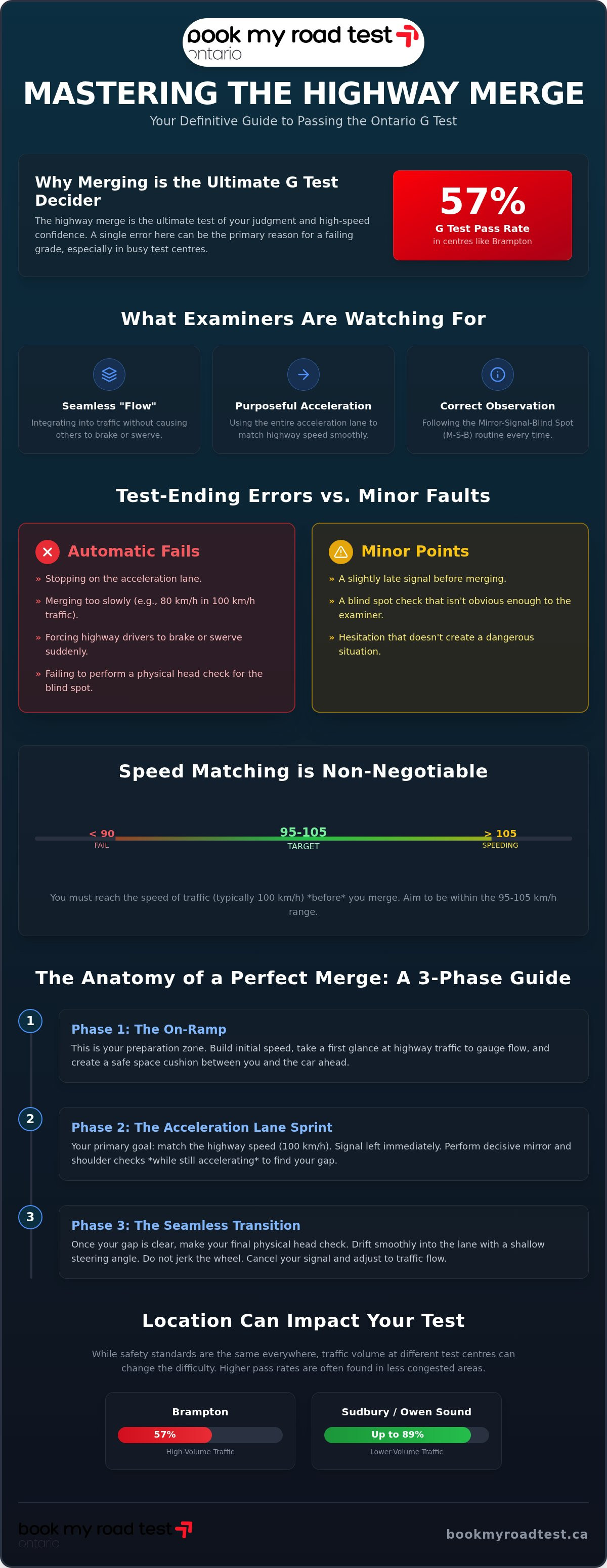
The G licence is the final step in Ontario’s graduated licensing system. While the G2 test focuses on basic car control and residential rules, the G test is specifically designed to prove you can safely manage high-speed environments. This is why the highway portion carries so much weight. In many Ontario centres, a poor merge is the primary reason for a failing grade. For instance, statistics show that Brampton has a G test pass rate of just 57%, largely due to the complexity of merging onto the 410. Conversely, centres like Sudbury or Owen Sound see rates up to 89%, but the expectations for highway safety remain just as strict regardless of where you book.
Merging is a high-pressure task because it requires you to manage speed control, observation, and spatial judgment simultaneously. You aren't just moving your vehicle; you're integrating into a fast-moving stream of traffic. Understanding the fundamentals of merging is essential because examiners need to see that you can join the flow without causing others to brake. If you're looking for merging on highway for g test tips, the first thing to realize is that examiners aren't just checking your speedometer. They're gauging your confidence and your ability to read the road ahead.
What Examiners Look for During the Merge
Examiners watch for what they call "flow." They want to see that you aren't a disruption to the existing traffic. This starts with smooth, purposeful acceleration on the on-ramp to reach the highway speed. They also strictly monitor your observation habits. You must use the Mirror-Signal-Blind Spot (M-S-B) routine. A simple glance in the glass isn't enough; you need a clear, physical turn of the head to check your blind spot before you cross the line. Early signalling is also vital. It tells other drivers your intent, which helps them create space for you to enter safely.
Automatic Fails vs. Minor Points
You need to distinguish between a small mistake and a test-ending error. A minor point might be a slightly late signal or a check that wasn't quite obvious enough. However, certain actions are considered dangerous and result in an automatic fail. When reviewing merging on highway for g test tips, the most critical piece of advice is to never stop on the acceleration lane. Stopping creates a massive safety hazard for you and the drivers behind you. Similarly, merging at 80 km/h when the traffic is moving at 100 km/h is often an immediate fail. MTO speed tolerances typically expect you to be between 95 and 105 km/h. Merging too slowly forces highway drivers to change lanes or slam on their brakes, which proves you aren't yet ready for a full G licence.
The Anatomy of a Perfect Highway Merge: A Step-by-Step Guide
A successful highway entry is a three-part process that requires precision from start to finish. When you're looking for merging on highway for g test tips, it helps to view the merge as a sequence of zones rather than a single event. Each zone has a specific goal that prepares you for the next, ensuring you don't feel overwhelmed by high-speed traffic. Success begins the moment you enter the on-ramp, not when you first see the highway lanes. By breaking the process down, you can manage your space and speed with the confidence examiners expect.
Phase 1: The On-Ramp and Initial Observation
Your merge starts the moment your wheels touch the on-ramp. Use this time to build speed toward the advisory limit while taking your first "glance" at the highway. This early observation allows you to identify the flow of traffic and spot potential gaps before you even reach the straightaway. It's also the time to establish a space cushion. Avoid tailgating the vehicle ahead of you on the ramp. If they hesitate, you'll need that extra room to accelerate safely without getting trapped behind them. Being proactive here reduces the stress of the final transition.
Phase 2: The Acceleration Lane Sprint
As the ramp straightens into the acceleration lane, your primary job is to match the speed of the traffic. In Ontario, this typically means reaching 100 km/h quickly and smoothly. Signal left immediately as the lane opens up. This gives drivers already on the highway plenty of time to adjust their position. You must also be aware of your surroundings, especially when safely merging near large trucks or buses that require more space to accommodate you. Perform a decisive shoulder check to your left blind spot while your foot is still on the gas. This shows the examiner you are proactive and ready to join the flow.
Phase 3: The Seamless Transition
The final step is the transition into the live lane. Aim for a shallow steering angle to drift into the gap rather than jerking the wheel. One of the most important merging on highway for g test tips is to maintain your speed as you cross the line; never tap the brakes during the transition unless it is an emergency. Once you're safely in the lane, cancel your signal and check your rearview mirror to confirm your new position. If you feel ready to put these steps into practice, you can find an available road test slot at a centre that fits your schedule and offers a straightforward testing route.
Speed Matching: The Secret to Passing Without Hesitation
Many drivers fail the G test because they hesitate. This hesitation often shows up as merging at a speed significantly lower than the flow of traffic. Ontario examiners look for you to hit the posted limit before you cross the shoulder line. If the limit is 100 km/h, they expect to see your needle between 95 and 105 km/h. Merging at 80 km/h isn't "safer"; it's a hazard that forces highway drivers to slam on their brakes. When looking for merging on highway for g test tips, remember that speed is your best tool for safety.
Some older DriveTest centres have notoriously short acceleration lanes. In these spots, you don't have the luxury of a long, gradual build-up. You must be firm with the accelerator to reach highway speeds before the lane runs out. If you enter at 99 km/h, you're in great shape. If you push to 105 km/h to match a fast-moving pack, most examiners will see that as good judgment rather than speeding. However, exceeding 105 km/h consistently might lead to a warning or a deduction for poor speed control. It's about finding that sweet spot where you're moving with the pack, not against it.
The Math of the Merge: Speed vs. Distance
When your car moves at the same speed as the traffic in the right lane, the gap between vehicles appears to stop moving relative to you. This makes it much easier to steer into the space without panic. Speed matching is the act of equalizing your velocity with the flow of traffic before lane entry. By reaching this target early, you give yourself the ability to choose your gap more effectively. These highway merging tips highlight that accelerating slightly faster than the flow for a brief moment can actually help you slot into a gap more decisively than waiting for one to appear.
Handling Different Posted Speed Limits
Not every highway on the G test will be a 400-series road with a 100 km/h limit. Some routes include highways with 80 km/h or 90 km/h limits. You must spot these speed limit signs as soon as you exit city streets. Transitioning from a 50 km/h zone to an 80 km/h highway requires a different level of aggression than hitting the 401. Don't be afraid to press the accelerator firmly to get your vehicle up to speed. Your engine is designed to handle it, and the examiner wants to see that you aren't afraid of the car's power. Correct speed matching is one of the most vital merging on highway for g test tips because it proves you can adapt to any road environment you encounter.
Troubleshooting Common Merging Errors and Test Day Pitfalls
Many drivers experience a "frozen" feeling when they reach the end of the ramp and see a wall of high-speed traffic. This mental block often leads to the most dangerous mistake: stopping. Identifying a suitable gap is a skill you must demonstrate clearly. For the purpose of the G test, a safe gap is generally two to three car lengths. If you find yourself staring too long at the traffic, you might fall into the "shoulder check trap," where you drift out of your lane while looking back. Keep your checks quick and return your eyes to the road ahead immediately. If you realize you aren't going fast enough, don't panic. Press the accelerator firmly to close the speed gap before you reach the end of the lane.
What to Do When There is No Gap
The 'Blind Spot' Blunder
A common error is checking the blind spot too early, before you've even reached the acceleration lane, or too late, as you're already crossing the line. To satisfy an Ontario examiner, use the "Chin-to-Shoulder" technique. This involves a clear, exaggerated physical turn of the head so the examiner can see you are actually looking. Failing to perform this check is often an automatic fail, even if the lane is completely empty. The examiner needs to see that the habit is ingrained in your driving process. If you're looking for more merging on highway for g test tips, remember that the examiner is scoring your head movements as much as your car's position.
If you're worried about these high-pressure scenarios, the best way to gain confidence is through consistent practice at different times of day. Once you feel ready to tackle the 400-series, you can book your G road test at a centre that offers the best environment for your skills. Taking the test at a centre with less aggressive traffic can often reduce the likelihood of these "no-gap" situations occurring and help you stay calm during the merge.
Finalizing Your G Test Preparation and Booking Your Slot
Practice turns theory into instinct. Finding a quiet highway entry is the best way to apply the merging on highway for g test tips we've discussed. Before you head out, check your vehicle thoroughly. You should review these road test booking hacks Ontario to ensure your car meets all safety requirements, such as working signals and brake lights. Being physically and mentally prepared for the merge reduces your overall test-day anxiety. This allows you to focus on the examiner's instructions rather than worrying about the mechanics of the car.
Don't let booking delays stall your progress. It's common for drivers to lose their edge if they wait months between their practice sessions and the actual test. Securing a date while your skills are sharp is vital for a first-time pass. When you know exactly how to handle the acceleration lane, you gain a psychological edge that carries through the rest of the evaluation.
Creating a Practice Routine
Dedicate specific sessions to highway work. Spend 30 minutes doing nothing but loops of highway on-ramps and off-ramps. This repetition builds the muscle memory needed for high-speed environments. Narrate your actions out loud as you drive. Say things like, "Mirror, signal, blind spot, speed is 100." This verbal reinforcement keeps you focused and ensures you don't skip steps. If possible, have a passenger grade you specifically on your merging speed to ensure you're consistently hitting the 95 to 105 km/h target before you cross the line.
Securing Your Appointment with Ease
The stress of finding an available slot can often distract you from your driving practice. Hunting for a date at a preferred centre shouldn't be a full-time job. You can use a road test booking service to manage the logistics for you. This independent facilitator helps you find a time and location that fits your schedule, allowing you to focus your energy on the road rather than a refresh button. By streamlining the booking process, you can stay calm and keep your eyes on the goal of becoming a fully licensed driver.
Ready to get your full licence? Book your G road test appointment today and skip the wait.
Master the Merge and Claim Your Full G Licence
Success on your final road test depends on your ability to integrate seamlessly with high-speed traffic. By prioritizing speed matching and executing clear, visible head checks, you demonstrate the professional judgment examiners expect. Remember that hitting the 95 to 105 km/h target is always safer than hesitating in the acceleration lane. Consistently applying these merging on highway for g test tips during your practice sessions will ensure you stay calm and focused when it matters most.
Don't let the administrative burden of scheduling hold you back from finishing your graduated licensing journey. Our independent third-party service is trusted by thousands of Ontario drivers to provide stress-free road test scheduling at centres across the province. We manage the logistics so you can spend your time behind the wheel perfecting your technique.
Secure your G road test appointment now and focus on your driving!
You've put in the hard work and learned the right techniques. Stay confident, keep your eyes on the road, and you'll be holding your full G licence before you know it.
Frequently Asked Questions
What is an automatic fail for merging on the G test?
An automatic fail occurs if you stop on the acceleration lane or force other drivers to change lanes or brake to accommodate you. Examiners also disqualify candidates for failing to perform a visible, physical shoulder check before moving into the live lane. These errors are considered dangerous because they disrupt the high-speed flow of traffic. Demonstrating confidence and maintaining your speed is the best way to avoid these immediate disqualifications during your evaluation.
What speed should I be at when I merge onto the highway?
You should be at the posted speed limit, which is typically 100 km/h on most 400-series highways. Ontario examiners generally expect your speed to be between 95 and 105 km/h as your tires cross the line. Reaching this target is one of the most important merging on highway for g test tips to remember. It proves you can integrate into traffic without causing a bottleneck or a safety risk for others.
Do I have to merge onto a 400-series highway for the G test?
Yes, the G test specifically evaluates your ability to drive on high-speed highways. You must have experience on roads with a speed limit of at least 80 km/h to even qualify for the appointment. Most test routes use 400-series highways like the 401, 410, or the QEW to assess these skills. Examiners need to see that you are comfortable at these higher velocities before granting you a full licence.
What if the highway traffic is moving faster than the speed limit?
Prioritize matching the flow of traffic while staying as close to the limit as possible. If traffic is moving slightly faster than the limit, merging at exactly 100 km/h is usually acceptable and safe. However, merging at 80 km/h in this scenario would be a safety hazard and likely lead to a fail. Your goal is to enter the highway without forcing any other driver to adjust their speed or lane position.
Can I fail if I merge too early in the acceleration lane?
Merging too early can result in a failure if you cross a solid white line or haven't reached the required speed yet. The acceleration lane is designed to give you enough space to hit 100 km/h before joining live traffic. Use the majority of the lane to ensure your transition is smooth and safe. Crossing the line too soon shows the examiner a lack of patience and poor spatial awareness during the merge.
How many times will I have to merge during the G road test?
Most G road tests involve entering and exiting the highway at least twice. This allows the examiner to see your consistency in different traffic conditions and ensure your first merge wasn't just luck. You'll need to demonstrate proper signalling, mirror usage, and speed matching for each entry and exit. Consistent performance across both attempts is key to showing you've mastered the high-speed portion of the test.
What should I do if a truck is in my way while merging?
Is it better to merge at the beginning or the end of the acceleration lane?
It is best to merge in the middle or later portion of the lane once you have reached full highway speed. Merging too early often prevents you from reaching the necessary 100 km/h target. Conversely, waiting until the very end of the lane can cause panic if a gap doesn't open up. Following these merging on highway for g test tips will help you be at full speed halfway through the lane so you can choose your entry point calmly.


