

Imagine reaching the end of a 400-series on-ramp with traffic moving at 110 km/h while knowing your G2 licence expires in just a few months. It is a high-pressure moment that makes many Ontario drivers delay their final step toward a full licence. Learning exactly how to prepare for g road test requirements is the difference between a stressful failure and a confident pass. We understand that highway merging and the fear of losing your driving status can feel overwhelming, especially when test slots at DriveTest centres are so hard to find.
This guide will help you master the advanced driving skills and logistical steps needed to pass your G road test and secure your full licence with confidence. You will learn how to handle the 2026 highway driving declaration, which requires at least five high-speed trips in the last three months. We also preview the specific manoeuvres examiners look for and provide tips for securing a convenient appointment before your current licence expires. From vehicle safety checks to merging at speed, we have organized everything you need to succeed on your first attempt.
Key Takeaways
- Understand the 2026 eligibility rules and why holding your G2 licence for at least 12 months is just the first step.
- Learn exactly how to prepare for g road test success by mastering high-speed highway merges and the essential three-point check.
- Ensure your vehicle and documentation meet strict DriveTest standards to avoid an automatic cancellation on your test day.
- Use mock tests and varied weather practice to build the confidence needed to handle real-world traffic scenarios.
- Discover how to bypass long wait times by finding last-minute cancellation slots through a specialized booking service.
Understanding the Ontario G Road Test Requirements
The G road test represents the final milestone in the Canadian driver's licensing system for Ontario residents. It's a significant transition that moves you beyond the restrictions of a novice driver. To be eligible, you must have held your G2 licence for at least 12 months. This time is intended for you to gain the experience necessary for high-speed environments. Passing this test means you no longer have to worry about your novice licence expiring or the strict zero-blood-alcohol requirements that apply to G2 holders. It's a permanent status that offers peace of mind and full driving privileges across North America.
The 2026 G Test Format: Modified vs. Standard
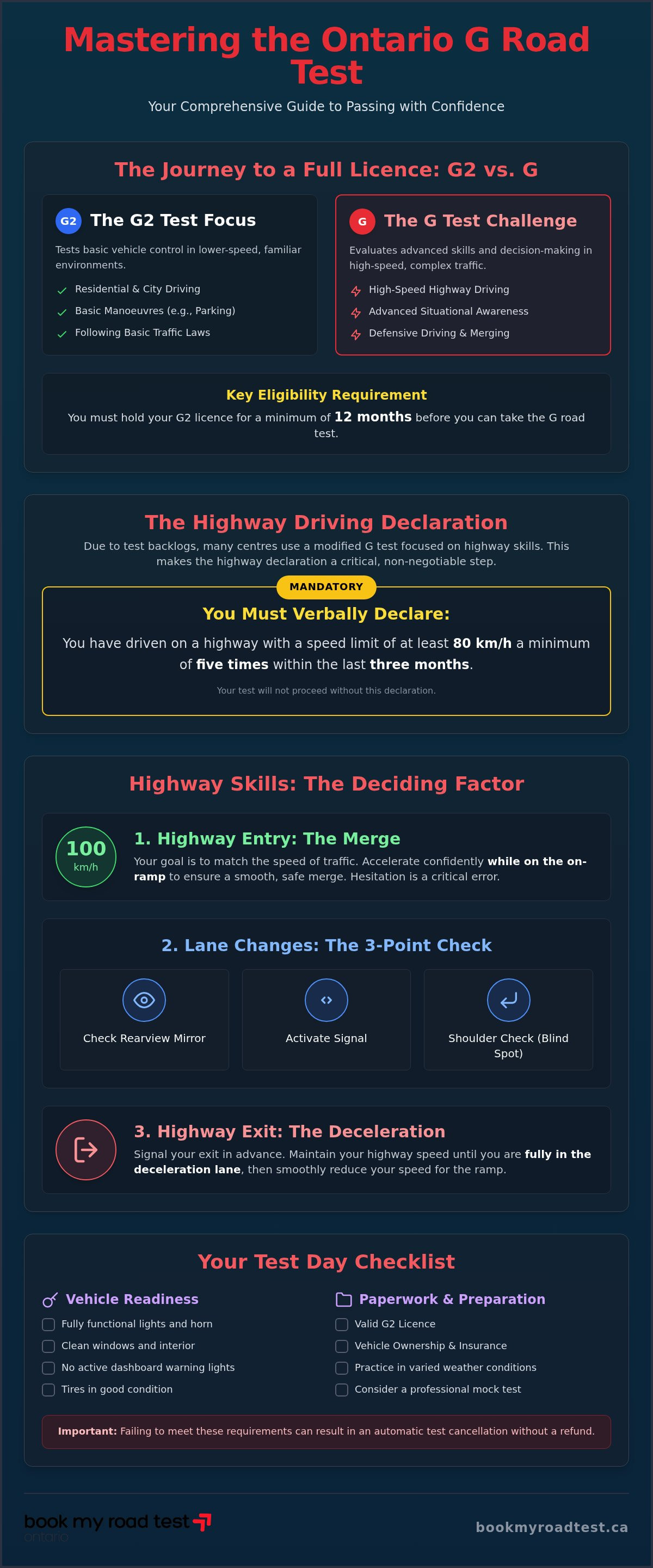
As of 2026, many DriveTest centres still utilize a modified version of the G test to help clear the persistent booking backlogs. This version is streamlined to focus almost entirely on highway driving and arterial road safety. While this might sound less intimidating, it places a massive emphasis on your ability to handle high-speed traffic. You might find that residential manoeuvres like parallel parking, three-point turns, or emergency stops are omitted if the modified format is active at your chosen location. However, highway merging and lane changes remain mandatory and are often where most applicants struggle. When considering how to prepare for g road test day, you must prioritize your highway declaration. You'll be asked to confirm you've driven on a 400-series highway or a road with a speed limit of at least 80 km/h at least five times in the three months before your test.
Why the G Test is More Than Just a City Drive
The G2 road test was primarily about basic vehicle control and following the rules of the road in a residential or city setting. The G test shifts that focus toward advanced situational awareness and your ability to interact with complex traffic flows. Examiners aren't just checking if you can stay in your lane; they're looking for consistent defensive driving habits. This includes scanning intersections, checking your mirrors every 5 to 8 seconds, and demonstrating clear head movements during every lane change. You'll be expected to reach the speed of highway traffic while still on the on-ramp, ensuring a smooth and safe merge. It's about proving you can make split-second decisions at 100 km/h without hesitation. Mastery of these advanced skills shows the examiner that you are a predictable and safe driver who is ready for a full licence.
Mastering Advanced Highway and City Driving Skills
Mastering the G road test requires a shift from basic vehicle operation to advanced traffic management. Examiners aren't just looking for technical accuracy; they're looking for a driver who is predictable and confident at high speeds. When you're researching how to prepare for g road test day, your practice sessions should prioritize the transition between city streets and major 400-series highways. This is where most applicants feel the most pressure, but with the right techniques, you can demonstrate total control.
Highway Entry and Exit Strategies
The highway merge is often the deciding factor for an examiner. You must reach the posted speed limit, usually 100 km/h, while you're still on the acceleration ramp. Entering the highway at a lower speed is a safety hazard and a common reason for failure. You should find a gap in traffic early by checking your mirrors and blind spot as soon as the ramp straightens out. Avoid stopping or hesitating at the end of the ramp, as this creates a dangerous situation for you and the drivers behind you. When it's time to exit, maintain your highway speed until you've fully entered the deceleration lane. Signal your intent early, but not so early that it confuses drivers at previous exits. Smooth speed transitions show the examiner that you understand the mechanics of high-speed flow.
Observational Skills and Mirror Checks
Observation is about more than just looking; it's about proving to the examiner that you're aware of your surroundings. Use the "moving head" technique to make your checks obvious. Don't just move your eyes; turn your head slightly so the examiner sees you scanning mirrors every 5 to 8 seconds. This habit is a core part of any reliable G road test checklist. You must also perform a full "Three-Point Check" before every lane change. This includes checking your rearview mirror, activating your signal, and performing a quick shoulder check to clear your blind spot. Even when you have a green light at an intersection, turn your head left and right to scan for red-light runners or pedestrians. In busy urban centres, pay extra attention to cyclists and transit vehicles that may be entering your path unexpectedly.
Safety also depends on maintaining a proper following distance. In high-speed traffic, use the 3-second rule to ensure you have enough space to react to sudden braking. This gap should increase during poor weather or at night. Additionally, be hyper-aware of speed limit changes in construction zones or school areas. Missing a single "40 km/h" sign can result in an immediate fail. If you're feeling ready but are struggling to find an available slot to show off these skills, you can book your road test through a service that identifies cancellations in real-time. Consistent practice of these advanced manoeuvres will ensure you're ready for whatever the examiner throws your way.
The Pre-Test Vehicle and Documentation Checklist
Passing the G road test requires more than just highway skills; it starts before you even turn the key. If your paperwork is missing or your car is unfit, the examiner will cancel your appointment. This results in a lost test fee and a long wait for a new slot. Understanding how to prepare for g road test day includes a thorough inspection of your vehicle and your documents to ensure you aren't turned away before you begin.
Essential Documents to Bring
You must present your physical G2 driver's licence at the DriveTest centre. Temporary paper versions are generally not sufficient on their own without the plastic card. If your licence has a "Condition X" requirement, ensure you have your glasses or contact lenses with you. You also need to provide the vehicle's ownership papers and a valid insurance slip. While digital insurance cards are increasingly common, having a printed backup is a safe way to avoid technical delays or device issues at the counter. Double-check that your insurance is current and covers the vehicle you intend to use for the test.
Vehicle Safety Standards for Examiners
The examiner will perform a basic safety check before they agree to enter your car. If they find a safety issue, the test ends immediately. Understanding how to prepare for g road test requirements means verifying these specific items beforehand:
- Lights: Ensure all four turn signals, both brake lights, and the high and low beam headlights work perfectly.
- Tires: Examiners check for adequate tread depth. Bald tires or visible cords are an automatic rejection.
- Dashboard: Ensure no critical warning lights, such as the SRS (airbag) or ABS lights, are active.
- Windshield: Large cracks, especially those in the driver's line of sight, will cause an immediate cancellation.
- Horn and Wipers: Both must be fully functional. Check your washer fluid levels as well.
Clean your car's interior before you arrive. Remove clutter from the floorboards, especially items that could roll under the brake pedal. A tidy car shows the examiner you are a responsible driver. Also, verify that your licence plate is clean and clearly visible. Remember that you must provide at least 48 hours' notice to cancel or reschedule without losing your pre-paid fee. Taking these logistical steps seriously ensures that when you finally arrive for your appointment, you can focus entirely on the driving skills discussed in previous sections.
Strategic Preparation: Mock Tests and Route Awareness
Mastering the physical skills of driving is only half the battle. The mental pressure of having an examiner watch your every move can lead to simple mistakes that you wouldn't normally make. The most effective way how to prepare for g road test success is to move beyond casual driving and begin intentional, high-pressure practice sessions. This stage of your preparation should focus on environmental variables and the specific psychological atmosphere of the test.
Simulating the Examiner Environment
One of the biggest shocks for many drivers is the total silence during the test. You're likely used to driving with music, podcasts, or a chatting passenger. During your G road test, the examiner will only speak to provide directions. Practise driving in complete silence with a friend or instructor who acts as the examiner. Ask them to sit with a clipboard and remain stoic while giving you verbal cues. This helps you get comfortable following directions quickly without needing a long explanation. It also prepares you to handle the constructive criticism you'll receive at the end of the session, which is vital for refining your habits before the real appointment.
Practising in varied weather is another critical strategy. Don't wait for a sunny day to get behind the wheel. In Ontario, you might face heavy rain, sun glare, or light snow during your 20-minute window. Learning to manage your following distance and visibility in these conditions will give you a massive advantage over drivers who only practise in perfect weather. Similarly, you should intentionally schedule practice sessions during peak traffic hours. Congestion on the 400-series highways forces you to make quicker decisions regarding gap selection and merging, which are skills the examiner will watch closely.
Understanding Local Road Conditions
Many drivers search online for the "exact" route used by their local DriveTest centre. This is a risky strategy. Examiners frequently alter routes due to construction, accidents, or simply to ensure drivers aren't just memorizing a path. Instead of memorizing one street, spend time exploring the five-kilometre radius around the testing centre. Look for unique local features that could trip you up, such as:
- Unexpected roundabouts or multi-lane intersections.
- Bike lanes that require specific shoulder-check protocols before turning.
- Hidden speed limit signs where the limit drops suddenly from 60 km/h to 40 km/h.
- School zones or community safety zones that are strictly enforced.
Being aware of these local nuances reduces the chance of a surprise during your test. For more tips on navigating the logistical side of your appointment, check out our guide on road test booking hacks Ontario: The ultimate 2026 checklist. If you feel your skills are sharp but you can't find an available time slot, you can book your road test appointment through our real-time search service to secure a date that fits your schedule.
Securing Your G Road Test Appointment Without the Wait
The final hurdle in your journey to a full licence isn't always the driving itself. In 2026, the logistical challenge of finding an open slot at a DriveTest centre can be just as daunting as the highway merge. Standard booking portals often show zero availability for months at a time. This creates significant anxiety for drivers whose G2 licences are nearing their five-year expiry date. Knowing how to prepare for g road test logistical hurdles is just as vital as practicing your lane changes. If you wait until the last minute to book through traditional channels, you risk losing your driving privileges entirely.
Beating the Wait Times for Your Full G Licence
Last-minute cancellations are the most effective way to skip the months-long queue. While the official portal requires you to manually refresh and check individual locations, cancellations are often claimed within seconds of appearing. These slots open up when other drivers reschedule or fail to provide the required 48 hours' notice for a cancellation. Using a service that monitors multiple centres simultaneously allows you to secure these rare openings as they happen. This is particularly helpful if you are flexible with your location and willing to travel to a nearby city for an earlier date. For a deeper look at the current landscape, read our analysis on is a road test booking service worth it? Ontario wait times in 2026.
Managing Your Appointment with Book My Road Test Ontario
We act as an independent facilitator to simplify a process that often feels bureaucratic and stressful. Our service is designed for busy professionals and students who don't have the time to spend hours refreshing a webpage. We focus on finding cancellation slots in real-time, providing you with a streamlined path to your appointment. It's important to understand that we are a third-party service and not the Ministry of Transportation. Our expertise lies in navigating the high demand of the current booking system to find you a seat.
By handling the search for you, we reduce the logistical pressure so you can focus on how to prepare for g road test manoeuvres and safety checks. Once your date is secured, you can return to the skills we covered in the previous sections with a clear deadline in mind. This methodical approach ensures you aren't just ready to drive, but you're also positioned to take your test at a time and place that works for you. Secure your G road test appointment today with our specialized booking service.
Final Steps Toward Your Full Ontario Licence
Securing your full G licence is a major milestone that offers permanent driving freedom and peace of mind. By mastering high-speed highway merging and maintaining a strict observational routine, you've already done the hard work of building advanced skills. You now understand how to prepare for g road test requirements, from verifying your vehicle's safety standards to simulating the pressure of a real examiner through mock tests.
Don't let a crowded booking calendar stall your progress or risk your G2 expiry. We are an independent third-party booking specialist dedicated to helping Ontario drivers find cancellation slots quickly. Our streamlined process removes the frustration of manual searches, allowing you to focus on your driving performance instead of a computer screen. Book your G road test appointment through our simplified service today!
Success on the road comes from a blend of technical mastery and logistical readiness. You have the tools and the guide needed to pass with confidence. We look forward to seeing you earn your full licence and enjoy the roads of Ontario safely.
Frequently Asked Questions
How long is the G road test in Ontario in 2026?
The G road test typically lasts between 20 and 30 minutes. This duration can vary slightly depending on local traffic conditions and the specific route chosen by your examiner. It's best to arrive at the DriveTest centre at least 30 minutes before your scheduled time to complete the check-in process and ensure your vehicle is ready for the pre-test inspection.
What happens if my G2 licence expires before my G test date?
If your G2 licence is close to expiry, you must book your G test before the deadline. If your appointment is scheduled for a date after your expiry, you might be granted a temporary extension until the day of your test. However, failing that test without a valid licence could mean restarting the graduated system from G1. This is a key reason why many drivers look for how to prepare for g road test logistics early to avoid expiry risks.
Do I need to go on the 400-series highway during the G test?
Yes, driving on a 400-series highway or a high-speed expressway is a mandatory part of the G road test. Examiners need to see that you can merge safely at 100 km/h and maintain a proper following distance at high speeds. If the testing centre is not near a 400-series highway, you will be tested on a provincial highway with a speed limit of at least 80 km/h.
How many times can I fail the G road test?
There is no limit on how many times you can attempt the G road test. You are required to pay the $91.25 fee for each attempt. If you're unsuccessful, you must wait at least 10 days before trying again. Repeated failures can become expensive and stressful, so focusing on how to prepare for g road test skills through mock tests is highly recommended before your first attempt.
Can I use my own car for the G road test?
How much highway driving experience do I need before the test?
You must declare that you have driven on a high-speed highway at least five times in the three months before your test. Each trip must be on a road with a speed limit of 80 km/h or higher. This experience is verified through a declaration form you sign at the DriveTest centre before your examiner enters the vehicle. Falsifying this information can lead to a cancelled test.
Is the G road test still modified in 2026?
Many DriveTest centres in 2026 continue to use a modified version of the G test to manage high volumes. This modified format focuses heavily on highway driving and arterial roads while omitting manoeuvres like parallel parking or three-point turns. You should check with your specific centre, but always assume highway merging and lane changes will be the core focus of your evaluation.
How can I find a road test cancellation slot quickly?
Finding a cancellation slot requires constant monitoring of the booking system. Because these slots are claimed almost instantly, many drivers use an independent third-party service to track availability in real-time. These services are specialized in identifying openings across multiple centres simultaneously, which is much more efficient than manually refreshing the official portal throughout the day.


