

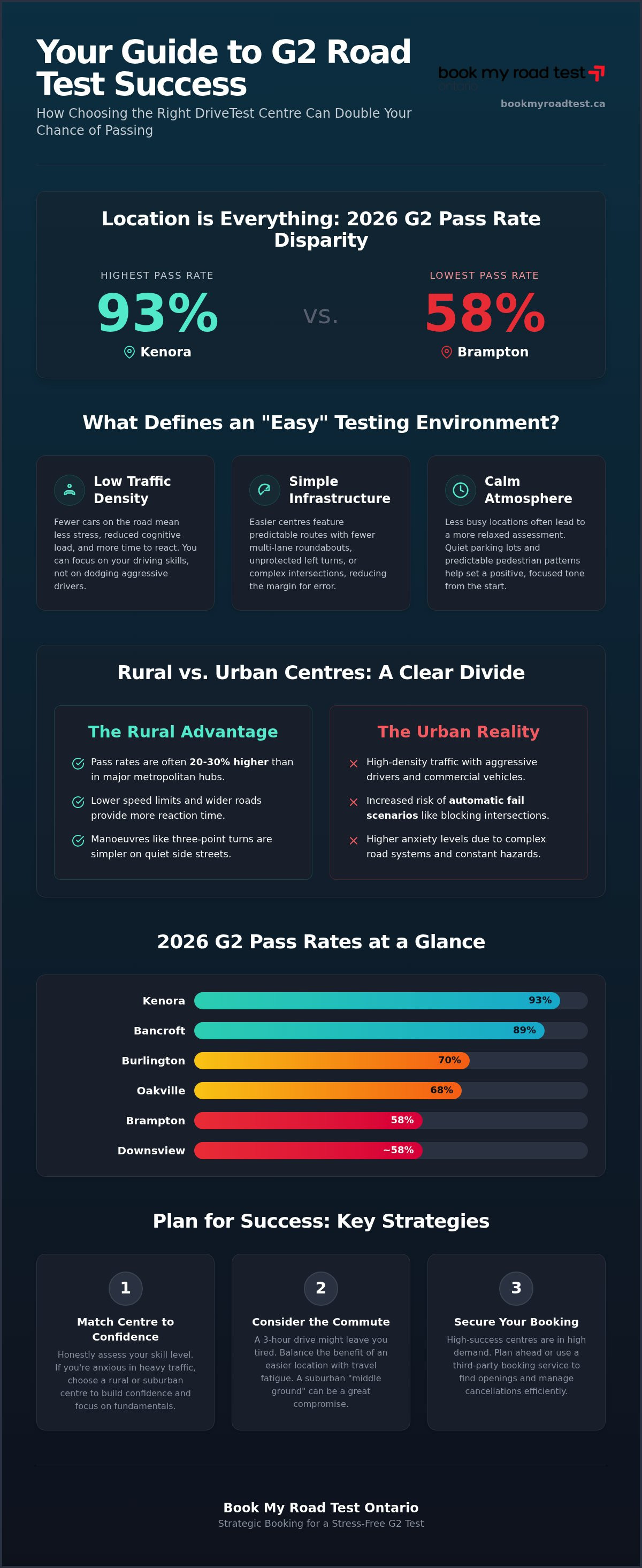
Did you know that your choice of location could nearly double your chances of passing? In 2026, G2 pass rates across Ontario vary significantly, ranging from a challenging 58% in Brampton to a staggering 93% in Kenora. Finding the easiest drivetest centre for g2 isn't just about luck. It's about making a strategic choice that aligns with your current driving confidence and skill level.
We understand that the pressure of heavy metropolitan traffic and complex multi-lane intersections can make test day feel incredibly stressful. It's frustrating to face long wait times only to deal with the high failure rates common in the Greater Toronto Area. You deserve a testing environment where you can feel calm, focused, and prepared to succeed.
This article will teach you how to identify the best testing locations based on pass rates, road complexity, and traffic patterns to maximize your chances of success. We'll explore the latest 2026 data, compare rural versus urban routes, and provide tips for securing a booking at your preferred centre quickly. By the end, you'll have a clear plan to reduce your anxiety and earn your licence with ease.
Key Takeaways
- Understand the specific road layouts and traffic patterns that define an "easy" testing environment for new drivers.
- Compare rural and urban pass rates to see how location choice significantly impacts your statistical chance of success.
- Learn how to identify the easiest drivetest centre for g2 by matching route complexity to your individual driving confidence.
- Master strategic booking techniques to secure a slot at your chosen centre, even during high-demand periods in 2026.
- Discover how a third-party booking service simplifies the process by targeting centres with higher success rates and managing cancellations for you.
What Makes a DriveTest Centre 'Easy' for a G2 Test?
Searching for the easiest drivetest centre for g2 requires looking beyond just pass rate percentages. An 'easy' centre is typically defined by lower traffic density and simpler road infrastructure. In these locations, the physical layout of the route presents fewer technical challenges. This allows you to focus on demonstrating your fundamental skills rather than managing high-stress traffic scenarios. Within the Ontario graduated licensing system, the G2 test evaluates your ability to handle basic road conditions independently. Choosing a location with simpler road geometry, such as fewer multi-lane turns and complex intersections, significantly reduces the margin for error during your assessment.
The role of the examiner is also influenced by the centre's environment. In smaller, less busy locations, examiners often work in a less rushed atmosphere. This can lead to a more relaxed assessment where the examiner isn't feeling the pressure of a backlogged schedule. While every examiner follows the same Ministry standards, a calm environment benefits everyone involved. The 'Ease Factor' of a location is essentially a combination of low traffic volume and high route predictability.
The Psychology of a Quiet Testing Environment
Lower noise levels and fewer moving hazards directly reduce your cognitive load. When you aren't constantly scanning for aggressive drivers or sudden lane changes, you can better monitor your speed and mirror checks. Smaller centres also offer more predictable pedestrian patterns. You won't usually find the chaotic foot traffic seen near major downtown transit hubs. A calm start in the centre's parking lot helps set a positive tone for the entire test. Starting your engine in a quiet lot rather than a packed, frantic one helps keep your heart rate steady from the first minute.
Infrastructure Factors: Roundabouts vs. Controlled Intersections
Many G2 candidates prefer centres that rely on traditional controlled intersections rather than complex roundabouts. Navigating a multi-lane roundabout requires split-second decision-making that can be daunting for a new driver. High-traffic areas often feature 'unprotected' left turns, where you must judge gaps in oncoming traffic across several lanes. In contrast, easier centres might feature more 'protected' left-turn signals or simpler two-lane roads. You should also consider the presence of bike lanes and transit-only corridors. These add extra layers of observation requirements that can complicate a straightforward drive. Identifying the easiest drivetest centre for g2 often means finding a route that minimizes these specific infrastructure hurdles.
Rural vs. Urban Centres: Comparing Success Rates
Statistics show a clear divide in success rates across the province. Rural DriveTest centres frequently report pass rates that are 20% to 30% higher than metropolitan hubs. For instance, data from 2026 shows Kenora maintains a 93% pass rate and Bancroft sits at 89%. In contrast, centres like Brampton and Downsview struggle with pass rates around 58%. These numbers often lead candidates to hunt for the easiest drivetest centre for g2 outside of the city. While the criteria for passing remain the same, the environment where you perform your skills changes the difficulty level.
The Rural Advantage: Speed and Space
Small-town centres offer several logistical benefits. Lower speed limits in residential areas provide you with more reaction time to process road signs and hazards. Roads are often wider, and you will encounter fewer aggressive motorists. Performing a three-point turn or an emergency stop is much simpler on a quiet side street than in a bustling urban neighbourhood. This lack of pressure allows you to focus entirely on your G2 road test preparation and technical execution.
The Urban Reality: Higher Stakes
Metropolitan centres present a different set of challenges. You must manage heavy commercial vehicles and drivers who may not respect your "student driver" status. In dense traffic, automatic fail scenarios become more common. For example, blocking an intersection during a light change or failing to yield to a transit bus can end a test instantly. Many urban candidates feel forced into these locations due to a lack of transport, but the high failure rates make them a risky choice for those with high anxiety.
You should also consider the "Commute Trade-off." Driving three hours to a rural centre might leave you too exhausted to perform your best. If a long trip feels overwhelming, look for a suburban middle ground. Centres like Burlington (70%) or Oakville (68%) offer a balance of manageable traffic and higher success rates than the Toronto core. If you want to target these specific locations without the stress of constant searching, you can book your road test through a specialized facilitator. This approach allows you to secure a slot at a centre that matches your comfort level while saving you time.
Identifying the Best Centre for Your Skill Level
Finding the easiest drivetest centre for g2 requires an honest look at your own driving strengths. If you find high-speed merging onto highways or frequent multi-lane changes stressful, you should avoid centres located near major 400-series highway interchanges. Your goal is to choose a testing environment that feels familiar. For example, if you've spent most of your time training in urban areas, a rural route might surprise you with gravel shoulders or uncontrolled intersections. Conversely, if you've only driven in quiet suburbs, the aggressive pace of a city centre can cause significant anxiety.
Seasonality also plays a major role in your success. A rural centre might have a high pass rate in the summer, but it can become quite difficult during a Canadian winter. Smaller towns often have fewer snowplows, which can lead to unplowed side roads or obscured lane markings during your test. You should also investigate the parallel parking setup at your target location. Some centres require you to park between real vehicles on public streets, while others use pylons in a designated lot. If you're worried about accidental contact with another vehicle, a pylon-based centre will likely feel much more manageable.
Before you commit to a location, spend time scouting the area using virtual maps. Many local communities share specific test route details online. Looking at satellite views of the centre's surrounding streets allows you to identify tricky one-way roads or unusual intersection layouts before you ever get behind the wheel. This preparation helps you avoid surprises on the day of your appointment.
Matching the Route to Your Practice Habits
Try to select a location that mirrors the environment where you did your initial training. Moving from a quiet residential area to a busy downtown core for your test often results in "environmental shock." This sudden increase in sensory input can lead to simple mistakes. Virtual maps are excellent tools for previewing difficult intersections. By identifying complex turns or hidden stop signs early, you can mentally prepare for the specific challenges of that route. This turns an unfamiliar town into a predictable path.
Timing Your Test for Maximum Ease
The time of day is just as important as the location. Even the easiest drivetest centre for g2 can become a high-pressure environment during school-zone rush hours. Increased pedestrian traffic and strictly enforced 30 km/h zones require intense concentration. Most instructors recommend the "Golden Window" between 10:00 AM and 2:00 PM. During these hours, you avoid the morning commute and the afternoon school rush, giving you the clearest roads possible. You can find more timing strategies in our guide on road test booking hacks to help you secure the best possible slot for your needs.
Strategic Booking: How to Secure a Slot at Your Preferred Centre
Finding the easiest drivetest centre for g2 is only half the battle. Once you've identified your target, you need a strategic plan to secure a slot. Start by identifying two or three centres that fit your criteria for road layout and pass rates. This gives you backup options if your first choice is fully booked for months. Many of the highest-rated centres, like Bancroft or Owen Sound, have long wait times because other drivers are also looking for simpler routes.
You must also master the 'cancellation game.' According to provincial rules, drivers must cancel or reschedule at least 48 hours before their appointment to avoid losing their fee. This means new slots often appear unexpectedly as people realize they aren't ready. Monitoring these patterns manually is a tedious refresh and wait cycle. You can bypass this stress by using a professional booking service. We act as an intermediary to find these last minute openings for you.
Beating the 2026 Wait Time Crunch
Wait times in 2026 remain high across Ontario. High-demand slots in suburban centres often disappear within seconds of being posted. It's essential to stay 'test-ready' while you wait. If a cancellation appears for a date only a few days away, you need to be prepared to take it. If you've completed an MTO-approved BDE course, your wait time is reduced from 12 months to 8 months, which helps you get on the road sooner. You might ask, is a road test booking service worth it for these competitive locations? For candidates facing months of delays, the peace of mind is often the deciding factor.
Administrative Readiness for Your Booking
Check your G1 expiry date before targeting a distant centre. You cannot attempt a road test if your current licence is about to expire. Ensure you have your credit card and licence details ready for instant entry. When a slot at the easiest drivetest centre for g2 opens up, there is no time to search for your wallet. Schedule flexibility is your best tool. Being available for mid-week or mid-day appointments significantly increases your chances of success. If you want to stop refreshing the page and start preparing for your drive, you can secure a road test booking through our facilitator service today.
How Book My Road Test Ontario Simplifies Your G2 Journey
Finding the easiest drivetest centre for g2 is a smart strategy, but it only works if you can actually secure a time slot. Many locations with the highest pass rates, such as Kenora or Bancroft, are in high demand across the province. We help you target these specific centres by monitoring for cancellations and new openings around the clock. This allows you to focus your energy on driving practice rather than administrative logistics. As an independent facilitator, we provide a streamlined path forward for busy drivers who value their time and peace of mind.
There's a direct connection between booking stress and your actual performance on test day. If you're anxious about your G1 expiry date or the lack of local appointments, that stress follows you into the driver's seat. High anxiety levels often lead to simple, avoidable mistakes during your assessment. By removing the burden of the search, we help you enter the car with a clear, focused mind. You can dedicate your training hours to mastering technical skills instead of refreshing a website. We act as a helpful ally, making a complex task manageable and transparent.
Expertise in Finding Cancellations
Our system is built to identify last-minute openings much more effectively than manual searching. Most drivers don't have the time to check the official portal every hour of the day. Slots at preferred centres often disappear within minutes of being released. By securing an earlier date at a location with a simpler road layout, you increase your chances of passing on your first attempt. You avoid the frustration of the standard booking portal and the uncertainty of long-term waitlists. It's a professional, efficient solution for a bureaucratic challenge.
Your Path to a G2 Licence Starts with the Right Appointment
A well-chosen centre is the foundation of test-day confidence. When you know you're testing in an environment that matches your skill level, your nerves naturally settle. This strategic advantage is often the difference between a pass and a fail. Securing the right appointment is the final piece of your licensing puzzle. You can learn more about how a road test booking service manages these details for you in our pillar guide. If you're ready to stop searching and start driving, booking through our platform provides the support you need to succeed.
Take the Next Step Toward Your G2 Licence
Choosing the easiest drivetest centre for g2 depends on matching the road's complexity with your personal confidence level. You've learned that rural routes offer simplicity while urban centres provide convenience but higher stakes. Success in 2026 requires more than just good driving; it requires a strategic approach to where and when you book. By prioritizing centres with manageable layouts and avoiding peak traffic hours, you significantly lower your test-day stress.
Searching for these ideal slots doesn't have to be a full-time job. We are an independent facilitator specialized in finding last-minute cancellations that aren't easily visible on the standard portal. Our service saves you hours of manual searching and the frustration of constant refreshing. You can focus entirely on your skills while we handle the logistics of the scheduling process.
Secure your G2 road test at your preferred centre with Book My Road Test Ontario and take the first step toward your full licence today. You've done the work to prepare. Now, let us help you find the best place to show it. Safe driving!
Frequently Asked Questions
Which DriveTest centre in Ontario has the highest pass rate for G2 tests?
Kenora currently holds the provincial record with a G2 pass rate of 93%. Other high-performing locations include Sault Ste. Marie and Bancroft, which both maintain an 89% success rate. These northern and rural centres are often considered the easiest drivetest centre for g2 because they offer simpler routes with significantly less traffic. You should still practise thoroughly to ensure you meet all safety standards regardless of where you book.
Is it worth driving to a rural centre to take my G2 road test?
It depends on your comfort level with long-distance travel and your driving confidence. Rural centres statistically show success rates that are 20% to 30% higher than those in metropolitan areas. This is usually due to fewer complex intersections and less aggressive motorists. However, you must consider the fatigue of a long commute. If you arrive at the centre feeling exhausted, your ability to stay focused during the assessment might decrease.
Do examiners at 'easier' centres mark more leniently than those in cities?
No, all examiners in Ontario follow the same standardized Ministry of Transportation scoring criteria. Every candidate is evaluated on specific technical skills, such as mirror checks, signalling, and speed control. The perception of leniency usually stems from the environment rather than the examiner. In a quiet town, you simply encounter fewer high-risk hazards. This makes it easier to keep a clean score sheet without the pressure of dense urban traffic.
Can I take my G2 test at any location, or must it be near my home?
You can take your road test at any DriveTest centre in Ontario. There's no requirement to book an appointment in your home city or town. Many drivers choose to travel to locations with higher pass rates or shorter wait times to improve their odds. Just keep in mind that as of May 11, 2026, all applicants must declare that Ontario is their primary residence and that their presence in Canada is legal.
Why are some DriveTest centres considered much harder than others?
Difficulty is mainly determined by local traffic volume and road infrastructure. Centres in the Greater Toronto Area, such as Brampton or Etobicoke, feature multi-lane roundabouts, heavy commercial truck traffic, and high pedestrian density. These factors increase the number of hazards you must monitor simultaneously. A route with more protected left turns and fewer transit-only lanes is naturally more manageable for a new driver than a busy metropolitan business corridor.
What is the best time of day to book a G2 test to avoid heavy traffic?
The ideal time to book is during the "Golden Window" between 10:00 AM and 2:00 PM. This timeframe avoids both the morning work commute and the afternoon school-zone rush. During these hours, roads are generally clearer and pedestrian activity is at its lowest point. Booking in this window helps you find the easiest drivetest centre for g2 conditions by ensuring the route is as predictable and calm as possible.
How do I find out which centres have the shortest wait times in 2026?
Wait times fluctuate daily based on new cancellations and seasonal demand. High-demand centres in suburban areas often have backlogs of several months, while rural locations might have earlier openings. You can check the official portal frequently or use a third-party service to manage the search for you. These services specialize in finding last-minute cancellations, which is often the only way to secure an appointment quickly at a preferred location.
Does using a road test booking service increase my chances of passing?
A booking service doesn't change the test requirements, but it can improve your performance by reducing pre-test anxiety. By handling the difficult search for a cancellation, these services allow you to focus entirely on your driving practise. Securing an appointment at a centre with a simpler route or a higher success rate also statistically improves your odds. It's about finding an environment where you feel confident demonstrating your skills to the examiner.


