

What if your G road test ends before you even put the car in drive? You've spent months practising highway merges and perfecting your lane changes. It's natural to feel that using own car for g road test ontario is the best way to stay comfortable and confident during the evaluation. Most drivers prefer the familiarity of their own steering wheel and brake tension when the stakes are high.
We understand that the pressure of meeting MTO standards is stressful, especially when a small technicality could cost you 50% of your $91.25 test fee. This guide ensures your personal vehicle is fully compliant so you avoid an "out-of-order" cancellation. You'll learn exactly how to inspect your car for DriveTest standards, what documents to bring, and how to find a cancellation slot fast once you're ready to go. We provide the clarity you need to turn a complex bureaucratic process into a manageable checklist.
Key Takeaways
- Confirm your eligibility to use a personal, borrowed, or rented vehicle as long as it meets all MTO safety requirements.
- Avoid an out-of-order designation and a 50% fee loss by verifying all safety standards for using own car for g road test ontario.
- Perform a comprehensive vehicle inspection 24 hours before your appointment to allow time for any necessary minor repairs.
- Ensure your car is clean and organized to demonstrate professionalism and provide a safe environment for your examiner.
- Streamline your path to a full licence by focusing on booking road test cancellations once your vehicle is fully prepared.
Can You Use Your Own Car for the G Road Test in Ontario?
You can definitely use your own vehicle for your G road test. DriveTest allows any Class G passenger vehicle as long as it meets strict safety standards set by the Ministry of Transportation (MTO). Whether you're using a car you own, one you've borrowed from a friend, or even a rental, the examiner's primary concern is safety. The vehicle must be in the same class as the licence you're applying for. Choosing to go the route of using own car for g road test ontario often provides a significant psychological advantage. You already know how the brakes respond and exactly how much pressure the accelerator needs to reach highway speeds.
The Legal Requirements for Personal Vehicles
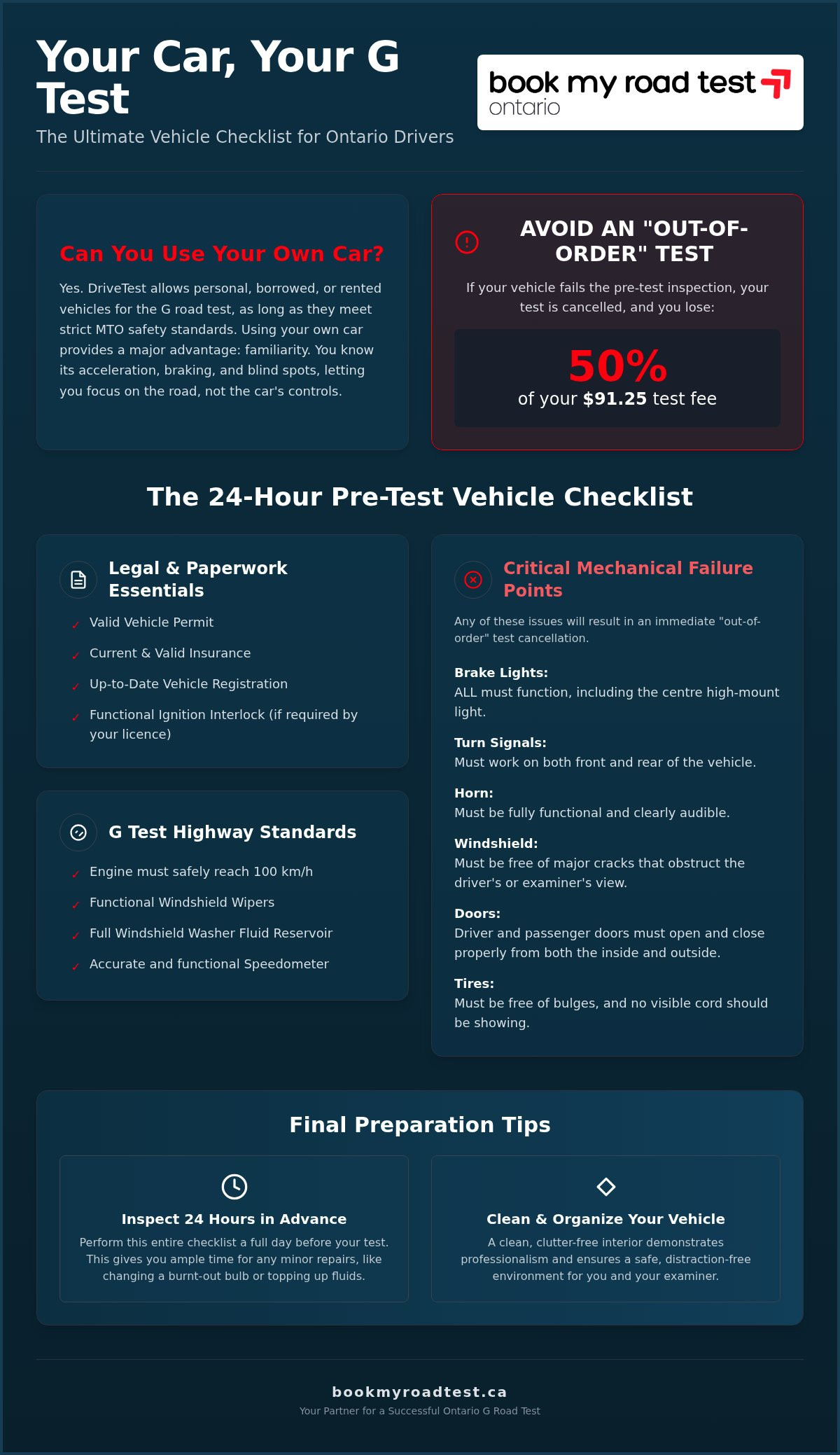
Before you arrive at the centre, verify that your paperwork is in order. Your vehicle must have a valid permit and current insurance. While Ontario has eliminated physical licence plate stickers, your vehicle registration must be up to date in the provincial system. If your licence carries a condition for an ignition interlock device, your vehicle must have one that is fully functional. DriveTest examiners will check these details before the test begins. If any legal requirement is missing, they'll mark the test "out-of-order." This means you'll lose 50% of your pre-paid fee immediately. It's a costly mistake that is easily avoided with a quick document check.
Why Familiarity Matters for the G Exit Test
The G exit test is more demanding than the G2 because it includes high-speed highway driving. Merging into traffic at 100 km/h requires precise timing and an intimate understanding of your car’s acceleration. When you're using own car for g road test ontario, you don't have to guess how quickly the engine will respond. You're already comfortable with the specific blind spots and mirror placements. This familiarity eliminates the learning curve that comes with driving an instructor's car or a rental for the first time. It lets you focus entirely on the road and the examiner’s instructions rather than searching for the hazard light button or adjusting a seat. Being in a familiar environment helps you stay calm, realize better control of the vehicle, and demonstrate your skills effectively.
DriveTest Vehicle Requirements: Avoiding the Out-of-Order Designation
An "out-of-order" status is more than just a delay; it's a financial penalty. If your vehicle doesn't meet the MTO safety criteria, your test is cancelled before you even shift into gear. The impact is immediate. You lose 50% of your pre-paid $91.25 road test fee. The other half remains as a credit on your account, but you must pay the balance again to secure a new appointment. This makes the stakes high when using own car for g road test ontario. It's not just about your driving skills. It's about your vehicle's maintenance. You don't want to lose money because of a burnt-out bulb you could have fixed for five dollars.
The process begins with a basic safety check. The examiner will stand outside the car and signal for you to activate your lights. They'll check your turn signals, brake lights, and hazard lights. They'll also listen for a clear, functional horn. This isn't a full mechanical inspection, but it covers the essentials that keep drivers safe. If your car fails this initial hurdle, the examiner won't even enter the vehicle. It's a quick, decisive moment that determines if your test proceeds or ends in the parking lot.
Critical Mechanical Failure Points
There are several deal-breakers that lead to an automatic out-of-order result. All brake lights must function perfectly. This includes the centre high-mount light in your rear window. If any of these three lights are out, you won't be allowed to start. Your turn signals must also work on both the front and back of the vehicle. Consulting a guide on vehicle requirements for the G test provides a solid baseline for your pre-test check. Beyond lights, the windshield must be free of major cracks that obstruct the view. Doors are another common fail point. Both the driver and passenger doors must open and close correctly from the inside and outside. Finally, check your tires. Any visible cord or significant bulges will result in an immediate cancellation.
Highway-Specific Standards for the G Test
The G test is unique because it requires high-speed highway driving. Your vehicle's engine must be capable of reaching 100 km/h safely and without hesitation. If the car struggles to accelerate or makes concerning noises under load, the examiner may deem it unfit. Visibility is equally important. Functional windshield wipers and a full washer fluid reservoir are mandatory. If it starts to rain and your wipers fail, the test is over. Speedometer accuracy is also vital. You're expected to maintain strict speed limits, and a faulty gauge makes this impossible. Once you're confident your car is ready, you can focus on finding a slot by searching for road test cancellations. Preparing your vehicle properly is the only way to ensure your hard-earned money isn't wasted on a technicality.
Own Car vs. Driving School Car: Which is Better for Your G Test?
Choosing the right vehicle is the first step toward passing. While using own car for g road test ontario is the most common choice, it's not always the best one for every driver. You need to weigh the psychological comfort of your own seat against the technical reliability of a professional vehicle. Driving school cars are specifically maintained for these tests. They often feature dual brakes, which provides a safety net for the examiner. This can lead to a smoother interaction during the test. The examiner knows they can intervene if a dangerous situation arises on the highway, which often keeps the atmosphere in the cabin more relaxed.
The Pros and Cons of Using Your Personal Vehicle
The primary benefit of using your own car is the lack of additional costs. You don't have to pay a rental fee, which can often exceed $150. You also have total familiarity with the vehicle’s response times, from the weight of the steering to the sensitivity of the brake pedal. However, the responsibility is entirely yours. You must ensure every technical detail is perfect. If a signal bulb burns out during your drive to the centre, you face an immediate cancellation. Reviewing a vehicle requirements checklist before you leave home is the only way to mitigate this risk. You are essentially acting as your own fleet manager on test day.
When to Consider a Driving School Rental
Renting an instructor's car is often the smarter move if your personal vehicle has any red flags. If your car has a persistent "Check Engine" light or minor mechanical quirks, don't risk the appointment. DriveTest examiners will not start the test if they see dashboard warning lights related to safety systems. A rental also makes sense if your daily driver is difficult to manoeuvre. Parallel parking a large pickup truck is significantly harder than parking a compact driving school sedan. If you want the peace of mind that the car is 100% compliant with MTO standards, paying for a rental provides a layer of insurance against technical failure. It allows you to focus on your driving rather than worrying about an "out-of-order" result.
Your decision should ultimately reflect your current confidence level. If you've spent dozens of hours practising in your own car and it's in excellent condition, that familiarity is a powerful tool. However, if the thought of a technical rejection adds too much stress to your day, the professional route is a valid alternative. Whether you choose an instructor's vehicle or stick to using own car for g road test ontario, your priority is arriving with a vehicle that won't be rejected at the curb.
Pre-Test Vehicle Inspection: A 24-Hour Checklist
Don't wait until the morning of your exam to check your car. Performing a thorough inspection 24 hours before your appointment gives you a vital buffer. If you discover a burnt-out indicator bulb or a low tire, you'll have enough time to visit a local shop or a gas station for a quick fix. When using own car for g road test ontario, this proactive approach is the only way to guarantee you aren't sent home early. Start by verifying your documentation. Ensure your insurance pink slip and vehicle permit are in the glovebox and that both are valid. Expired documents are an immediate fail, even if the car itself is perfect.
Appearance matters more than you might realize. Wash the exterior and vacuum the interior. A clean car signals to the examiner that you're a responsible and organized driver. It also makes the cabin a more pleasant environment for the test. While you're at it, top up your fluid levels. Windshield washer fluid is particularly important for the G test. If a truck kicks up mud on the highway and you can't clear your view, the examiner may terminate the test for safety reasons.
The Exterior Walk-Around
- Test every light: Have a friend stand outside while you cycle through high and low beams, front and rear indicators, and hazard lights. Don't forget the centre brake light.
- Check the horn: It must be audible and function on the first press.
- Inspect the tires: Look for proper inflation and ensure the tread depth is sufficient. Bald tires are a common reason for technical rejections.
Interior and Safety Gear
The examiner's safety is just as important as yours. Confirm that both the driver and passenger seatbelts latch securely and retract without getting stuck. Test the passenger-side door from both sides; it must open easily for the examiner to enter and exit. You should also clear any clutter from the dashboard and seats. Remove hanging items like air fresheners or charms from the rear-view mirror. These can be seen as obstructions to your field of vision. Finally, start the engine and look at the dashboard. It must be free of warning lights like ABS, Airbag, or Check Engine. If these lights are on, the examiner won't risk the highway portion of the test.
Once you've cleared this checklist, your vehicle is officially ready for the road. With the car prep out of the way, you can focus on the final logistical step. If you haven't secured your date yet, you can book your road test now to find the most convenient slot at a nearby centre.
Preparing for Your Appointment: Logistics and Booking Strategies
Once your vehicle is in peak condition, the focus shifts to the calendar. Finding a date is often the most challenging part of the process. In many parts of the province, wait times for G road tests can stretch several months. This backlog causes significant stress for drivers whose G2 licences may be nearing expiry. Having a strategy for using own car for g road test ontario means more than just mechanical prep. It requires a proactive approach to the booking system itself. You need to be ready to act quickly when a slot becomes available.
Success on test day depends on your organization. Before you leave the house, verify that you have your physical G2 licence. It's also a good idea to carry a secondary piece of photo ID just in case there's an issue with your primary card. Having your paperwork ready prevents unnecessary delays at the check-in counter. When you arrive with a compliant car and the right documents, you project the confidence of a driver who is ready for the full G licence.
How to Secure a Road Test Slot Faster
Cancellations are your best friend when looking for an earlier date. Drivers frequently reschedule, which opens up immediate spots that don't appear in long-term calendars. Check the system frequently, especially in the early morning or late evening. If you find the manual search too time-consuming, you can use a road test booking service to simplify the search. These platforms are designed to help you find openings much faster than traditional methods. You should also consider being flexible with the location. Choosing a centre outside of high-traffic urban areas often results in better availability and shorter wait times.
Final Test-Day Preparation
Arrive at the DriveTest centre at least 30 minutes before your scheduled appointment. This time is essential for navigating the parking lot and completing the check-in process. Park your vehicle in the area specifically designated for road tests. Once you're in a spot, head inside to check in at the kiosk or the counter. Keep your vehicle permit and insurance pink slip in your hand or on the dashboard. The examiner will need to verify these before they begin the exterior safety check. Book My Road Test Ontario is an independent service designed for convenience, helping you navigate the booking hurdles so you can focus on your driving. By managing these logistics early, you ensure that the only thing you have to worry about is the road ahead.
Take Control of Your Test Day Success
Preparing for your G exit exam requires a balance of driving skill and mechanical diligence. By performing a 24-hour vehicle check and ensuring all documentation is valid, you eliminate the risk of a technical rejection. Familiarity with your vehicle’s handling is a major asset during high-speed highway merges; choosing the route of using own car for g road test ontario allows you to focus entirely on the road rather than a new dashboard layout. You've already mastered the lanes, so don't let a simple technicality hold you back.
Once your car is ready, the only remaining challenge is securing a date that fits your schedule. We provide independent booking assistance for Ontario drivers, focusing on finding cancellations to save you time. Our service is not affiliated with the MTO or DriveTest. It's a dedicated tool designed for fast and efficient appointment searching. Find an Ontario Road Test Appointment Today to secure your G or G2 slot without the stress. You've put in the work to be a safe driver, and we're here to help you cross the finish line.
Frequently Asked Questions
Can I use a rental car for my G road test in Ontario?
Yes, you can use a rental car, but you must ensure the rental agreement does not specifically prohibit its use for a driver's examination. Most major companies allow it, but you'll need to provide the rental contract and proof of insurance at the centre. It's your responsibility to ensure the specific vehicle meets all MTO safety standards before the examiner begins the inspection. Arriving without the proper paperwork will result in a cancelled appointment.
What happens if my brake light goes out right before the test?
If any brake light, including the centre high-mount light, fails during the pre-test check, your appointment will be marked "out-of-order." You will lose 50% of your pre-paid test fee and must pay the difference to rebook. This is why using own car for g road test ontario requires a final light check just minutes before your scheduled time to avoid costly technical cancellations. A simple bulb replacement can save your entire appointment.
Does my car need to have a certain amount of petrol for the test?
Your vehicle must have enough fuel to complete the entire 30 to 40 minute examination, which includes a significant portion of highway driving. Arriving with the low-fuel warning light on is a major risk; the examiner may refuse to start the test if they believe the vehicle could stall. Aim for at least a quarter tank of petrol to ensure the test proceeds without any safety interruptions or mid-test mechanical concerns.
Will I fail the G test if my "Check Engine" light is on?
Yes, a "Check Engine" light is often grounds for an "out-of-order" designation. DriveTest examiners view dashboard warning lights as an indication that the vehicle is not in safe working condition. This also applies to ABS or airbag warning lights. If your car displays any of these, it is better to resolve the mechanical issue or use a different vehicle to avoid forfeiting half of your fee. Safety is the examiner's primary concern during the evaluation.
Can I use a vehicle with an ignition interlock device for the G test?
You can use a vehicle equipped with an ignition interlock device if it is a specific condition of your licence. You must inform the DriveTest centre when you book or check in for your appointment. The device must be fully functional, and you will be required to perform the breath sample as part of the normal operation of the vehicle during the road test evaluation. This ensures you are compliant with all provincial legal requirements.
Is it true that examiners prefer driving school cars?
No, examiners do not have a preference for driving school cars over personal vehicles. Their only priority is that the car meets all safety requirements and that the driver demonstrates competence. While instructor cars offer dual brakes for examiner safety, using own car for g road test ontario is perfectly acceptable. As long as your car is clean and mechanically sound, you will be evaluated fairly based on your driving performance and highway merging skills.
What documents do I need to show for my own car on test day?
You must present three specific documents before your test can begin:
- A valid Ontario G2 driver's licence.
- The original vehicle permit (registration).
- A valid motor vehicle liability insurance card (pink slip).
Ensure these documents are current and not expired. Digital insurance slips are generally accepted, but having a physical copy in the glovebox is a safer backup for the examiner to verify quickly.
Do I need to have winter tires for a road test in the winter?
Winter tires are not a mandatory requirement for a road test in Ontario. However, they are highly recommended for your own safety and confidence during the highway portion of the G test. If the weather is poor and your vehicle lacks sufficient traction, the examiner may decide the conditions are too dangerous to proceed with the test. Having proper tires ensures you can safely demonstrate lane changes and merging in typical Canadian winter conditions.


