

Your Ontario road test actually begins several minutes before you ever shift the car into drive. The moment the examiner approaches your window, they are already grading you on one critical factor: is your car legally fit for the road? If your vehicle fails the initial vehicle safety inspection for road test, your appointment ends before it even starts.
It's incredibly stressful to spend weeks practicing your turns and parking, only to have your session cancelled because of a minor mechanical issue like a cracked windshield or a dim signal light. Many drivers find it confusing to distinguish between a standard mechanic's safety and the specific requirements found at the DriveTest centre. You shouldn't have to risk your booking fee on a simple oversight or a misunderstanding of the rules.
This guide provides the complete 2026 Ontario checklist so you know exactly what examiners check before they get in the car. We'll cover every requirement from tire condition to horn functionality, helping you avoid an "out-of-order" status and the 50% forfeited fee that follows. By the time you finish reading, you'll have the peace of mind that comes with presenting a truly road-ready vehicle.
Key Takeaways
- Understand the critical difference between a standard mechanic's safety certificate and the specific functional checks performed by a DriveTest examiner.
- Master the exterior checklist, including signal requirements and the "third" brake light standard, to pass your vehicle safety inspection for road test.
- Verify interior safety features like seatbelt locking mechanisms and horn audibility to prevent your vehicle from being declared "out-of-order."
- Ensure your vehicle permit and insurance documentation meet the updated 2026 digital and physical standards before you arrive at the centre.
- Learn how to conduct a 48-hour "dry run" inspection to identify mechanical issues early and protect your appointment and test fee.
Why the Pre-Test Vehicle Safety Inspection Matters
The road test doesn't start with your foot on the gas. It starts with the examiner's eyes on your vehicle. This screening is a mandatory vehicle safety inspection for road test candidates, designed to protect both you and the examiner. While many people think of a "safety" as the detailed mechanical check required to sell a used car, the DriveTest check is different. It's a functional assessment focused on immediate roadworthiness.
According to this Vehicle Inspection Overview, the core purpose of such checks is to ensure that vehicles conform to safety regulations. In Ontario, your examiner isn't looking at your engine's internal health; they are looking for defects that could cause an accident during the next 20 minutes. They prioritize these safety checks because no amount of driving skill can compensate for a car that can't signal or stop reliably. If the car isn't safe, the test is over before it begins.
The Consequences of a Failed Vehicle Inspection
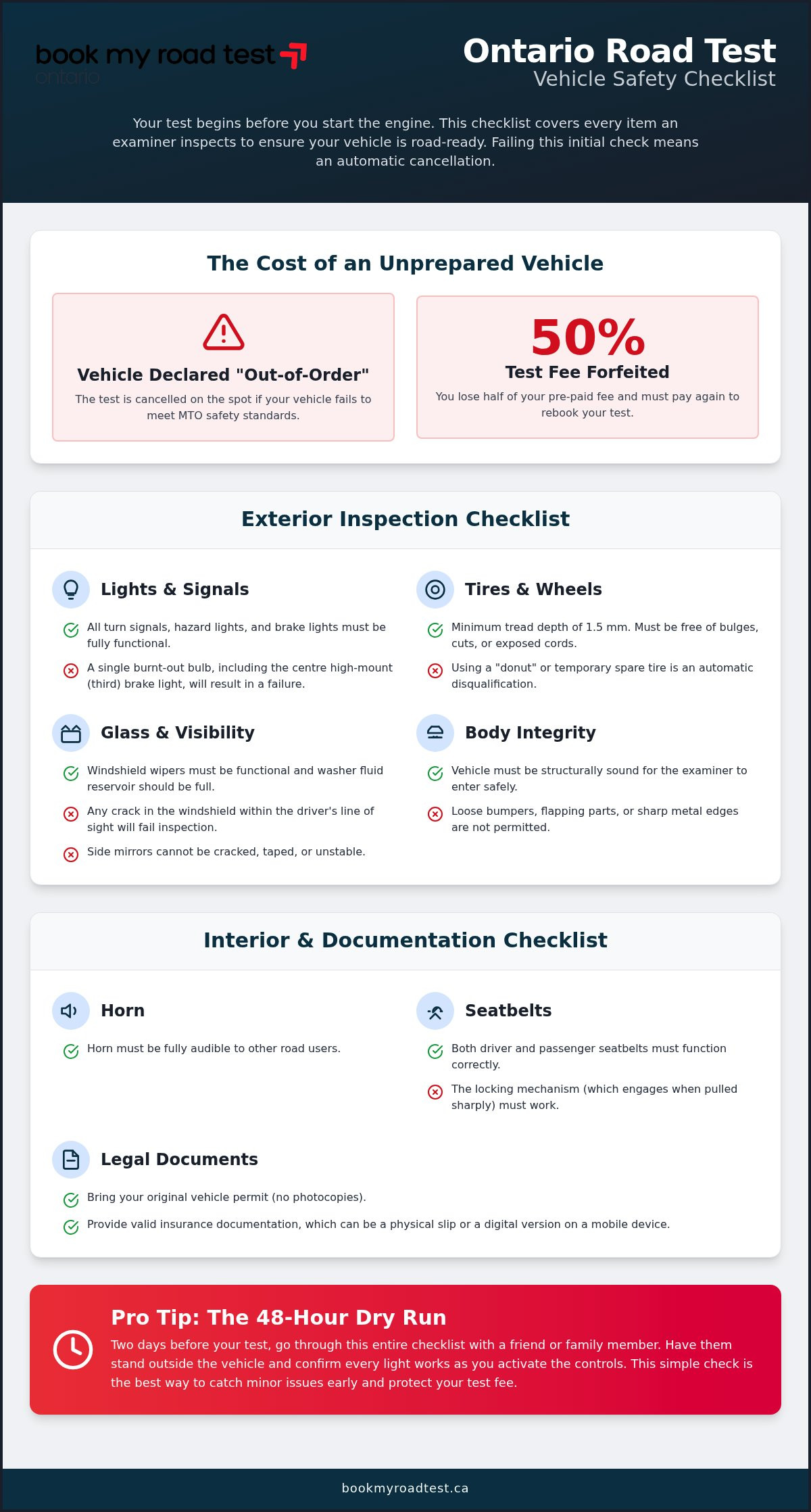
If your car doesn't meet the Ministry of Transportation (MTO) standards, the examiner will declare the vehicle "out-of-order." This results in the immediate cancellation of your appointment. You won't even get to pull out of the parking space. It's a frustrating end to weeks of preparation.
The financial impact is also significant. You will forfeit 50% of your pre-paid road test fee if your vehicle is declared out-of-order. In 2026, with high demand for slots at every DriveTest centre, losing your appointment is a major setback. You'll have to pay to rebook and wait for a new opening, which can take weeks. This is why many drivers rely on an independent road test booking service to find last-minute cancellation slots after a vehicle-related fail.
Understanding "Out-of-Order" (OOO) Criteria
Examiners look for specific defects that make the vehicle unsafe for a test. A non-functional brake light, a cracked windshield in the driver's line of sight, or a horn that doesn't work are common reasons for an OOO status. You cannot fix these issues on the spot during your appointment time. The schedule at the centre is too tight to allow for parking lot repairs, even for something as simple as a bulb change.
The examiner has final discretion over these safety-related decisions. If they feel the vehicle poses any risk to themselves or other road users, the test will not proceed. It's a strict policy, but it ensures that every road test in Ontario maintains a high safety standard. Checking your vehicle thoroughly a few days in advance is the only way to guarantee you won't be sent home early.
Exterior Checklist: Visibility and Signal Requirements
The examiner begins the vehicle safety inspection for road test candidates by standing at the front and then the rear of the car. They will ask you to activate your turn signals, hazards, and brake lights. Every single bulb must work. In Ontario, if your vehicle was manufactured with a centre high-mount brake light, that third light must illuminate along with the left and right lamps. A single burnt-out bulb is enough to halt the process immediately. It's a simple failure that costs you time and money.
Tires are another major focus during this screening. They must be free of bulges, cuts, or exposed cords. Using a "donut" or temporary spare tire is an automatic out-of-order disqualification. These tires aren't designed for standard driving conditions or highway speeds. While you don't need a professional Official Vehicle Inspection Checklist to spot a bald tire, the examiner will check for a minimum tread depth of 1.5 millimetres. If your tires are nearing the wear bars, replace them before your appointment.
Glass and Mirror Visibility Standards
Visibility is non-negotiable for a safe exam. Any crack in the windshield that is within the driver's direct line of sight or interferes with the wiper path will likely result in a failed inspection. Your windshield wipers must be functional and capable of clearing rain or debris effectively. Ensure your washer fluid reservoir is full, especially during the winter or spring months. Mirrors must be present, stable, and easily adjustable. If a side mirror is cracked or held on by tape, the examiner will deem the vehicle unsafe for the road.
Tires, Wheels, and Basic Body Integrity
The vehicle's body must be structurally sound. Loose bumpers, flapping wheel well liners, or sharp jagged metal from rust or a previous accident are considered safety hazards. The examiner must be able to enter and exit the vehicle easily. This means the passenger-side door and handle must function perfectly from both the inside and outside. Similarly, the driver-side window must be able to roll down. This is necessary in case you need to use hand signals during the test or if the examiner needs to communicate with you from outside.
If a minor exterior issue like a cracked signal lens results in a cancellation, you can find a new road test date quickly through a specialized booking service to get back on schedule without the typical long wait times.
Interior Safety Standards: Cabin and Control Checks
The interior check is just as rigorous as the walk-around. Once the examiner is satisfied with your signals and tires, they'll join you in the cabin. This phase of the vehicle safety inspection for road test candidates focuses on the controls and the immediate environment where the test takes place. If the examiner feels unsafe or cramped due to vehicle defects, they won't proceed with the exam.
Seatbelts are the first priority. Both the driver and passenger belts must buckle securely and retract without hesitation. Frayed or cut webbing is an automatic fail. The examiner will also ask you to perform a "quick tap" on the horn. It must be loud enough to be heard by other drivers. If your horn is silent or requires excessive force to trigger, the car will be declared out-of-order. This is a common point of failure for older vehicles that haven't been driven frequently.
Dashboard warning lights provide a quick health report of your car. While a "maintenance required" light for an oil change might be overlooked, safety-critical lights are dealbreakers. An active Airbag (SRS) light or an Anti-lock Braking System (ABS) light indicates a system failure. If the red brake warning light stays illuminated after the parking brake is released, the examiner will stop the test immediately. Finally, ensure the passenger footwell is completely clear. Loose water bottles, trash, or bags can roll under your pedals, creating a lethal hazard during a sudden stop.
Brake and Accelerator Pedal Response
The examiner will verify that your pedals function with the correct resistance. A "spongy" brake pedal that sinks to the floor indicates air in the lines or a fluid leak. This is a major safety defect. Your parking brake, whether it's a hand lever or a button, must be strong enough to hold the vehicle's weight. Additionally, your floor mats must be the correct size and properly secured. Stacked or loose mats that could slide forward and jam the accelerator or brake pedal are a frequent cause for test cancellations.
Examiner Access and Cabin Environment
Examiners must be able to exit the vehicle quickly in an emergency. This means the passenger-side door and handle must work perfectly from both the inside and outside. If you're testing in the winter, your heating and defrosting systems must be fully functional. You can't complete a road test if the windshield keeps fogging up. Also, ensure your speedometer is accurate and clearly visible from the passenger seat. The examiner needs to see your exact speed to grade your performance accurately.
Legal Requirements and Documentation for the Road Test
The legal side of the vehicle safety inspection for road test day is often the most overlooked. You might have a perfectly maintained car, but if your paperwork is out of order, the examiner will cancel your appointment immediately. This check happens at the DriveTest counter before the examiner even walks to your vehicle. You must present your current G1 or G2 driver’s licence and the original vehicle permit. Photocopies of the permit are generally not accepted; ensure you have the green "ownership" document ready in your glovebox.
Proof of insurance is mandatory. By 2026, Ontario fully accepts digital insurance cards, often called "digital pink slips," on your smartphone. While convenient, this comes with risks. If your phone battery dies or you have no signal to load the app, you won't be allowed to test. Carrying a physical paper slip is a reliable backup that prevents a cancelled session. Ensure the policy is active and covers the date of your exam; an expired policy results in an "out-of-order" status and a lost fee.
Step-by-Step Document Verification
- VIN Matching: Confirm the Vehicle Identification Number on your permit matches the VIN plate visible through the driver-side windshield.
- Expiry Dates: Check that your vehicle registration and insurance policy haven't expired. An expired sticker or policy is an automatic fail.
- Vehicle Class: Verify your vehicle is appropriate for the licence class. For a G or G2 test, you need a standard passenger vehicle like a car, SUV, or minivan.
Plate and Sticker Compliance
Your licence plates must be securely fastened to both the front and rear of the vehicle. In Ontario, missing a front plate is a legal violation and will stop your test. Plate covers are another common issue. If you use a tinted or dirty cover that obscures the letters or numbers, the examiner may ask you to remove it or cancel the test. The plates must be clearly legible from a distance. If they are peeling or unreadable, you should replace them at a ServiceOntario centre before your test date.
If you are using a newly purchased vehicle, you might have a temporary "trip permit." This must be clearly displayed on the windshield according to Ministry guidelines. Ensure all plates are bolted tightly. A rattling or loose plate can be flagged as a safety hazard. If you've lost your appointment due to a paperwork error, you can book your road test in Ontario through our service to find a fast replacement slot and get back on the road.
Preparation Tips: How to Avoid a Cancelled Appointment
The 48-hour rule is your best defence against a last-minute cancellation. By performing a thorough check two days before your appointment, you give yourself enough time to visit a mechanic or replace a burnt-out bulb. If you wait until the morning of the exam to look at your car, any discovery becomes a crisis. A successful vehicle safety inspection for road test day relies on this proactive approach. It ensures you arrive at the centre focused on your driving skills rather than worrying about a flickering signal light.
Many applicants choose to use a driving school vehicle for their exam. These cars are maintained specifically to meet DriveTest standards and are rarely flagged as out-of-order. If your personal vehicle is older or has persistent dashboard warning lights, renting a car from a licensed instructor provides significant peace of mind. They understand the exact functional requirements examiners look for and can verify the car is ready before you even leave for the centre.
The 48-Hour Pre-Test Walkaround
- The Signal Check: Ask a friend to stand outside while you test the left signal, right signal, hazards, and brake lights. Remember to check that third middle brake light.
- Fluid and Leak Inspection: Park on a clean patch of pavement and check for fresh puddles after an hour. Significant leaks can lead to an immediate fail.
- Functional Controls: Test your horn with a quick tap. Ensure your windshield wipers clear the glass without leaving streaks that obscure your vision.
Next Steps After a Vehicle Fail
If your vehicle is declared out-of-order, the examiner will stop the test and you will forfeit 50% of your pre-paid fee. This is a frustrating outcome, but it isn't the end of your journey. You'll need to fix the identified issue and secure a new time slot. Because the system is often crowded, finding a new date can take weeks or even months if you rely on standard booking methods. This is where a road test booking service becomes a vital tool. These services specialize in finding last-minute cancellations, helping you get back on the schedule much faster than the average wait time.
Whether you are securing your G2 or looking for a G test booking, preparation is the key to avoiding the out-of-order trap. Treat your car as the first part of the exam. When you present a clean, functional, and well-documented vehicle, you demonstrate responsibility before you even put the car in gear. This sets a professional tone for the rest of your road test.
Drive with Confidence on Test Day
Mastering the vehicle safety inspection for road test day ensures your weeks of practice don't go to waste. By verifying your signal lights, checking your tire tread, and organizing your original permit in advance, you eliminate the risk of an "out-of-order" status. These simple functional checks prevent the frustration of a cancelled appointment and the loss of 50% of your pre-paid fee. Taking thirty minutes for a pre-test walkaround is the best investment you can make in your driving future.
If you've already experienced a cancellation or are struggling to find an open slot at your local centre, Book My Road Test Ontario is here to help. As an independent and transparent booking facilitator, we specialize in finding last-minute road test cancellations to save you time. We offer a reliable service for G2 and G licence candidates who want to skip the long wait times. You can secure your next road test appointment with Book My Road Test Ontario and let us handle the administrative burden. With a safe vehicle and the right documentation, you are ready to succeed. Good luck on your exam.
Frequently Asked Questions
Can I take the road test if my "Check Engine" light is on?
Yes, you can generally take the test with a check engine light on. This light often signals emissions issues rather than immediate safety hazards. However, the vehicle safety inspection for road test protocol is strict about safety-critical warnings. If your ABS, Airbag, or red Brake warning lights are illuminated, the examiner will cancel the session. Ensure no warnings interfere with the car's basic mechanical operation or safety systems.
Will a small crack in the windshield cause me to fail the safety inspection?
A windshield crack will cause a failure if it is in the driver’s direct line of vision or within the area cleared by the wipers. If the crack is larger than a few centimetres or has sharp edges, the examiner will likely deem the vehicle unsafe. Small stone chips outside these critical zones are usually acceptable. It is best to repair any glass damage early to avoid a subjective decision by the examiner.
What happens if a brake light goes out right before my test?
If a brake light fails just before your appointment, your vehicle will be marked "out-of-order." Every exterior bulb, including the high-mount centre light, must function perfectly during the pre-test check. You cannot perform repairs once the examiner arrives at your car. Since this results in a cancelled test and a lost fee, always carry spare bulbs and check your signals one last time in the DriveTest parking lot.
Do I need a Safety Standards Certificate (SSC) for my road test?
No, you do not need to present a formal Safety Standards Certificate (SSC) to the examiner. That certificate is required for vehicle registration or transferring ownership. For your appointment, the examiner conducts a vehicle safety inspection for road test purposes to ensure the car is functionally safe. While an SSC proves long-term mechanical health, the road test check focuses on immediate items like lights, tires, and visibility.
Can I use a vehicle with a "donut" spare tire for the test?
You cannot use a vehicle equipped with a "donut" or temporary spare tire for any Ontario road test. These tires are designed only for short-distance emergency use and lack the stability required for a full driving exam. If you have a flat tire on the morning of your test, you must replace it with a full-sized tire or use a different vehicle. Using a temporary spare leads to an immediate cancellation.
Is it better to use my own car or a driving school car?
Using a driving school car is often the safer choice for passing the inspection. These vehicles are professionally maintained and frequently checked against DriveTest requirements. However, if your personal car is in excellent condition and meets all 2026 standards, using it may help you feel more comfortable. Choose the vehicle that gives you the most confidence in both its mechanical reliability and your ability to operate its controls smoothly.
What documents do I need to show the examiner before the test?
You must present your valid G1 or G2 driver’s licence, the original vehicle permit (ownership), and valid proof of insurance. While digital insurance slips are accepted in Ontario, having a physical backup is recommended in case of technical issues. Ensure your permit is signed and the VIN matches your vehicle. If any of these documents are missing or expired, you will not be allowed to begin the practical portion of the test.
Will I lose my money if my car fails the safety inspection?
If your vehicle fails the inspection, you will forfeit 50% of your pre-paid road test fee. This is the standard penalty for an "out-of-order" vehicle. You will then need to pay the remaining balance and find a new appointment slot once the mechanical or documentation issue is resolved. To avoid this financial loss and the stress of rebooking, perform a comprehensive walkaround check at least two days before your scheduled time.


